

Nutritional Freshwater Life
270
Amino Acids (g/100 g Protein or g/16 g N)
Glycine
5.02
Alanine
3.68
Cystine
1.45
Valine
4.73
Methionine
3.46
Isoleucine
4.53
Leucine
7.73
Tyrosine
3.65
Phenylalanine
5.14
Source: Data from Onadeko et al. (2011).
FAMILY: HYLIDAE
Osteopilus septentrionalis A.M.C. Duméril & Bibron 1841
Order: Anura
Family: Hylidae
Common name: Cuban tree frog.
Distribution: Bahamas, Cayman Islands,
Cuba. Introduced: Anguilla, Costa Rica,
Guadeloupe, Puerto Rico, Turks and Caicos Islands, United States, Virgin Islands,
Britain, Virgin Islands (AmphibiaWeb).
Habitat: Tree dwelling and pools.
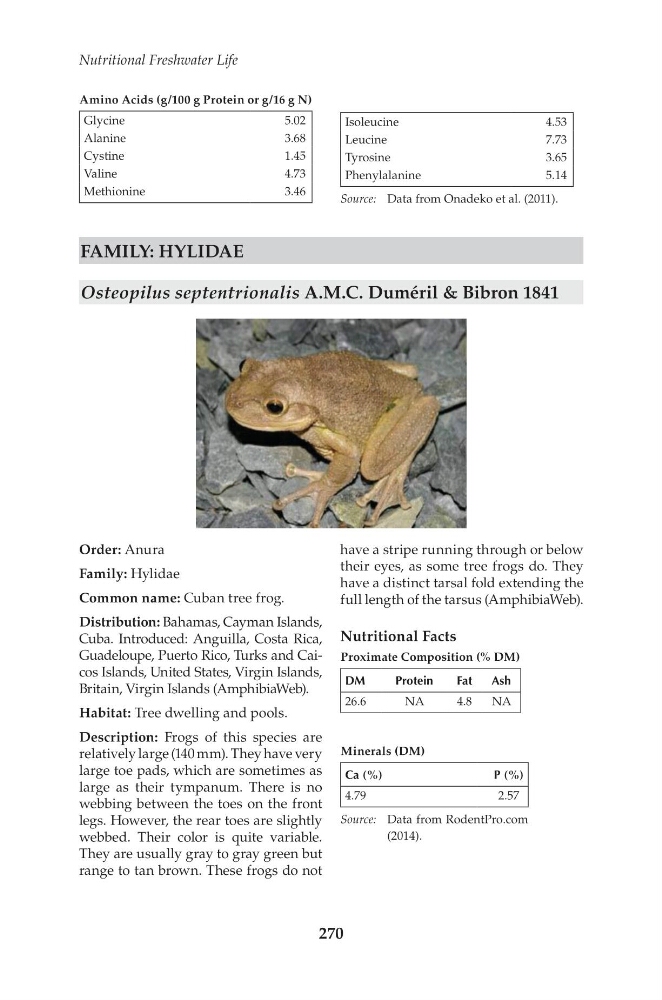
Description: Frogs of this species are
relatively large (140 mm). They have very
large toe pads, which are sometimes as
large as their tympanum. There is no
webbing between the toes on the front
legs. However, the rear toes are slightly
webbed. Their color is quite variable.
They are usually gray to gray green but
range to tan brown. These frogs do not
have a stripe running through or below
their eyes, as some tree frogs do. They
have a distinct tarsal fold extending the
full length of the tarsus (AmphibiaWeb).
Nutritional Facts
Proximate Composition (% DM)
DM
Protein
Fat
Ash
26.6
NA
4.8
NA
Minerals (DM)
Ca (%)
P (%)
4.79
2.57
Source: Data from RodentPro.com
(2014).
270
Amino Acids (g/100 g Protein or g/16 g N)
Glycine
5.02
Alanine
3.68
Cystine
1.45
Valine
4.73
Methionine
3.46
Isoleucine
4.53
Leucine
7.73
Tyrosine
3.65
Phenylalanine
5.14
Source: Data from Onadeko et al. (2011).
FAMILY: HYLIDAE
Osteopilus septentrionalis A.M.C. Duméril & Bibron 1841
Order: Anura
Family: Hylidae
Common name: Cuban tree frog.
Distribution: Bahamas, Cayman Islands,
Cuba. Introduced: Anguilla, Costa Rica,
Guadeloupe, Puerto Rico, Turks and Caicos Islands, United States, Virgin Islands,
Britain, Virgin Islands (AmphibiaWeb).
Habitat: Tree dwelling and pools.
Description: Frogs of this species are
relatively large (140 mm). They have very
large toe pads, which are sometimes as
large as their tympanum. There is no
webbing between the toes on the front
legs. However, the rear toes are slightly
webbed. Their color is quite variable.
They are usually gray to gray green but
range to tan brown. These frogs do not
have a stripe running through or below
their eyes, as some tree frogs do. They
have a distinct tarsal fold extending the
full length of the tarsus (AmphibiaWeb).
Nutritional Facts
Proximate Composition (% DM)
DM
Protein
Fat
Ash
26.6
NA
4.8
NA
Minerals (DM)
Ca (%)
P (%)
4.79
2.57
Source: Data from RodentPro.com
(2014).