

7
2
ALGAE AND PLANTS
ALGAE
PhyLuM: ChLoroPhyta (Green aLGae)
Chlorella vulgaris (Beyerinck) Beijerinck 1890
Phylum: Chlorophyta
Class: Trebouxiophyceae
Order: Chlorellales
Family: Chlorellaceae
Common name: Chlorella.
Distribution: Atlantic islands, North
America, South America, Southwest
Asia, Southeast Asia, Australia and
New Zealand, Europe (AlgaeBase).
Habitat: Freshwater and terrestrial
habitats.
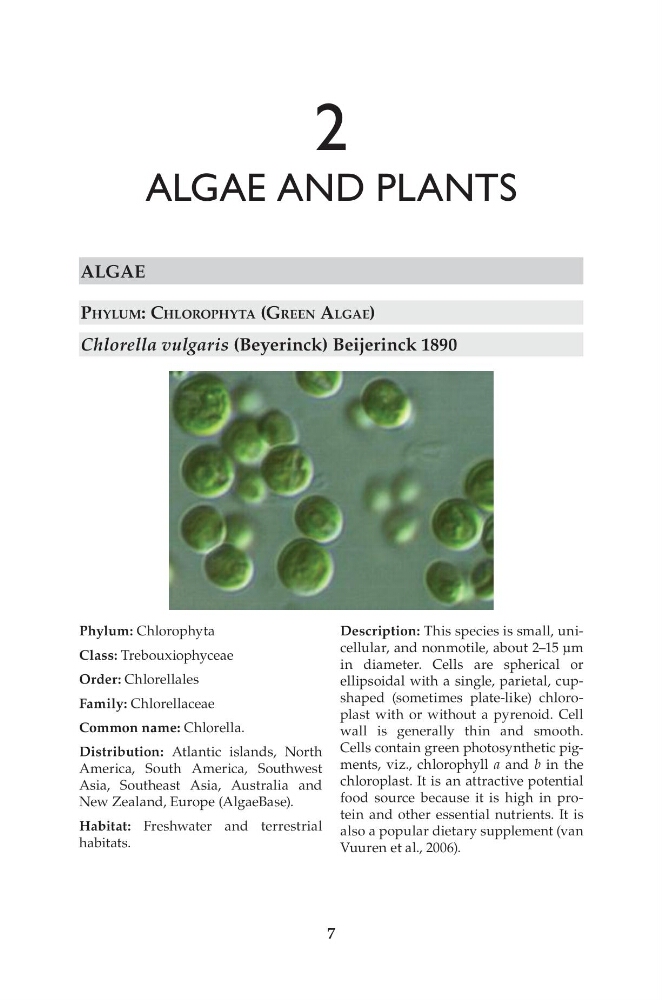
Description: This species is small, unicellular, and nonmotile, about 2–15 μm
in diameter. Cells are spherical or
ellipsoidal with a single, parietal, cupshaped (sometimes plate-like) chloroplast with or without a pyrenoid. Cell
wall is generally thin and smooth.
Cells contain green photosynthetic pigments, viz., chlorophyll a and b in the
chloroplast. It is an attractive potential
food source because it is high in protein and other essential nutrients. It is
also a popular dietary supplement (van
Vuuren et al., 2006).
2
ALGAE AND PLANTS
ALGAE
PhyLuM: ChLoroPhyta (Green aLGae)
Chlorella vulgaris (Beyerinck) Beijerinck 1890
Phylum: Chlorophyta
Class: Trebouxiophyceae
Order: Chlorellales
Family: Chlorellaceae
Common name: Chlorella.
Distribution: Atlantic islands, North
America, South America, Southwest
Asia, Southeast Asia, Australia and
New Zealand, Europe (AlgaeBase).
Habitat: Freshwater and terrestrial
habitats.
Description: This species is small, unicellular, and nonmotile, about 2–15 μm
in diameter. Cells are spherical or
ellipsoidal with a single, parietal, cupshaped (sometimes plate-like) chloroplast with or without a pyrenoid. Cell
wall is generally thin and smooth.
Cells contain green photosynthetic pigments, viz., chlorophyll a and b in the
chloroplast. It is an attractive potential
food source because it is high in protein and other essential nutrients. It is
also a popular dietary supplement (van
Vuuren et al., 2006).