

Nutritional Freshwater Life
4
FRESHWATER CRUSTACEANS
Among freshwater crustaceans, crayfish
assume greater importance, as they have
a super healthy combination of nutrients.
From an almost pure form of protein to
a healthy amount of omega-3 fatty acids,
they are the most beneficial fats to eat for
human nutrition. Crayfish protein has
large amounts of the amino acid tyrosine that mentally energizes the brain.
In addition, there is a healthy supply of
vitamins D and A, as well as calcium,
potassium, copper, and zinc in crayfish.
Iodine is also often mentioned as an
important ingredient. Further, crayfish
are a very low carbohydrate food, and
you can safely eat crayfish without
putting on unwanted weight. Next to
crayfish, freshwater crabs are important, as their meat is nutritionally good,
being high in vitamins, high-quality proteins, and amino acids. It is also rich in
minerals such as calcium, copper, zinc,
phosphorus, and iron, while having
lower levels of fat and carbohydrates.
FRESHWATER MOLLUSCS
Freshwater bivalves, the class of molluscs that includes clams and mussels,
are extremely rich in a unique combination of nutrients that promote men’s
health. These organisms are a superior
source of low-calorie protein loaded with
minerals such as potassium, phosphorus,
manganese, iron, selenium, and zinc and
vitamins such as B3, B12, C, and riboflavin. Three ounces of raw clams will cost
you only 63 calories, but you get 11 g of
protein, 66% of the daily recommended
amount of iron, and 700% of the daily
recommended amount of vitamin B12.
Chinese medicine recommends clams
for treating hemorrhoids. The importance of freshwater gastropods (snails)
in mitigating the protein deficiency in
poor countries, such as Bangladesh,
cannot be overlooked.
FROGS
A number of species of frogs, including the bullfrog (Rana catesbeiana) and
green frog (Rana clamitans), are nowadays harvested from the wild, and
their legs are sold as a luxury food
in expensive restaurants of several
countries.
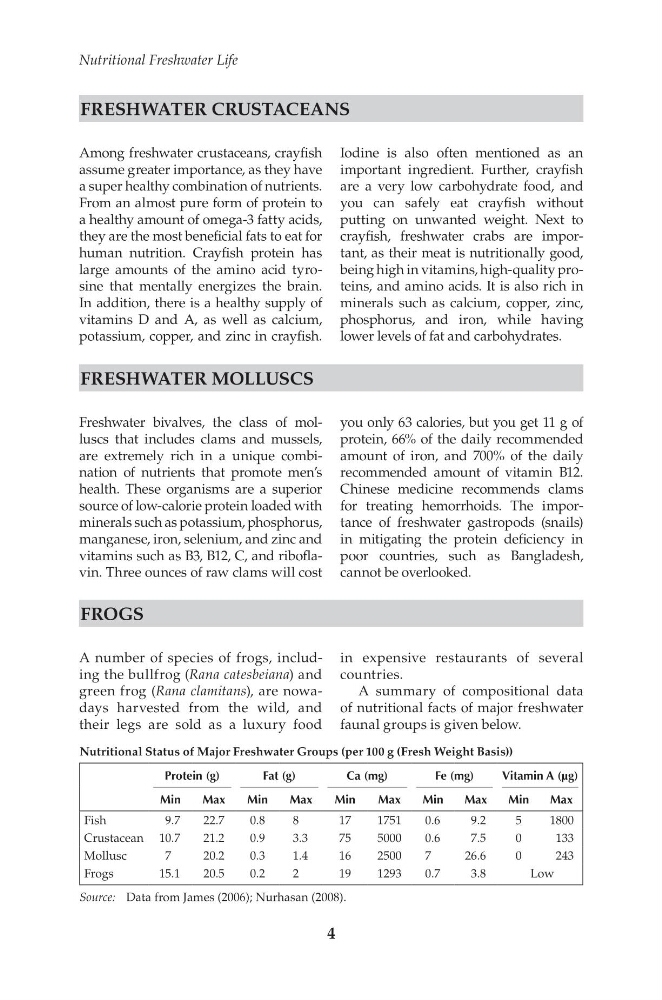
A summary of compositional data
of nutritional facts of major freshwater
faunal groups is given below.
Nutritional Status of Major Freshwater Groups (per 100 g (Fresh Weight Basis))
Protein (g)
Fat (g)
Ca (mg)
Fe (mg)
Vitamin A (µg)
Min
Max
Min
Max
Min
Max
Min
Max
Min
Max
Fish
9.7
22.7
0.8
8
17
1751
0.6
9.2
5
1800
Crustacean 10.7
21.2
0.9
3.3
75
5000
0.6
7.5
0
133
Mollusc
7
20.2
0.3
1.4
16
2500
7
26.6
0
243
Frogs
15.1
20.5
0.2
2
19
1293
0.7
3.8
Low
Source: Data from James (2006); Nurhasan (2008).
4
FRESHWATER CRUSTACEANS
Among freshwater crustaceans, crayfish
assume greater importance, as they have
a super healthy combination of nutrients.
From an almost pure form of protein to
a healthy amount of omega-3 fatty acids,
they are the most beneficial fats to eat for
human nutrition. Crayfish protein has
large amounts of the amino acid tyrosine that mentally energizes the brain.
In addition, there is a healthy supply of
vitamins D and A, as well as calcium,
potassium, copper, and zinc in crayfish.
Iodine is also often mentioned as an
important ingredient. Further, crayfish
are a very low carbohydrate food, and
you can safely eat crayfish without
putting on unwanted weight. Next to
crayfish, freshwater crabs are important, as their meat is nutritionally good,
being high in vitamins, high-quality proteins, and amino acids. It is also rich in
minerals such as calcium, copper, zinc,
phosphorus, and iron, while having
lower levels of fat and carbohydrates.
FRESHWATER MOLLUSCS
Freshwater bivalves, the class of molluscs that includes clams and mussels,
are extremely rich in a unique combination of nutrients that promote men’s
health. These organisms are a superior
source of low-calorie protein loaded with
minerals such as potassium, phosphorus,
manganese, iron, selenium, and zinc and
vitamins such as B3, B12, C, and riboflavin. Three ounces of raw clams will cost
you only 63 calories, but you get 11 g of
protein, 66% of the daily recommended
amount of iron, and 700% of the daily
recommended amount of vitamin B12.
Chinese medicine recommends clams
for treating hemorrhoids. The importance of freshwater gastropods (snails)
in mitigating the protein deficiency in
poor countries, such as Bangladesh,
cannot be overlooked.
FROGS
A number of species of frogs, including the bullfrog (Rana catesbeiana) and
green frog (Rana clamitans), are nowadays harvested from the wild, and
their legs are sold as a luxury food
in expensive restaurants of several
countries.
A summary of compositional data
of nutritional facts of major freshwater
faunal groups is given below.
Nutritional Status of Major Freshwater Groups (per 100 g (Fresh Weight Basis))
Protein (g)
Fat (g)
Ca (mg)
Fe (mg)
Vitamin A (µg)
Min
Max
Min
Max
Min
Max
Min
Max
Min
Max
Fish
9.7
22.7
0.8
8
17
1751
0.6
9.2
5
1800
Crustacean 10.7
21.2
0.9
3.3
75
5000
0.6
7.5
0
133
Mollusc
7
20.2
0.3
1.4
16
2500
7
26.6
0
243
Frogs
15.1
20.5
0.2
2
19
1293
0.7
3.8
Low
Source: Data from James (2006); Nurhasan (2008).