

Nutritional Freshwater Life
230
Distribution: Africa: Endemic to Lake
Tanganyika (Bailly, 1997g).
Habitat: Lacustrine species, preferring
open waters.
Description: Body of this species is
fairly slender. Prepelvic scutes are not
strongly keeled, beginning behind
base of last pectoral fin ray. Lower
gill rakers numbering 35–38 are long
and slender. A distinct silver stripe is
seen along the flank. Snout is broad
with tapering sides, not concave when
viewed from above. It grows to a maximum size of 17 cm. It has a large air
bladder, which is responsible for its
ability to move great vertical distances
(Bailly, 1997g).
Nutritional Facts
Proximate Composition (g/100 g DM)
Protein Lipid CHO a Moisture Ash
67.22
6.75
5.03
5.44
15.56
a Carbohydrate.
Minerals (mg/g DM)
Ca
P
K
Na
Mg
Zn
Fe
306
175
45
26
19 1.23 0.38
Source: Data from Abdulkarim et al. (2013).
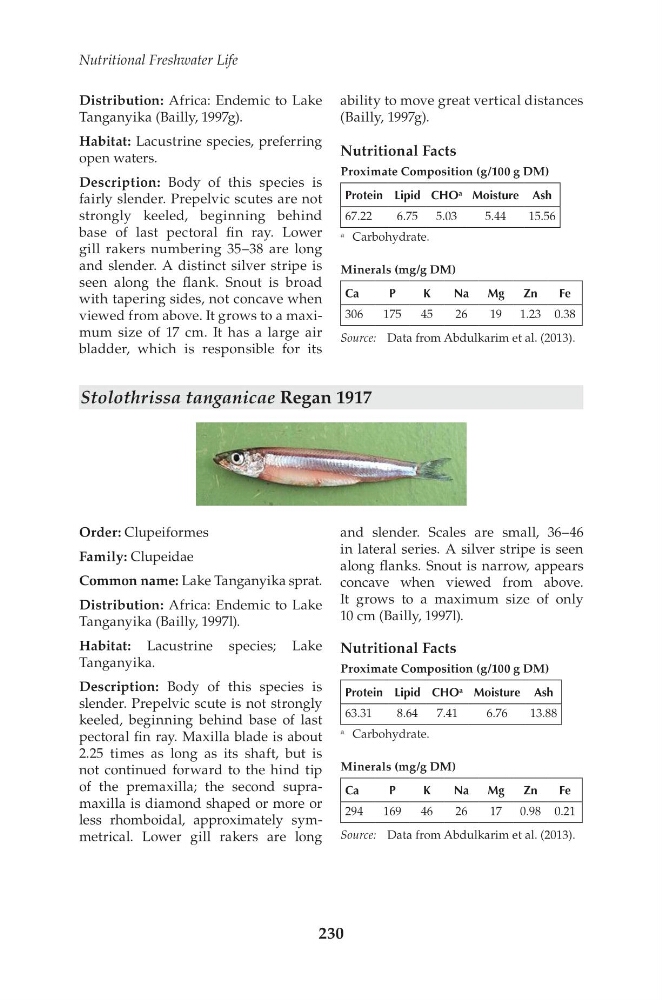
Stolothrissa tanganicae Regan 1917
Order: Clupeiformes
Family: Clupeidae
Common name: Lake Tanganyika sprat.
Distribution: Africa: Endemic to Lake
Tanganyika (Bailly, 1997l).
Habitat: Lacustrine species; Lake
Tanganyika.
Description: Body of this species is
slender. Prepelvic scute is not strongly
keeled, beginning behind base of last
pectoral fin ray. Maxilla blade is about
2.25 times as long as its shaft, but is
not continued forward to the hind tip
of the premaxilla; the second supramaxilla is diamond shaped or more or
less rhomboidal, approximately symmetrical. Lower gill rakers are long
and slender. Scales are small, 36–46
in lateral series. A silver stripe is seen
along flanks. Snout is narrow, appears
concave when viewed from above.
It grows to a maximum size of only
10 cm (Bailly, 1997l).
Nutritional Facts
Proximate Composition (g/100 g DM)
Protein Lipid CHO a Moisture Ash
63.31
8.64
7.41
6.76
13.88
a Carbohydrate.
Minerals (mg/g DM)
Ca
P
K
Na
Mg
Zn
Fe
294
169
46
26
17 0.98 0.21
Source: Data from Abdulkarim et al. (2013).
230
Distribution: Africa: Endemic to Lake
Tanganyika (Bailly, 1997g).
Habitat: Lacustrine species, preferring
open waters.
Description: Body of this species is
fairly slender. Prepelvic scutes are not
strongly keeled, beginning behind
base of last pectoral fin ray. Lower
gill rakers numbering 35–38 are long
and slender. A distinct silver stripe is
seen along the flank. Snout is broad
with tapering sides, not concave when
viewed from above. It grows to a maximum size of 17 cm. It has a large air
bladder, which is responsible for its
ability to move great vertical distances
(Bailly, 1997g).
Nutritional Facts
Proximate Composition (g/100 g DM)
Protein Lipid CHO a Moisture Ash
67.22
6.75
5.03
5.44
15.56
a Carbohydrate.
Minerals (mg/g DM)
Ca
P
K
Na
Mg
Zn
Fe
306
175
45
26
19 1.23 0.38
Source: Data from Abdulkarim et al. (2013).
Stolothrissa tanganicae Regan 1917
Order: Clupeiformes
Family: Clupeidae
Common name: Lake Tanganyika sprat.
Distribution: Africa: Endemic to Lake
Tanganyika (Bailly, 1997l).
Habitat: Lacustrine species; Lake
Tanganyika.
Description: Body of this species is
slender. Prepelvic scute is not strongly
keeled, beginning behind base of last
pectoral fin ray. Maxilla blade is about
2.25 times as long as its shaft, but is
not continued forward to the hind tip
of the premaxilla; the second supramaxilla is diamond shaped or more or
less rhomboidal, approximately symmetrical. Lower gill rakers are long
and slender. Scales are small, 36–46
in lateral series. A silver stripe is seen
along flanks. Snout is narrow, appears
concave when viewed from above.
It grows to a maximum size of only
10 cm (Bailly, 1997l).
Nutritional Facts
Proximate Composition (g/100 g DM)
Protein Lipid CHO a Moisture Ash
63.31
8.64
7.41
6.76
13.88
a Carbohydrate.
Minerals (mg/g DM)
Ca
P
K
Na
Mg
Zn
Fe
294
169
46
26
17 0.98 0.21
Source: Data from Abdulkarim et al. (2013).