

Nutritional Freshwater Life
186
Vitamins (per 100 g)
Vitamin C (mg)
0.0
Thiamin (mg)
0.10
Riboflavin (mg)
0.03
Niacin (mg)
2.10
Pantothenic acid (mg)
0.75
Vitamin B6 (mg)
0.30
Folate (µg)
9
Choline (mg)
ND
Vitamin B12 (µg)
3.82
Vitamin A (IU)
90
Vitamin E (mg)
ND
Vitamin D(IU)
ND
Vitamin K (µg)
ND
ND, no data.
Source: Data from Tacon and Metian
(2013).
Dicentrarchus labrax Linnaeus 1758
Order: Perciformes
Family: Moronidae
Common name: European seabass.
Distribution: Eastern Atlantic: Norway
to Morocco, the Canary Islands and
Senegal; Mediterranean and Black Sea
(Binohlan, 1990b).
Habitat: Estuaries and brackish water
lagoons. Sometimes they venture
upstream into freshwater.
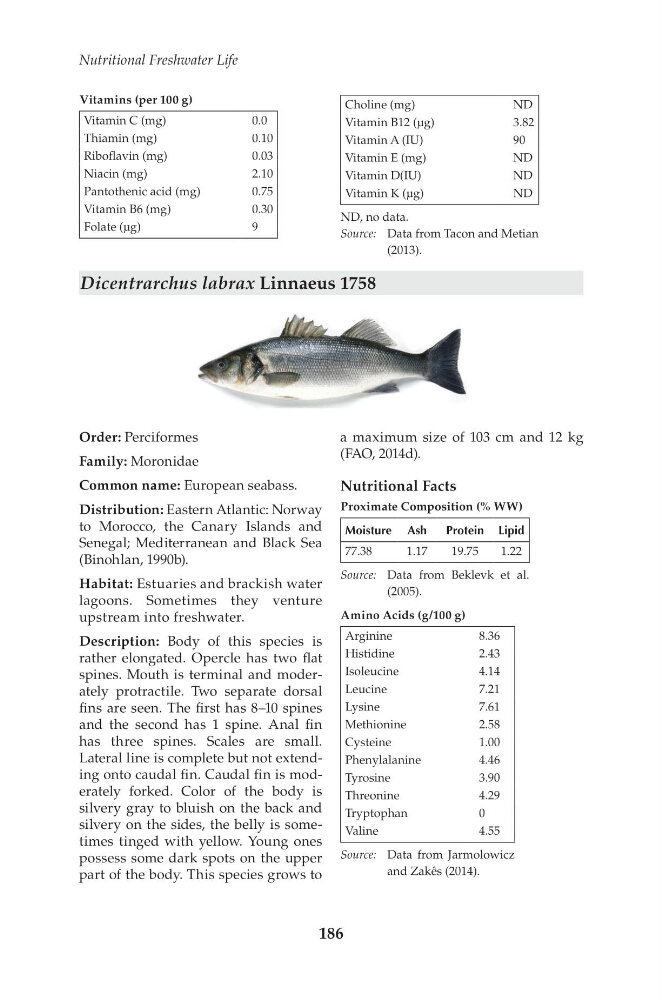
Description: Body of this species is
rather elongated. Opercle has two flat
spines. Mouth is terminal and moderately protractile. Two separate dorsal
fins are seen. The first has 8–10 spines
and the second has 1 spine. Anal fin
has three spines. Scales are small.
Lateral line is complete but not extending onto caudal fin. Caudal fin is moderately forked. Color of the body is
silvery gray to bluish on the back and
silvery on the sides, the belly is sometimes tinged with yellow. Young ones
possess some dark spots on the upper
part of the body. This species grows to
a maximum size of 103 cm and 12 kg
(FAO, 2014d).
Nutritional Facts
Proximate Composition (% WW)
Moisture Ash
Protein Lipid
77.38
1.17
19.75
1.22
Source: Data from Beklevk et al.
(2005).
Amino Acids (g/100 g)
Arginine
8.36
Histidine
2.43
Isoleucine
4.14
Leucine
7.21
Lysine
7.61
Methionine
2.58
Cysteine
1.00
Phenylalanine
4.46
Tyrosine
3.90
Threonine
4.29
Tryptophan
0
Valine
4.55
Source: Data from Jarmolowicz
and Zakês (2014).
186
Vitamins (per 100 g)
Vitamin C (mg)
0.0
Thiamin (mg)
0.10
Riboflavin (mg)
0.03
Niacin (mg)
2.10
Pantothenic acid (mg)
0.75
Vitamin B6 (mg)
0.30
Folate (µg)
9
Choline (mg)
ND
Vitamin B12 (µg)
3.82
Vitamin A (IU)
90
Vitamin E (mg)
ND
Vitamin D(IU)
ND
Vitamin K (µg)
ND
ND, no data.
Source: Data from Tacon and Metian
(2013).
Dicentrarchus labrax Linnaeus 1758
Order: Perciformes
Family: Moronidae
Common name: European seabass.
Distribution: Eastern Atlantic: Norway
to Morocco, the Canary Islands and
Senegal; Mediterranean and Black Sea
(Binohlan, 1990b).
Habitat: Estuaries and brackish water
lagoons. Sometimes they venture
upstream into freshwater.
Description: Body of this species is
rather elongated. Opercle has two flat
spines. Mouth is terminal and moderately protractile. Two separate dorsal
fins are seen. The first has 8–10 spines
and the second has 1 spine. Anal fin
has three spines. Scales are small.
Lateral line is complete but not extending onto caudal fin. Caudal fin is moderately forked. Color of the body is
silvery gray to bluish on the back and
silvery on the sides, the belly is sometimes tinged with yellow. Young ones
possess some dark spots on the upper
part of the body. This species grows to
a maximum size of 103 cm and 12 kg
(FAO, 2014d).
Nutritional Facts
Proximate Composition (% WW)
Moisture Ash
Protein Lipid
77.38
1.17
19.75
1.22
Source: Data from Beklevk et al.
(2005).
Amino Acids (g/100 g)
Arginine
8.36
Histidine
2.43
Isoleucine
4.14
Leucine
7.21
Lysine
7.61
Methionine
2.58
Cysteine
1.00
Phenylalanine
4.46
Tyrosine
3.90
Threonine
4.29
Tryptophan
0
Valine
4.55
Source: Data from Jarmolowicz
and Zakês (2014).