

46
Air Pollution and Turbulence: Modeling and Applications
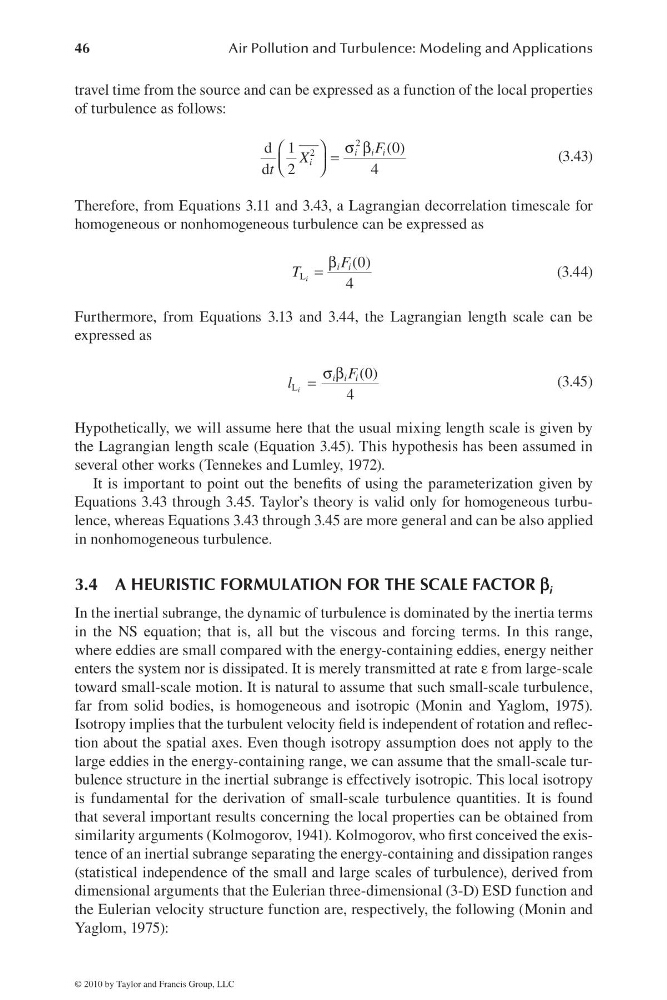
travel time from the source and can be expressed as a function of the local properties
of turbulence as follows:
σ β
⎛
⎞ =
⎜
⎟
⎝
⎠
2
2
d 1
(0)
d 2
4
i i i
i
F
X
t
(3.43)
Therefore, from Equations 3.11 and 3.43, a Lagrangian decorrelation timescale for
homogeneous or nonhomogeneous turbulence can be expressed as
β
=
L
(0)
4
i
i i
F
T
(3.44)
Furthermore, from Equations 3.13 and 3.44, the Lagrangian length scale can be
expressed as
σ β
=
L
(0)
4
i
i i i
F
l
(3.45)
Hypothetically, we will assume here that the usual mixing length scale is given by
the Lagrangian length scale (Equation 3.45). This hypothesis has been assumed in
several other works (Tennekes and Lumley, 1972).
It is important to point out the benefi ts of using the parameterization given by
Equations 3.43 through 3.45. Taylor’s theory is valid only for homogeneous turbulence, whereas Equations 3.43 through 3.45 are more general and can be also applied
in nonhomogeneous turbulence.
3.4 A HEURISTIC FORMULATION FOR THE SCALE FACTOR b i
In the inertial subrange, the dynamic of turbulence is dominated by the inertia terms
in the NS equation; that is, all but the viscous and forcing terms. In this range,
where eddies are small compared with the energy-containing eddies, energy neither
enters the system nor is dissipated. It is merely transmitted at rate ε from large-scale
toward small-scale motion. It is natural to assume that such small-scale turbulence,
far from solid bodies, is homogeneous and isotropic (Monin and Yaglom, 1975).
Isotropy implies that the turbulent velocity fi eld is independent of rotation and refl ection about the spatial axes. Even though isotropy assumption does not apply to the
large eddies in the energy-containing range, we can assume that the small-scale turbulence structure in the inertial subrange is effectively isotropic. This local isotropy
is fundamental for the derivation of small-scale turbulence quantities. It is found
that several important results concerning the local properties can be obtained from
similarity arguments (Kolmogorov, 1941). Kolmogorov, who fi rst conceived the existence of an inertial subrange separating the energy-containing and dissipation ranges
(statistical independence of the small and large scales of turbulence), derived from
dimensional arguments that the Eulerian three-dimensional (3-D) ESD function and
the Eulerian velocity structure function are, respectively, the following (Monin and
Yaglom, 1975):
© 2010 by Taylor and Francis Group, LLC
Air Pollution and Turbulence: Modeling and Applications
travel time from the source and can be expressed as a function of the local properties
of turbulence as follows:
σ β
⎛
⎞ =
⎜
⎟
⎝
⎠
2
2
d 1
(0)
d 2
4
i i i
i
F
X
t
(3.43)
Therefore, from Equations 3.11 and 3.43, a Lagrangian decorrelation timescale for
homogeneous or nonhomogeneous turbulence can be expressed as
β
=
L
(0)
4
i
i i
F
T
(3.44)
Furthermore, from Equations 3.13 and 3.44, the Lagrangian length scale can be
expressed as
σ β
=
L
(0)
4
i
i i i
F
l
(3.45)
Hypothetically, we will assume here that the usual mixing length scale is given by
the Lagrangian length scale (Equation 3.45). This hypothesis has been assumed in
several other works (Tennekes and Lumley, 1972).
It is important to point out the benefi ts of using the parameterization given by
Equations 3.43 through 3.45. Taylor’s theory is valid only for homogeneous turbulence, whereas Equations 3.43 through 3.45 are more general and can be also applied
in nonhomogeneous turbulence.
3.4 A HEURISTIC FORMULATION FOR THE SCALE FACTOR b i
In the inertial subrange, the dynamic of turbulence is dominated by the inertia terms
in the NS equation; that is, all but the viscous and forcing terms. In this range,
where eddies are small compared with the energy-containing eddies, energy neither
enters the system nor is dissipated. It is merely transmitted at rate ε from large-scale
toward small-scale motion. It is natural to assume that such small-scale turbulence,
far from solid bodies, is homogeneous and isotropic (Monin and Yaglom, 1975).
Isotropy implies that the turbulent velocity fi eld is independent of rotation and refl ection about the spatial axes. Even though isotropy assumption does not apply to the
large eddies in the energy-containing range, we can assume that the small-scale turbulence structure in the inertial subrange is effectively isotropic. This local isotropy
is fundamental for the derivation of small-scale turbulence quantities. It is found
that several important results concerning the local properties can be obtained from
similarity arguments (Kolmogorov, 1941). Kolmogorov, who fi rst conceived the existence of an inertial subrange separating the energy-containing and dissipation ranges
(statistical independence of the small and large scales of turbulence), derived from
dimensional arguments that the Eulerian three-dimensional (3-D) ESD function and
the Eulerian velocity structure function are, respectively, the following (Monin and
Yaglom, 1975):
© 2010 by Taylor and Francis Group, LLC