

304
Air Pollution and Turbulence: Modeling and Applications
(The advantage of such a double deconvolution calculation is that it automatically
incorporates consistent estimates of the so-called isofl ux contributions.) In contrast,
the inversion by Tans et al. (1990) used ocean CO 2 partial pressure data in northern
and tropical regions with the inversion mainly determining southern ocean sinks and
northern and tropical land fl uxes.
Although the various contending calculations were performed before the advent
of systematic uncertainty analysis from the Bayesian synthesis approach, it is possible to revisit the various cases, cast them in Bayesian synthesis form, and compare
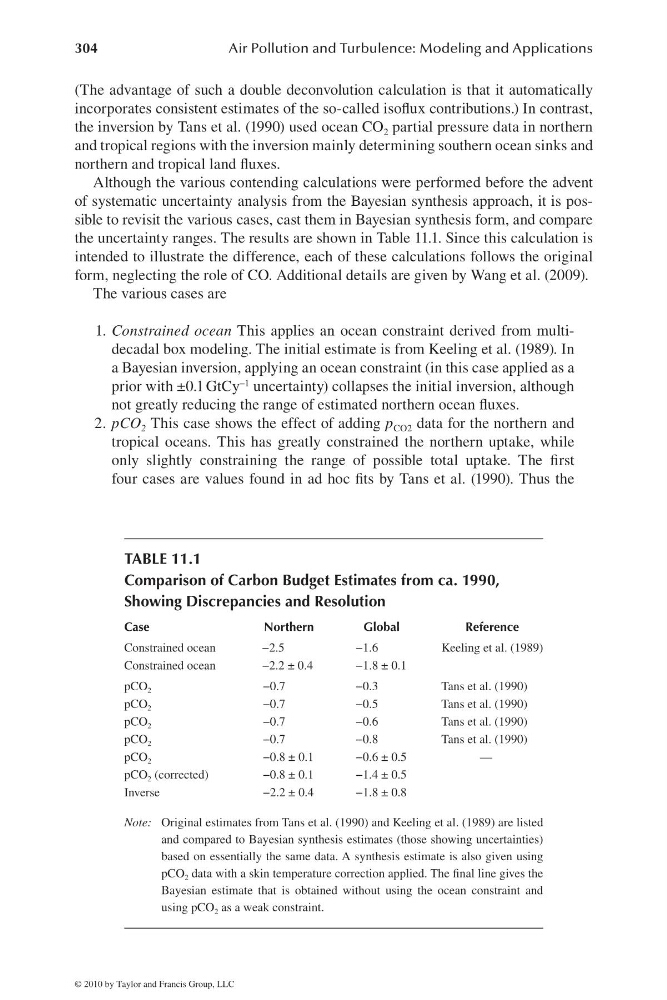
the uncertainty ranges. The results are shown in Table 11.1. Since this calculation is
intended to illustrate the difference, each of these calculations follows the original
form, neglecting the role of CO. Additional details are given by Wang et al. (2009).
The various cases are
1. Constrained ocean This applies an ocean constraint derived from multidecadal box modeling. The initial estimate is from Keeling et al. (1989). In
a Bayesian inversion, applying an ocean constraint (in this case applied as a
prior with ±0.1 GtCy −1 uncertainty) collapses the initial inversion, although
not greatly reducing the range of estimated northern ocean fl uxes.
2. pCO 2 This case shows the effect of adding p CO2 data for the northern and
tropical oceans. This has greatly constrained the northern uptake, while
only slightly constraining the range of possible total uptake. The fi rst
four cases are values found in ad hoc fi ts by Tans et al. (1990). Thus the
TABLE 11.1
Comparison of Carbon Budget Estimates from ca. 1990,
Showing Discrepancies and Resolution
Case
Northern
Global
Reference
Constrained ocean
−2.5
−1.6
Keeling et al. (1989)
Constrained ocean
−2.2 ± 0.4
−1.8 ± 0.1
pCO 2
−0.7
−0.3
Tans et al. (1990)
pCO 2
−0.7
−0.5
Tans et al. (1990)
pCO 2
−0.7
−0.6
Tans et al. (1990)
pCO 2
−0.7
−0.8
Tans et al. (1990)
pCO 2
−0.8 ± 0.1
−0.6 ± 0.5
—
pCO 2 (corrected)
−0.8 ± 0.1
−1.4 ± 0.5
Inverse
−2.2 ± 0.4
−1.8 ± 0.8
Note: Original estimates from Tans et al. (1990) and Keeling et al. (1989) are listed
and compared to Bayesian synthesis estimates (those showing uncertainties)
based on essentially the same data. A synthesis estimate is also given using
pCO 2 data with a skin temperature correction applied. The fi nal line gives the
Bayesian estimate that is obtained without using the ocean constraint and
using pCO 2 as a weak constraint.
© 2010 by Taylor and Francis Group, LLC
Air Pollution and Turbulence: Modeling and Applications
(The advantage of such a double deconvolution calculation is that it automatically
incorporates consistent estimates of the so-called isofl ux contributions.) In contrast,
the inversion by Tans et al. (1990) used ocean CO 2 partial pressure data in northern
and tropical regions with the inversion mainly determining southern ocean sinks and
northern and tropical land fl uxes.
Although the various contending calculations were performed before the advent
of systematic uncertainty analysis from the Bayesian synthesis approach, it is possible to revisit the various cases, cast them in Bayesian synthesis form, and compare
the uncertainty ranges. The results are shown in Table 11.1. Since this calculation is
intended to illustrate the difference, each of these calculations follows the original
form, neglecting the role of CO. Additional details are given by Wang et al. (2009).
The various cases are
1. Constrained ocean This applies an ocean constraint derived from multidecadal box modeling. The initial estimate is from Keeling et al. (1989). In
a Bayesian inversion, applying an ocean constraint (in this case applied as a
prior with ±0.1 GtCy −1 uncertainty) collapses the initial inversion, although
not greatly reducing the range of estimated northern ocean fl uxes.
2. pCO 2 This case shows the effect of adding p CO2 data for the northern and
tropical oceans. This has greatly constrained the northern uptake, while
only slightly constraining the range of possible total uptake. The fi rst
four cases are values found in ad hoc fi ts by Tans et al. (1990). Thus the
TABLE 11.1
Comparison of Carbon Budget Estimates from ca. 1990,
Showing Discrepancies and Resolution
Case
Northern
Global
Reference
Constrained ocean
−2.5
−1.6
Keeling et al. (1989)
Constrained ocean
−2.2 ± 0.4
−1.8 ± 0.1
pCO 2
−0.7
−0.3
Tans et al. (1990)
pCO 2
−0.7
−0.5
Tans et al. (1990)
pCO 2
−0.7
−0.6
Tans et al. (1990)
pCO 2
−0.7
−0.8
Tans et al. (1990)
pCO 2
−0.8 ± 0.1
−0.6 ± 0.5
—
pCO 2 (corrected)
−0.8 ± 0.1
−1.4 ± 0.5
Inverse
−2.2 ± 0.4
−1.8 ± 0.8
Note: Original estimates from Tans et al. (1990) and Keeling et al. (1989) are listed
and compared to Bayesian synthesis estimates (those showing uncertainties)
based on essentially the same data. A synthesis estimate is also given using
pCO 2 data with a skin temperature correction applied. The fi nal line gives the
Bayesian estimate that is obtained without using the ocean constraint and
using pCO 2 as a weak constraint.
© 2010 by Taylor and Francis Group, LLC