

Atmospheric Dispersion with a Large-Eddy Simulation
253
9.3.6.1.2 Neutral Dispersion
A neutral boundary layer is characterized by a profi le of potential temperature being
constant with height and by the heat fl ux Q * being equal to zero. A neutral PBL is
typically observed for short periods (e.g., before sunset and after sunrise), especially
when buoyancy forces are weaker than mechanical ones. The neutral boundary layer
was generated by LES using the input parameters indicated in Table 9.1. With no
heat fl ux from ground, the mechanical generation of turbulence is the predominant
factor infl uencing the fl ow structures and fl ow patterns.
To generate a neutral PBL, we fi rst generated a shear/buoyancy PBL, and then
(after 3000 s, approximately equivalent to seven turnover times), we set the surface heat fl ux to zero. In this shear-driven PBL, we injected the contaminant from
an elevated point source (h/H s = 0.5). To build a plume representation, we emitted
(emission time) the contaminant throughout the simulation period (2000Δt) and
got concentration statistics (sampling time) just in the second half period (1000Δt).
Since the travel time is much smaller (about 100Δt) than the sampling/emission
time, the plume representation of the present dispersion process is appropriate. The
mean plume height (red dotted line in Figure 9.3) remains almost constant during
the simulation, confi rming the absence of strong vertical meandering caused by
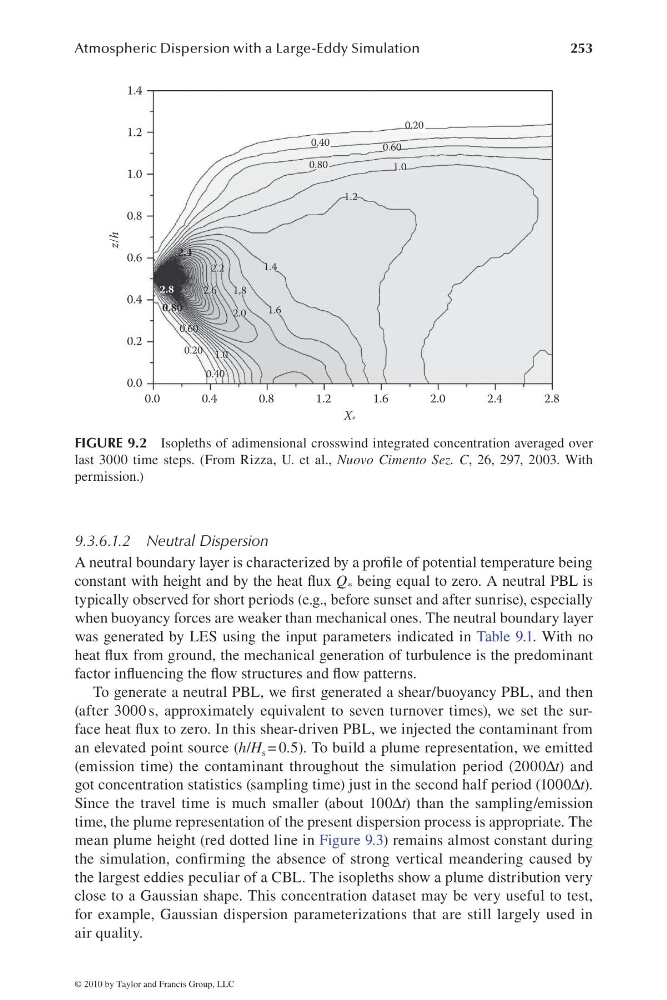
the largest eddies peculiar of a CBL. The isopleths show a plume distribution very
close to a Gaussian shape. This concentration dataset may be very useful to test,
for example, Gaussian dispersion parameterizations that are still largely used in
air quality.
2.8
0.20
0.60
0.80
0.40
1.0
1.2
1.4
1,8
1.0
2.2
2.4
2.8
0.80
0.60
0.20
0.40
2.6
1.6
2.0
2.4
2.0
1.6
1.2
X *
z/h
0.8
0.4
0.0
0.0
0.2
0.4
0.6
0.8
1.0
1.2
1.4
FIGURE 9.2 Isopleths of adimensional crosswind integrated concentration averaged over
last 3000 time steps. (From Rizza, U. et al., Nuovo Cimento Sez. C, 26, 297, 2003. With
permission.)
© 2010 by Taylor and Francis Group, LLC
253
9.3.6.1.2 Neutral Dispersion
A neutral boundary layer is characterized by a profi le of potential temperature being
constant with height and by the heat fl ux Q * being equal to zero. A neutral PBL is
typically observed for short periods (e.g., before sunset and after sunrise), especially
when buoyancy forces are weaker than mechanical ones. The neutral boundary layer
was generated by LES using the input parameters indicated in Table 9.1. With no
heat fl ux from ground, the mechanical generation of turbulence is the predominant
factor infl uencing the fl ow structures and fl ow patterns.
To generate a neutral PBL, we fi rst generated a shear/buoyancy PBL, and then
(after 3000 s, approximately equivalent to seven turnover times), we set the surface heat fl ux to zero. In this shear-driven PBL, we injected the contaminant from
an elevated point source (h/H s = 0.5). To build a plume representation, we emitted
(emission time) the contaminant throughout the simulation period (2000Δt) and
got concentration statistics (sampling time) just in the second half period (1000Δt).
Since the travel time is much smaller (about 100Δt) than the sampling/emission
time, the plume representation of the present dispersion process is appropriate. The
mean plume height (red dotted line in Figure 9.3) remains almost constant during
the simulation, confi rming the absence of strong vertical meandering caused by
the largest eddies peculiar of a CBL. The isopleths show a plume distribution very
close to a Gaussian shape. This concentration dataset may be very useful to test,
for example, Gaussian dispersion parameterizations that are still largely used in
air quality.
2.8
0.20
0.60
0.80
0.40
1.0
1.2
1.4
1,8
1.0
2.2
2.4
2.8
0.80
0.60
0.20
0.40
2.6
1.6
2.0
2.4
2.0
1.6
1.2
X *
z/h
0.8
0.4
0.0
0.0
0.2
0.4
0.6
0.8
1.0
1.2
1.4
FIGURE 9.2 Isopleths of adimensional crosswind integrated concentration averaged over
last 3000 time steps. (From Rizza, U. et al., Nuovo Cimento Sez. C, 26, 297, 2003. With
permission.)
© 2010 by Taylor and Francis Group, LLC