

180
Air Pollution and Turbulence: Modeling and Applications
of the advection–diffusion equation can be written either in integral or in series
formulations, with the main property that both solutions are equivalent (Moreira
et al., 2009b). We are aware of the existence of analytical solutions in the literature,
but for specifi c and particular problems. Among them, we mention the works of
Rounds (1955), Smith (1957), Scriven and Fisher (1975), Demuth (1978), van Ulden
(1978), Nieuwstadt and de Haan (1981), Tagliazucca et al. (1985), Tirabassi (1989),
Tirabassi and Rizza (1994), Sharan et al., (1996a), Lin and Hildemann (1997), and
Tirabassi (2003). In fact, all these solutions are valid for very specialized practical
situations with restrictions on wind and eddy diffusivities vertical profi les. Further,
in the last decade the ADMM (advection diffusion multilayer method) approach
appeared in the literature (Costa et al., 2006), which solves the multidimensional
advection–diffusion equation for more realistic physical scenario. The main idea
relies on the discretization of the ABL in a multilayer domain, assuming in each
layer that the eddy diffusivity and wind profi le take averaged values. The resulting
advection–diffusion equation in each layer is then solved by the Laplace transform
technique. For more details about this methodology, see the revision work done by
Moreira et al. (2006a). In this chapter, we focus our attention to the revision and
updating of the series solution of the advection–diffusion equation, known in the literature as the GILTT (generalized integral Laplace transform technique) approach.
The main idea of this methodology comprehends the following steps: expansion of
the concentration in series of eigenfunctions attained from an auxiliary problem;
replacing this equation in the advection–diffusion equation and taking moments, we
come out with a matrix ordinary differential equation that is then solved analytically
by the Laplace transform technique. This methodology skips the multilayer discretization of the height z appearing in the ADMM approach.
To reach our objective, we begin presenting the solution of the time-dependent,
two-dimensional (2D) advection–diffusion equation in Cartesian geometry by the
GILTT approach, assuming non-Fickian fl ows and considering that the eddy diffusivity coeffi cients depend on the x and z variable meanwhile the vertical wind profi le
depends on the z variable. Once we construct the solution for this general problem, in
the sequel, we show how to obtain the solution for simplifi ed models. We mean that we
consider the solution for the following particular problems: time-dependent Fickian
fl ow model, time-dependent Fickian fl ow without longitudinal diffusion, stationary
Fickian fl ow problems, and approximated three-dimensional (3D) GILTT solution.
We also present numerical simulations and future perspectives of this methodology.
7.2 THE ADVECTION–DIFFUSION EQUATION
AND THE GILTT METHOD
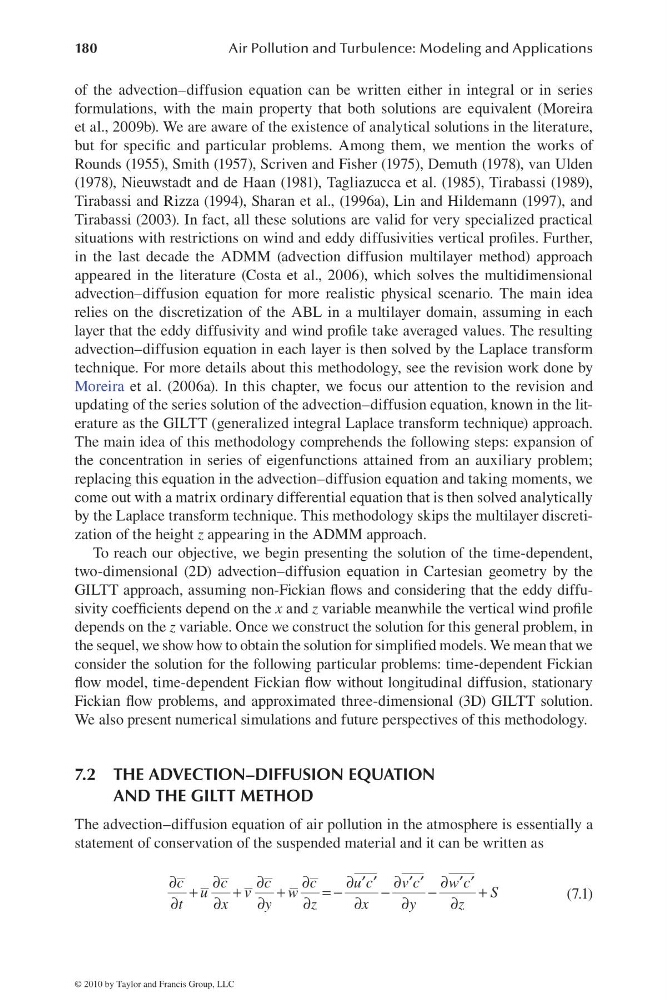
The advection–diffusion equation of air pollution in the atmosphere is essentially a
statement of conservation of the suspended material and it can be written as
∂
∂
∂
∂
∂
∂
∂
′ ′
′ ′
′ ′
+
+
+
=−
−
−
+
∂
∂
∂
∂
∂
∂
∂
c
c
c
c
uc
vc
wc
u
v
w
S
t
x
y
z
x
y
z
(7.1)
© 2010 by Taylor and Francis Group, LLC
Air Pollution and Turbulence: Modeling and Applications
of the advection–diffusion equation can be written either in integral or in series
formulations, with the main property that both solutions are equivalent (Moreira
et al., 2009b). We are aware of the existence of analytical solutions in the literature,
but for specifi c and particular problems. Among them, we mention the works of
Rounds (1955), Smith (1957), Scriven and Fisher (1975), Demuth (1978), van Ulden
(1978), Nieuwstadt and de Haan (1981), Tagliazucca et al. (1985), Tirabassi (1989),
Tirabassi and Rizza (1994), Sharan et al., (1996a), Lin and Hildemann (1997), and
Tirabassi (2003). In fact, all these solutions are valid for very specialized practical
situations with restrictions on wind and eddy diffusivities vertical profi les. Further,
in the last decade the ADMM (advection diffusion multilayer method) approach
appeared in the literature (Costa et al., 2006), which solves the multidimensional
advection–diffusion equation for more realistic physical scenario. The main idea
relies on the discretization of the ABL in a multilayer domain, assuming in each
layer that the eddy diffusivity and wind profi le take averaged values. The resulting
advection–diffusion equation in each layer is then solved by the Laplace transform
technique. For more details about this methodology, see the revision work done by
Moreira et al. (2006a). In this chapter, we focus our attention to the revision and
updating of the series solution of the advection–diffusion equation, known in the literature as the GILTT (generalized integral Laplace transform technique) approach.
The main idea of this methodology comprehends the following steps: expansion of
the concentration in series of eigenfunctions attained from an auxiliary problem;
replacing this equation in the advection–diffusion equation and taking moments, we
come out with a matrix ordinary differential equation that is then solved analytically
by the Laplace transform technique. This methodology skips the multilayer discretization of the height z appearing in the ADMM approach.
To reach our objective, we begin presenting the solution of the time-dependent,
two-dimensional (2D) advection–diffusion equation in Cartesian geometry by the
GILTT approach, assuming non-Fickian fl ows and considering that the eddy diffusivity coeffi cients depend on the x and z variable meanwhile the vertical wind profi le
depends on the z variable. Once we construct the solution for this general problem, in
the sequel, we show how to obtain the solution for simplifi ed models. We mean that we
consider the solution for the following particular problems: time-dependent Fickian
fl ow model, time-dependent Fickian fl ow without longitudinal diffusion, stationary
Fickian fl ow problems, and approximated three-dimensional (3D) GILTT solution.
We also present numerical simulations and future perspectives of this methodology.
7.2 THE ADVECTION–DIFFUSION EQUATION
AND THE GILTT METHOD
The advection–diffusion equation of air pollution in the atmosphere is essentially a
statement of conservation of the suspended material and it can be written as
∂
∂
∂
∂
∂
∂
∂
′ ′
′ ′
′ ′
+
+
+
=−
−
−
+
∂
∂
∂
∂
∂
∂
∂
c
c
c
c
uc
vc
wc
u
v
w
S
t
x
y
z
x
y
z
(7.1)
© 2010 by Taylor and Francis Group, LLC