

Mathematical Air Pollution Models: Eulerian Models
137
explicitly take into account all the parameters of a problem, so that their infl uence
can be reliably investigated, and it is easy to obtain the asymptotic behavior of the
solution, which is usually diffi cult to generate through numerical calculations.
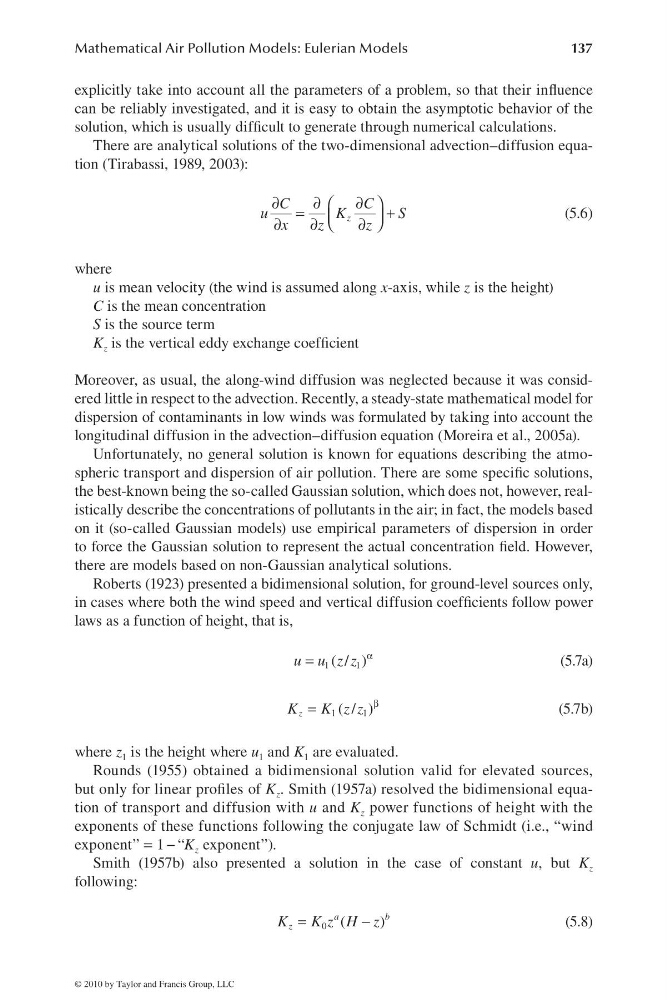
There are analytical solutions of the two-dimensional advection–diffusion equation (Tirabassi, 1989, 2003):
z
C
C
u
K
S
x
z
z
∂
∂
∂
⎛
⎞
=
+
⎜
⎟
⎝
⎠
∂
∂
∂
(5.6)
where
u is mean velocity (the wind is assumed along x-axis, while z is the height)
C is the mean concentration
S is the source term
K z is the vertical eddy exchange coeffi cient
Moreover, as usual, the along-wind diffusion was neglected because it was considered little in respect to the advection. Recently, a steady-state mathematical model for
dispersion of contaminants in low winds was formulated by taking into account the
longitudinal diffusion in the advection–diffusion equation (Moreira et al., 2005a).
Unfortunately, no general solution is known for equations describing the atmospheric transport and dispersion of air pollution. There are some specifi c solutions,
the best-known being the so-called Gaussian solution, which does not, however, realistically describe the concentrations of pollutants in the air; in fact, the models based
on it (so-called Gaussian models) use empirical parameters of dispersion in order
to force the Gaussian solution to represent the actual concentration fi eld. However,
there are models based on non-Gaussian analytical solutions.
Roberts (1923) presented a bidimensional solution, for ground-level sources only,
in cases where both the wind speed and vertical diffusion coeffi cients follow power
laws as a function of height, that is,
1
1
( / )
u u z z
α
=
(5.7a)
1
1
( / )
z
K K z z
=
β
(5.7b)
where z 1 is the height where u 1 and K 1 are evaluated.
Rounds (1955) obtained a bidimensional solution valid for elevated sources,
but only for linear profi les of K z . Smith (1957a) resolved the bidimensional equation of transport and diffusion with u and K z power functions of height with the
exponents of these functions following the conjugate law of Schmidt (i.e., “wind
exponent” = 1 − “K z exponent”).
Smith (1957b) also presented a solution in the case of constant u, but K z
following:
0 (
)
a
b
z
K K z H z
=
−
(5.8)
© 2010 by Taylor and Francis Group, LLC
137
explicitly take into account all the parameters of a problem, so that their infl uence
can be reliably investigated, and it is easy to obtain the asymptotic behavior of the
solution, which is usually diffi cult to generate through numerical calculations.
There are analytical solutions of the two-dimensional advection–diffusion equation (Tirabassi, 1989, 2003):
z
C
C
u
K
S
x
z
z
∂
∂
∂
⎛
⎞
=
+
⎜
⎟
⎝
⎠
∂
∂
∂
(5.6)
where
u is mean velocity (the wind is assumed along x-axis, while z is the height)
C is the mean concentration
S is the source term
K z is the vertical eddy exchange coeffi cient
Moreover, as usual, the along-wind diffusion was neglected because it was considered little in respect to the advection. Recently, a steady-state mathematical model for
dispersion of contaminants in low winds was formulated by taking into account the
longitudinal diffusion in the advection–diffusion equation (Moreira et al., 2005a).
Unfortunately, no general solution is known for equations describing the atmospheric transport and dispersion of air pollution. There are some specifi c solutions,
the best-known being the so-called Gaussian solution, which does not, however, realistically describe the concentrations of pollutants in the air; in fact, the models based
on it (so-called Gaussian models) use empirical parameters of dispersion in order
to force the Gaussian solution to represent the actual concentration fi eld. However,
there are models based on non-Gaussian analytical solutions.
Roberts (1923) presented a bidimensional solution, for ground-level sources only,
in cases where both the wind speed and vertical diffusion coeffi cients follow power
laws as a function of height, that is,
1
1
( / )
u u z z
α
=
(5.7a)
1
1
( / )
z
K K z z
=
β
(5.7b)
where z 1 is the height where u 1 and K 1 are evaluated.
Rounds (1955) obtained a bidimensional solution valid for elevated sources,
but only for linear profi les of K z . Smith (1957a) resolved the bidimensional equation of transport and diffusion with u and K z power functions of height with the
exponents of these functions following the conjugate law of Schmidt (i.e., “wind
exponent” = 1 − “K z exponent”).
Smith (1957b) also presented a solution in the case of constant u, but K z
following:
0 (
)
a
b
z
K K z H z
=
−
(5.8)
© 2010 by Taylor and Francis Group, LLC