

Parameterization of Convective Boundary Layer Turbulence and Clouds
117
contribution to the heat fl ux, except in the lower part of the BL. This is in agreement
with the LES study performed by Ebert et al. (1989) where it is concluded that mass
and heat transport spectra showed the relatively minor contribution made by smallsize eddies as compared with medium and large thermals. On the other hand, the MF
term dominates over the eddy-diffusivity term in the upper half of the mixed layer,
implying an upward (counter-gradient) heat fl ux across that region. In the inversion,
the MF term is also dominant and the fact that it goes to zero slightly above the eddydiffusivity profi le is an indication of overshooting of thermals.
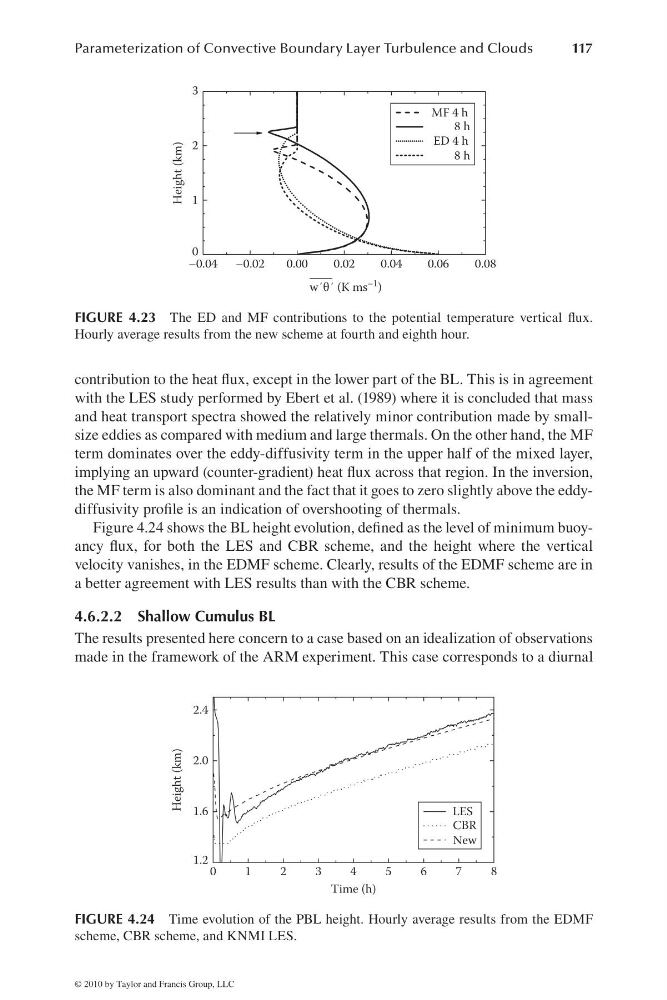
Figure 4.24 shows the BL height evolution, defi ned as the level of minimum buoyancy fl ux, for both the LES and CBR scheme, and the height where the vertical
velocity vanishes, in the EDMF scheme. Clearly, results of the EDMF scheme are in
a better agreement with LES results than with the CBR scheme.
4.6.2.2 Shallow Cumulus BL
The results presented here concern to a case based on an idealization of observations
made in the framework of the ARM experiment. This case corresponds to a diurnal
3
2
1
0
–0.04 –0.02
0.00
0.02
0.04
0.06
0.08
MF 4 h
8 h
8 h
ED 4 h
w΄θ΄ (K ms –1 )
Height (km)
FIGURE 4.23 The ED and MF contributions to the potential temperature vertical fl ux.
Hourly average results from the new scheme at fourth and eighth hour.
2.4
2.0
1.6
1.2
0
1
2
3
4
5
6
7
8
Time (h)
Height (km)
LES
CBR
New
FIGURE 4.24 Time evolution of the PBL height. Hourly average results from the EDMF
scheme, CBR scheme, and KNMI LES.
© 2010 by Taylor and Francis Group, LLC
117
contribution to the heat fl ux, except in the lower part of the BL. This is in agreement
with the LES study performed by Ebert et al. (1989) where it is concluded that mass
and heat transport spectra showed the relatively minor contribution made by smallsize eddies as compared with medium and large thermals. On the other hand, the MF
term dominates over the eddy-diffusivity term in the upper half of the mixed layer,
implying an upward (counter-gradient) heat fl ux across that region. In the inversion,
the MF term is also dominant and the fact that it goes to zero slightly above the eddydiffusivity profi le is an indication of overshooting of thermals.
Figure 4.24 shows the BL height evolution, defi ned as the level of minimum buoyancy fl ux, for both the LES and CBR scheme, and the height where the vertical
velocity vanishes, in the EDMF scheme. Clearly, results of the EDMF scheme are in
a better agreement with LES results than with the CBR scheme.
4.6.2.2 Shallow Cumulus BL
The results presented here concern to a case based on an idealization of observations
made in the framework of the ARM experiment. This case corresponds to a diurnal
3
2
1
0
–0.04 –0.02
0.00
0.02
0.04
0.06
0.08
MF 4 h
8 h
8 h
ED 4 h
w΄θ΄ (K ms –1 )
Height (km)
FIGURE 4.23 The ED and MF contributions to the potential temperature vertical fl ux.
Hourly average results from the new scheme at fourth and eighth hour.
2.4
2.0
1.6
1.2
0
1
2
3
4
5
6
7
8
Time (h)
Height (km)
LES
CBR
New
FIGURE 4.24 Time evolution of the PBL height. Hourly average results from the EDMF
scheme, CBR scheme, and KNMI LES.
© 2010 by Taylor and Francis Group, LLC