

Parameterization of Convective Boundary Layer Turbulence and Clouds
103
Nevertheless, in agreement with Sullivan et al. (1998), this constant ratio between
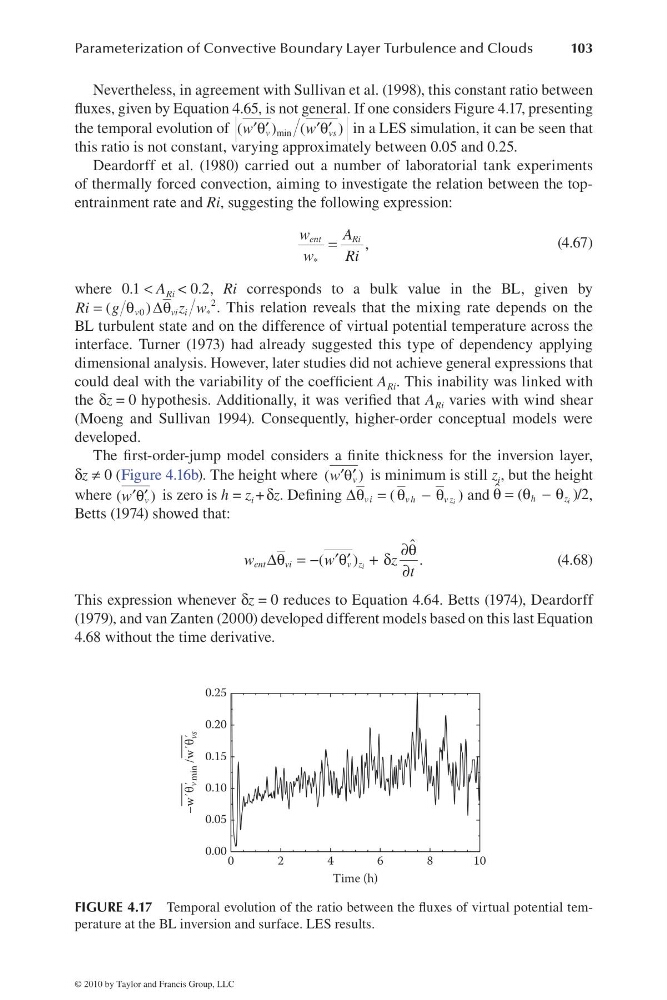
fl uxes, given by Equation 4.65, is not general. If one considers Figure 4.17, presenting
the temporal evolution of
θ
θ
′ ′
′ ′
min
(
)
(
)
v
v s
w
w
in a LES simulation, it can be seen that
this ratio is not constant, varying approximately between 0.05 and 0.25.
Deardorff et al. (1980) carried out a number of laboratorial tank experiments
of thermally forced convection, aiming to investigate the relation between the topentrainment rate and Ri, suggesting the following expression:
,
ent
Ri
w
A
w
Ri
∗
=
(4.67)
where 0.1 < A Ri < 0.2, Ri corresponds to a bulk value in the BL, given by
2
0
(
)
v
v i i
Ri g
z w ∗
=
θ Δθ
. This relation reveals that the mixing rate depends on the
BL turbulent state and on the difference of virtual potential temperature across the
interface. Turner (1973) had already suggested this type of dependency applying
dimensional analysis. However, later studies did not achieve general expressions that
could deal with the variability of the coeffi cient A Ri . This inability was linked with
the δz = 0 hypothesis. Additionally, it was verifi ed that A Ri varies with wind shear
(Moeng and Sullivan 1994). Consequently, higher-order conceptual models were
developed.
The fi rst-order-jump model considers a fi nite thickness for the inversion layer,
δz ≠ 0 (Figure 4.16b). The height where
θ
′ ′
(
)
v
w
is minimum is still z i , but the height
where
θ
′ ′
(
)
v
w
is zero is h = z i + δz. Defi ning
(
)
i
vi
v h
v z
Δθ = θ − θ
and ˆ (
) / 2
i
h
z
θ = θ − θ
,
Betts (1974) showed that:
∂θ
Δθ = − θ + δ
′ ′
∂
ˆ
(
)
.
i
ent
vi
v z
w
w
z
t
(4.68)
This expression whenever δz = 0 reduces to Equation 4.64. Betts (1974), Deardorff
(1979), and van Zanten (2000) developed different models based on this last Equation
4.68 without the time derivative.
0.25
0.20
0.15
0.10
0.05
0.00
0
2
4
6
8
1 0
Time (h)
–w΄θ΄
v min /w΄θ΄
vs
FIGURE 4.17 Temporal evolution of the ratio between the fl uxes of virtual potential temperature at the BL inversion and surface. LES results.
© 2010 by Taylor and Francis Group, LLC
103
Nevertheless, in agreement with Sullivan et al. (1998), this constant ratio between
fl uxes, given by Equation 4.65, is not general. If one considers Figure 4.17, presenting
the temporal evolution of
θ
θ
′ ′
′ ′
min
(
)
(
)
v
v s
w
w
in a LES simulation, it can be seen that
this ratio is not constant, varying approximately between 0.05 and 0.25.
Deardorff et al. (1980) carried out a number of laboratorial tank experiments
of thermally forced convection, aiming to investigate the relation between the topentrainment rate and Ri, suggesting the following expression:
,
ent
Ri
w
A
w
Ri
∗
=
(4.67)
where 0.1 < A Ri < 0.2, Ri corresponds to a bulk value in the BL, given by
2
0
(
)
v
v i i
Ri g
z w ∗
=
θ Δθ
. This relation reveals that the mixing rate depends on the
BL turbulent state and on the difference of virtual potential temperature across the
interface. Turner (1973) had already suggested this type of dependency applying
dimensional analysis. However, later studies did not achieve general expressions that
could deal with the variability of the coeffi cient A Ri . This inability was linked with
the δz = 0 hypothesis. Additionally, it was verifi ed that A Ri varies with wind shear
(Moeng and Sullivan 1994). Consequently, higher-order conceptual models were
developed.
The fi rst-order-jump model considers a fi nite thickness for the inversion layer,
δz ≠ 0 (Figure 4.16b). The height where
θ
′ ′
(
)
v
w
is minimum is still z i , but the height
where
θ
′ ′
(
)
v
w
is zero is h = z i + δz. Defi ning
(
)
i
vi
v h
v z
Δθ = θ − θ
and ˆ (
) / 2
i
h
z
θ = θ − θ
,
Betts (1974) showed that:
∂θ
Δθ = − θ + δ
′ ′
∂
ˆ
(
)
.
i
ent
vi
v z
w
w
z
t
(4.68)
This expression whenever δz = 0 reduces to Equation 4.64. Betts (1974), Deardorff
(1979), and van Zanten (2000) developed different models based on this last Equation
4.68 without the time derivative.
0.25
0.20
0.15
0.10
0.05
0.00
0
2
4
6
8
1 0
Time (h)
–w΄θ΄
v min /w΄θ΄
vs
FIGURE 4.17 Temporal evolution of the ratio between the fl uxes of virtual potential temperature at the BL inversion and surface. LES results.
© 2010 by Taylor and Francis Group, LLC