

92
Air Pollution and Turbulence: Modeling and Applications
where
u is related to the updrafts, and
e refers to the surrounding environment
The fi rst term in the r.h.s. is associated with the in-cloud turbulence. The second
term in the r.h.s. describes the turbulent mixing in the surroundings, and the third
term expresses the updrafts contribution to the vertical transport of φ. This last term
is, in the context of the MF approach, considered to be the most signifi cant to the
turbulent transport (Ooyama 1971; Betts 1973; Yanai et al. 1973).
If one considers Equation 4.49 and the following simplifi cations: (1) the area fraction occupied by thermals is very small (a u << 1), implies that the fi rst term on r.h.s.
member can be neglected and φ e ≅ φ
–
; (2) w e ≅ 0; and (3) the environment turbulence (second term in the r.h.s.) can be described by a K-diffusion approach, and not
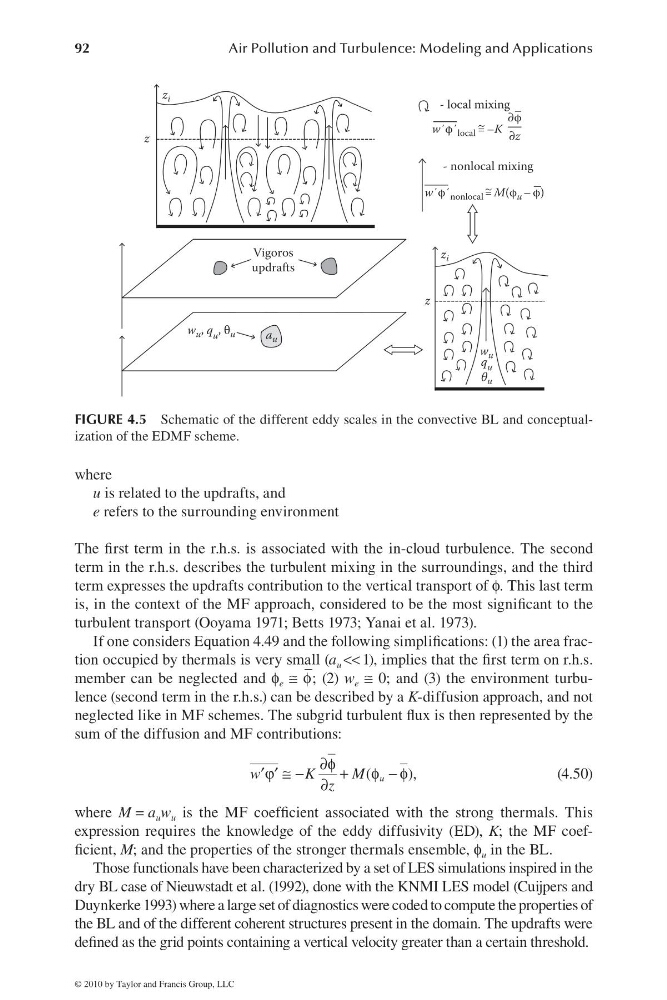
neglected like in MF schemes. The subgrid turbulent fl ux is then represented by the
sum of the diffusion and MF contributions:
(
),
u
w
K
M
z
∂φ
ϕ ≅ −
+ φ − φ
′ ′
∂
(4.50)
where M = a u w u is the MF coeffi cient associated with the strong thermals. This
expression requires the knowledge of the eddy diffusivity (ED), K; the MF coeffi cient, M; and the properties of the stronger thermals ensemble, φ u in the BL.
Those functionals have been characterized by a set of LES simulations inspired in the
dry BL case of Nieuwstadt et al. (1992), done with the KNMI LES model (Cuijpers and
Duynkerke 1993) where a large set of diagnostics were coded to compute the properties of
the BL and of the different coherent structures present in the domain. The updrafts were
defi ned as the grid points containing a vertical velocity greater than a certain threshold.
Vigoros
updrafts
a u
w u
z i
z
w u , q u , θ u
q u
θ u
z i
z
- local mixing
- nonlocal mixing
w΄φ΄ nonlocal = M(φ u – φ)
w΄φ΄ local = –K
∂φ
~
~
∂z
FIGURE 4.5 Schematic of the different eddy scales in the convective BL and conceptualization of the EDMF scheme.
© 2010 by Taylor and Francis Group, LLC
Air Pollution and Turbulence: Modeling and Applications
where
u is related to the updrafts, and
e refers to the surrounding environment
The fi rst term in the r.h.s. is associated with the in-cloud turbulence. The second
term in the r.h.s. describes the turbulent mixing in the surroundings, and the third
term expresses the updrafts contribution to the vertical transport of φ. This last term
is, in the context of the MF approach, considered to be the most signifi cant to the
turbulent transport (Ooyama 1971; Betts 1973; Yanai et al. 1973).
If one considers Equation 4.49 and the following simplifi cations: (1) the area fraction occupied by thermals is very small (a u << 1), implies that the fi rst term on r.h.s.
member can be neglected and φ e ≅ φ
–
; (2) w e ≅ 0; and (3) the environment turbulence (second term in the r.h.s.) can be described by a K-diffusion approach, and not
neglected like in MF schemes. The subgrid turbulent fl ux is then represented by the
sum of the diffusion and MF contributions:
(
),
u
w
K
M
z
∂φ
ϕ ≅ −
+ φ − φ
′ ′
∂
(4.50)
where M = a u w u is the MF coeffi cient associated with the strong thermals. This
expression requires the knowledge of the eddy diffusivity (ED), K; the MF coeffi cient, M; and the properties of the stronger thermals ensemble, φ u in the BL.
Those functionals have been characterized by a set of LES simulations inspired in the
dry BL case of Nieuwstadt et al. (1992), done with the KNMI LES model (Cuijpers and
Duynkerke 1993) where a large set of diagnostics were coded to compute the properties of
the BL and of the different coherent structures present in the domain. The updrafts were
defi ned as the grid points containing a vertical velocity greater than a certain threshold.
Vigoros
updrafts
a u
w u
z i
z
w u , q u , θ u
q u
θ u
z i
z
- local mixing
- nonlocal mixing
w΄φ΄ nonlocal = M(φ u – φ)
w΄φ΄ local = –K
∂φ
~
~
∂z
FIGURE 4.5 Schematic of the different eddy scales in the convective BL and conceptualization of the EDMF scheme.
© 2010 by Taylor and Francis Group, LLC