

90
Air Pollution and Turbulence: Modeling and Applications
to assume a constant lateral mixing with height is based on the fact that in a cumulus
ensemble there are cumulus with the tops at different heights, where the mixing
process is more relevant, and in the overall justify the constancy of the mixing rate.
Siebesma (1998) suggested that the lateral mixing rate of a cumulus ensemble may
be represented by the vertical distance to the cloud base, that is, ε ≈ 1/(z − z b ). On the
other hand, through a scale analysis, Nordeng (1994) proposed that ε ∝ 1/w c . Other
suggestions were developed to represent the lateral mixing (Grant and Brown 1999;
Lin 1999; Gregory 2001), but this issue is still in debate.
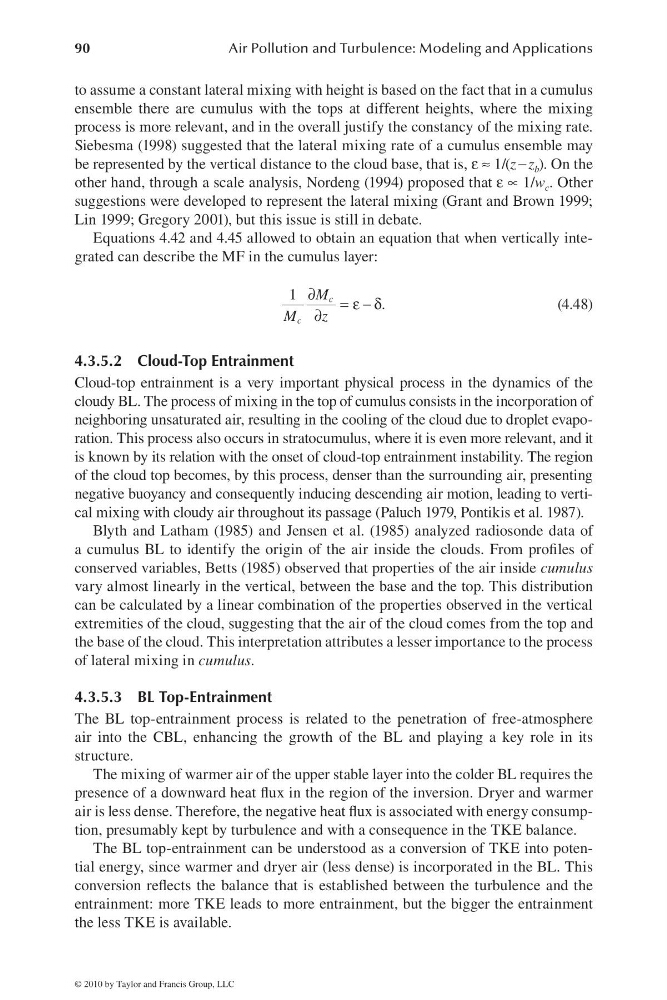
Equations 4.42 and 4.45 allowed to obtain an equation that when vertically integrated can describe the MF in the cumulus layer:
1
.
c
c
M
M
z
∂
= ε − δ
∂
(4.48)
4.3.5.2 Cloud-Top Entrainment
Cloud-top entrainment is a very important physical process in the dynamics of the
cloudy BL. The process of mixing in the top of cumulus consists in the incorporation of
neighboring unsaturated air, resulting in the cooling of the cloud due to droplet evaporation. This process also occurs in stratocumulus, where it is even more relevant, and it
is known by its relation with the onset of cloud-top entrainment instability. The region
of the cloud top becomes, by this process, denser than the surrounding air, presenting
negative buoyancy and consequently inducing descending air motion, leading to vertical mixing with cloudy air throughout its passage (Paluch 1979, Pontikis et al. 1987).
Blyth and Latham (1985) and Jensen et al. (1985) analyzed radiosonde data of
a cumulus BL to identify the origin of the air inside the clouds. From profi les of
conserved variables, Betts (1985) observed that properties of the air inside cumulus
vary almost linearly in the vertical, between the base and the top. This distribution
can be calculated by a linear combination of the properties observed in the vertical
extremities of the cloud, suggesting that the air of the cloud comes from the top and
the base of the cloud. This interpretation attributes a lesser importance to the process
of lateral mixing in cumulus.
4.3.5.3 BL Top-Entrainment
The BL top-entrainment process is related to the penetration of free-atmosphere
air into the CBL, enhancing the growth of the BL and playing a key role in its
structure.
The mixing of warmer air of the upper stable layer into the colder BL requires the
presence of a downward heat fl ux in the region of the inversion. Dryer and warmer
air is less dense. Therefore, the negative heat fl ux is associated with energy consumption, presumably kept by turbulence and with a consequence in the TKE balance.
The BL top-entrainment can be understood as a conversion of TKE into potential energy, since warmer and dryer air (less dense) is incorporated in the BL. This
conversion refl ects the balance that is established between the turbulence and the
entrainment: more TKE leads to more entrainment, but the bigger the entrainment
the less TKE is available.
© 2010 by Taylor and Francis Group, LLC
Air Pollution and Turbulence: Modeling and Applications
to assume a constant lateral mixing with height is based on the fact that in a cumulus
ensemble there are cumulus with the tops at different heights, where the mixing
process is more relevant, and in the overall justify the constancy of the mixing rate.
Siebesma (1998) suggested that the lateral mixing rate of a cumulus ensemble may
be represented by the vertical distance to the cloud base, that is, ε ≈ 1/(z − z b ). On the
other hand, through a scale analysis, Nordeng (1994) proposed that ε ∝ 1/w c . Other
suggestions were developed to represent the lateral mixing (Grant and Brown 1999;
Lin 1999; Gregory 2001), but this issue is still in debate.
Equations 4.42 and 4.45 allowed to obtain an equation that when vertically integrated can describe the MF in the cumulus layer:
1
.
c
c
M
M
z
∂
= ε − δ
∂
(4.48)
4.3.5.2 Cloud-Top Entrainment
Cloud-top entrainment is a very important physical process in the dynamics of the
cloudy BL. The process of mixing in the top of cumulus consists in the incorporation of
neighboring unsaturated air, resulting in the cooling of the cloud due to droplet evaporation. This process also occurs in stratocumulus, where it is even more relevant, and it
is known by its relation with the onset of cloud-top entrainment instability. The region
of the cloud top becomes, by this process, denser than the surrounding air, presenting
negative buoyancy and consequently inducing descending air motion, leading to vertical mixing with cloudy air throughout its passage (Paluch 1979, Pontikis et al. 1987).
Blyth and Latham (1985) and Jensen et al. (1985) analyzed radiosonde data of
a cumulus BL to identify the origin of the air inside the clouds. From profi les of
conserved variables, Betts (1985) observed that properties of the air inside cumulus
vary almost linearly in the vertical, between the base and the top. This distribution
can be calculated by a linear combination of the properties observed in the vertical
extremities of the cloud, suggesting that the air of the cloud comes from the top and
the base of the cloud. This interpretation attributes a lesser importance to the process
of lateral mixing in cumulus.
4.3.5.3 BL Top-Entrainment
The BL top-entrainment process is related to the penetration of free-atmosphere
air into the CBL, enhancing the growth of the BL and playing a key role in its
structure.
The mixing of warmer air of the upper stable layer into the colder BL requires the
presence of a downward heat fl ux in the region of the inversion. Dryer and warmer
air is less dense. Therefore, the negative heat fl ux is associated with energy consumption, presumably kept by turbulence and with a consequence in the TKE balance.
The BL top-entrainment can be understood as a conversion of TKE into potential energy, since warmer and dryer air (less dense) is incorporated in the BL. This
conversion refl ects the balance that is established between the turbulence and the
entrainment: more TKE leads to more entrainment, but the bigger the entrainment
the less TKE is available.
© 2010 by Taylor and Francis Group, LLC