

88
Air Pollution and Turbulence: Modeling and Applications
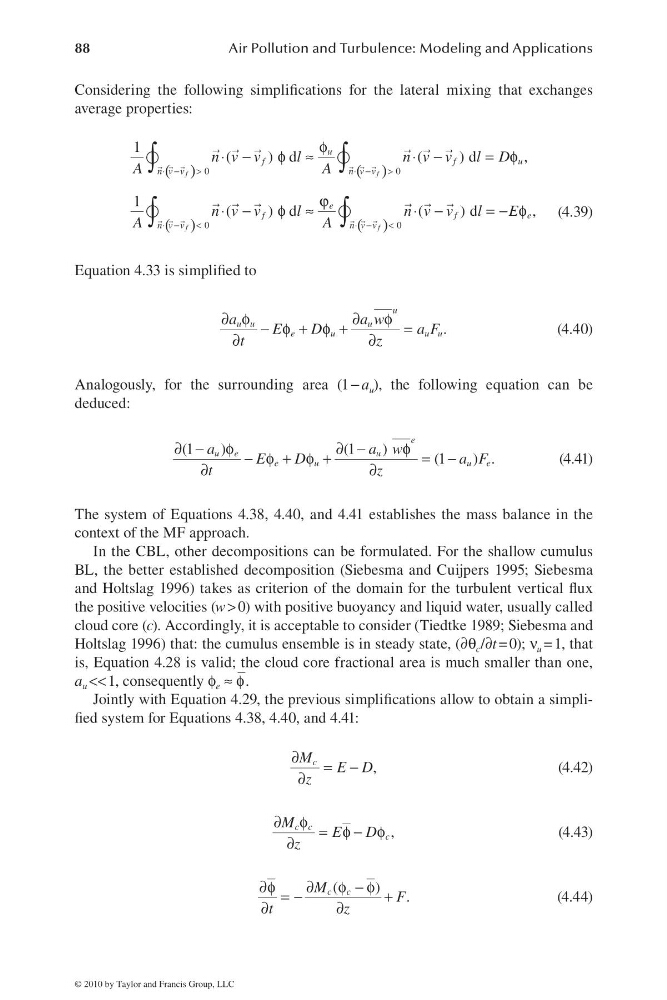
Considering the following simplifi cations for the lateral mixing that exchanges
average properties:
( )
( )
( )
( )
⋅ −
>
⋅ −
>
⋅ −
<
⋅ −
<
φ
⋅ −
φ ≈
⋅ −
= φ
ϕ
⋅ −
φ ≈
⋅ −
= − φ
∫
∫
∫
∫
0
0
0
0
1
(
) d
(
)d
,
1
(
) d
(
)d
,
f
f
f
f
u
f
f
u
n v v
n v v
e
f
f
e
n v v
n v v
n v v
l
n v v
l D
A
A
n v v
l
n v v
l
E
A
A
(4.39)
Equation 4.33 is simplifi ed to
.
u
u u
u
e
u
u u
a
a w
E
D
a F
t
z
∂ φ
∂
φ
− φ + φ +
=
∂
∂
(4.40)
Analogously, for the surrounding area (1 − a u ), the following equation can be
deduced:
(1
)
(1
)
(1
) .
e
u
e
u
e
u
u
e
a
aw
E
D
a F
t
z
∂ − φ
∂ −
φ
− φ + φ +
= −
∂
∂
(4.41)
The system of Equations 4.38, 4.40, and 4.41 establishes the mass balance in the
context of the MF approach.
In the CBL, other decompositions can be formulated. For the shallow cumulus
BL, the better established decomposition (Siebesma and Cuijpers 1995; Siebesma
and Holtslag 1996) takes as criterion of the domain for the turbulent vertical fl ux
the positive velocities (w > 0) with positive buoyancy and liquid water, usually called
cloud core (c). Accordingly, it is acceptable to consider (Tiedtke 1989; Siebesma and
Holtslag 1996) that: the cumulus ensemble is in steady state, (∂θ c /∂t = 0); ν u = 1, that
is, Equation 4.28 is valid; the cloud core fractional area is much smaller than one,
a u << 1, consequently φ e ≈ φ
– .
Jointly with Equation 4.29, the previous simplifi cations allow to obtain a simplifi ed system for Equations 4.38, 4.40, and 4.41:
,
c
M
E D
z
∂
= −
∂
(4.42)
,
c c
c
M
E
D
z
∂ φ = φ − φ
∂
(4.43)
(
)
.
c
c
M
F
t
z
∂φ
∂
φ − φ
= −
+
∂
∂
(4.44)
© 2010 by Taylor and Francis Group, LLC
Air Pollution and Turbulence: Modeling and Applications
Considering the following simplifi cations for the lateral mixing that exchanges
average properties:
( )
( )
( )
( )
⋅ −
>
⋅ −
>
⋅ −
<
⋅ −
<
φ
⋅ −
φ ≈
⋅ −
= φ
ϕ
⋅ −
φ ≈
⋅ −
= − φ
∫
∫
∫
∫
0
0
0
0
1
(
) d
(
)d
,
1
(
) d
(
)d
,
f
f
f
f
u
f
f
u
n v v
n v v
e
f
f
e
n v v
n v v
n v v
l
n v v
l D
A
A
n v v
l
n v v
l
E
A
A
(4.39)
Equation 4.33 is simplifi ed to
.
u
u u
u
e
u
u u
a
a w
E
D
a F
t
z
∂ φ
∂
φ
− φ + φ +
=
∂
∂
(4.40)
Analogously, for the surrounding area (1 − a u ), the following equation can be
deduced:
(1
)
(1
)
(1
) .
e
u
e
u
e
u
u
e
a
aw
E
D
a F
t
z
∂ − φ
∂ −
φ
− φ + φ +
= −
∂
∂
(4.41)
The system of Equations 4.38, 4.40, and 4.41 establishes the mass balance in the
context of the MF approach.
In the CBL, other decompositions can be formulated. For the shallow cumulus
BL, the better established decomposition (Siebesma and Cuijpers 1995; Siebesma
and Holtslag 1996) takes as criterion of the domain for the turbulent vertical fl ux
the positive velocities (w > 0) with positive buoyancy and liquid water, usually called
cloud core (c). Accordingly, it is acceptable to consider (Tiedtke 1989; Siebesma and
Holtslag 1996) that: the cumulus ensemble is in steady state, (∂θ c /∂t = 0); ν u = 1, that
is, Equation 4.28 is valid; the cloud core fractional area is much smaller than one,
a u << 1, consequently φ e ≈ φ
– .
Jointly with Equation 4.29, the previous simplifi cations allow to obtain a simplifi ed system for Equations 4.38, 4.40, and 4.41:
,
c
M
E D
z
∂
= −
∂
(4.42)
,
c c
c
M
E
D
z
∂ φ = φ − φ
∂
(4.43)
(
)
.
c
c
M
F
t
z
∂φ
∂
φ − φ
= −
+
∂
∂
(4.44)
© 2010 by Taylor and Francis Group, LLC