

Parameterization of Convective Boundary Layer Turbulence and Clouds
83
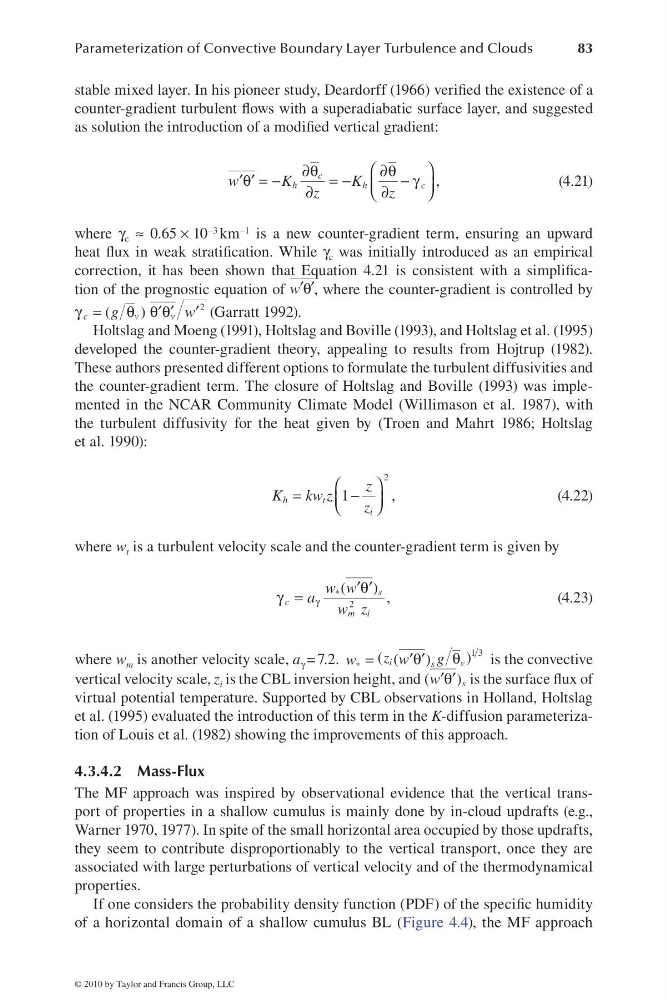
stable mixed layer. In his pioneer study, Deardorff (1966) verifi ed the existence of a
counter-gradient turbulent fl ows with a superadiabatic surface layer, and suggested
as solution the introduction of a modifi ed vertical gradient:
,
c
h
h
c
w
K
K
z
z
⎛
⎞
∂θ
∂θ
θ = −
= −
− γ
′ ′
⎜
⎟
∂
∂
⎝
⎠
(4.21)
where γ c ≈ 0.65 × 10 −3 km −1 is a new counter-gradient term, ensuring an upward
heat fl ux in weak stratifi cation. While γ c was initially introduced as an empirical
correction, it has been shown that Equation 4.21 is consistent with a simplifi cation of the prognostic equation of w′ ′
θ , where the counter-gradient is controlled by
2
(
)
c
v
v
g
w
γ =
θ θ θ
′ ′ ′ (Garratt 1992).
Holtslag and Moeng (1991), Holtslag and Boville (1993), and Holtslag et al. (1995)
developed the counter-gradient theory, appealing to results from Hojtrup (1982).
These authors presented different options to formulate the turbulent diffusivities and
the counter-gradient term. The closure of Holtslag and Boville (1993) was implemented in the NCAR Community Climate Model (Willimason et al. 1987), with
the turbulent diffusivity for the heat given by (Troen and Mahrt 1986; Holtslag
et al. 1990):
2
1
,
h
t
i
z
K
kwz
z
⎛
⎞
=
−
⎜
⎟
⎝
⎠
(4.22)
where w t is a turbulent velocity scale and the counter-gradient term is given by
2
(
) ,
s
c
m i
w w
a
w z
∗
γ
θ
′ ′
γ =
(4.23)
where w m is another velocity scale, a γ = 7.2.
1 3
(
)
(
)
i
v
s
z
g
w
w ∗
θ
θ
′ ′
=
is the convective
vertical velocity scale, z i is the CBL inversion height, and (
) s
w θ
′ ′ is the surface fl ux of
virtual potential temperature. Supported by CBL observations in Holland, Holtslag
et al. (1995) evaluated the introduction of this term in the K-diffusion parameterization of Louis et al. (1982) showing the improvements of this approach.
4.3.4.2 Mass-Flux
The MF approach was inspired by observational evidence that the vertical transport of properties in a shallow cumulus is mainly done by in-cloud updrafts (e.g.,
Warner 1970, 1977). In spite of the small horizontal area occupied by those updrafts,
they seem to contribute disproportionably to the vertical transport, once they are
associated with large perturbations of vertical velocity and of the thermodynamical
properties.
If one considers the probability density function (PDF) of the specifi c humidity
of a horizontal domain of a shallow cumulus BL (Figure 4.4), the MF approach
© 2010 by Taylor and Francis Group, LLC
83
stable mixed layer. In his pioneer study, Deardorff (1966) verifi ed the existence of a
counter-gradient turbulent fl ows with a superadiabatic surface layer, and suggested
as solution the introduction of a modifi ed vertical gradient:
,
c
h
h
c
w
K
K
z
z
⎛
⎞
∂θ
∂θ
θ = −
= −
− γ
′ ′
⎜
⎟
∂
∂
⎝
⎠
(4.21)
where γ c ≈ 0.65 × 10 −3 km −1 is a new counter-gradient term, ensuring an upward
heat fl ux in weak stratifi cation. While γ c was initially introduced as an empirical
correction, it has been shown that Equation 4.21 is consistent with a simplifi cation of the prognostic equation of w′ ′
θ , where the counter-gradient is controlled by
2
(
)
c
v
v
g
w
γ =
θ θ θ
′ ′ ′ (Garratt 1992).
Holtslag and Moeng (1991), Holtslag and Boville (1993), and Holtslag et al. (1995)
developed the counter-gradient theory, appealing to results from Hojtrup (1982).
These authors presented different options to formulate the turbulent diffusivities and
the counter-gradient term. The closure of Holtslag and Boville (1993) was implemented in the NCAR Community Climate Model (Willimason et al. 1987), with
the turbulent diffusivity for the heat given by (Troen and Mahrt 1986; Holtslag
et al. 1990):
2
1
,
h
t
i
z
K
kwz
z
⎛
⎞
=
−
⎜
⎟
⎝
⎠
(4.22)
where w t is a turbulent velocity scale and the counter-gradient term is given by
2
(
) ,
s
c
m i
w w
a
w z
∗
γ
θ
′ ′
γ =
(4.23)
where w m is another velocity scale, a γ = 7.2.
1 3
(
)
(
)
i
v
s
z
g
w
w ∗
θ
θ
′ ′
=
is the convective
vertical velocity scale, z i is the CBL inversion height, and (
) s
w θ
′ ′ is the surface fl ux of
virtual potential temperature. Supported by CBL observations in Holland, Holtslag
et al. (1995) evaluated the introduction of this term in the K-diffusion parameterization of Louis et al. (1982) showing the improvements of this approach.
4.3.4.2 Mass-Flux
The MF approach was inspired by observational evidence that the vertical transport of properties in a shallow cumulus is mainly done by in-cloud updrafts (e.g.,
Warner 1970, 1977). In spite of the small horizontal area occupied by those updrafts,
they seem to contribute disproportionably to the vertical transport, once they are
associated with large perturbations of vertical velocity and of the thermodynamical
properties.
If one considers the probability density function (PDF) of the specifi c humidity
of a horizontal domain of a shallow cumulus BL (Figure 4.4), the MF approach
© 2010 by Taylor and Francis Group, LLC