

84
Fumio Matsumura
phosphates. This is analogous to the activation process by higher organisms to
give more toxic (= antichlorergic potency) products (Grumwell and Erickson,
1973).
Pyretbroids are known to undergo photooxidative reactions (e.g., Tweedy
et at., 1970), although in this case the reactions are complex and one can only
guess the nature of the reactions involved by the products formed, e.g., benzaldehyde, benzoic acid, and 5-hydroxy-3-oxo-4-phenyl-l-cyclopentenyl methanol, from resmethrin.
Pyridines are also known to go through oxidative transformation. For instance, diquat and paraquat give a carbonyl and carboxylic acid, respectively,
as a result of photoxidation. It must be pointed out here that many of the reaction
products of biological oxidation, such as epoxides for cycladienes, N-oxides for
amines, sulfoxides, and sulfones from sulfides, have not been observed among
photolytic products.
3.5.4. Isomerization and Polymerization
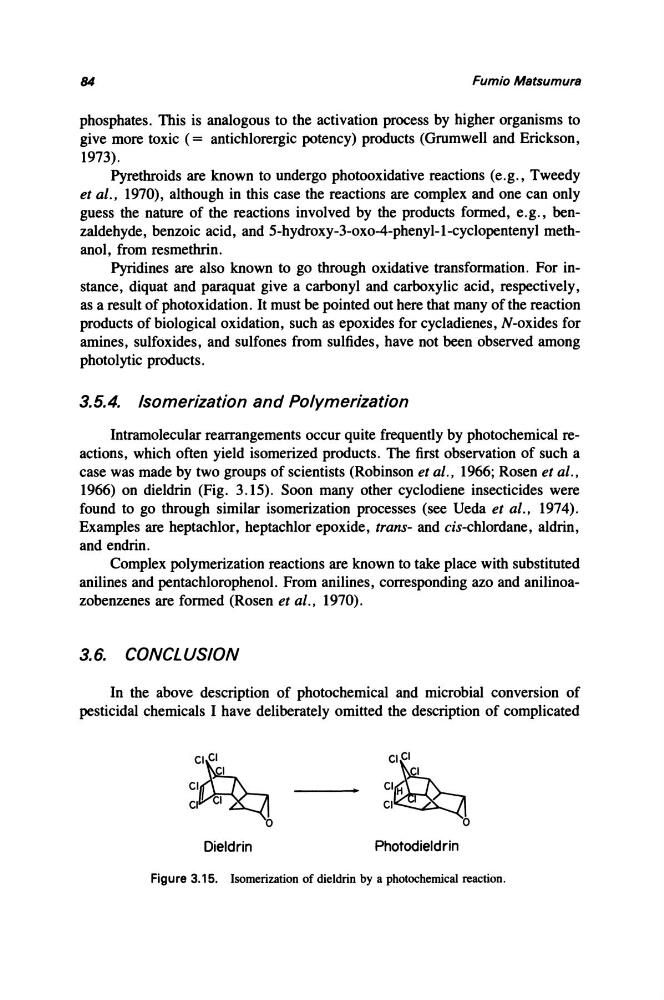
Intramolecular rearrangements occur quite frequently by photochemical reactions, which often yield isomerized products. The first observation of such a
case was made by two groups of scientists (Robinson et at., 1966; Rosen et at.,
1966) on dieldrin (Fig. 3.15). Soon many other cyclodiene insecticides were
found to go through similar isomerization processes (see Veda et at., 1974).
Examples are heptachlor, heptachlor epoxide, trans- and cis-chlordane, aldrin,
and endrin.
Complex polymerization reactions are known to take place with substituted
anilines and pentachlorophenol. From anilines, corresponding azo and anilinoazobenzenes are formed (Rosen et at., 1970).
3.6. CONCLUSION
In the above description of photochemical and microbial conversion of
pesticidal chemicals I have deliberately omitted the description of complicated
C~CI CI
CI
CI CI
o
C~ICI CI
CI H
CI
o
Dieldrin
Photodieldrin
Figure 3.15. Isomerization of dieldrin by a photochemical reaction.
Fumio Matsumura
phosphates. This is analogous to the activation process by higher organisms to
give more toxic (= antichlorergic potency) products (Grumwell and Erickson,
1973).
Pyretbroids are known to undergo photooxidative reactions (e.g., Tweedy
et at., 1970), although in this case the reactions are complex and one can only
guess the nature of the reactions involved by the products formed, e.g., benzaldehyde, benzoic acid, and 5-hydroxy-3-oxo-4-phenyl-l-cyclopentenyl methanol, from resmethrin.
Pyridines are also known to go through oxidative transformation. For instance, diquat and paraquat give a carbonyl and carboxylic acid, respectively,
as a result of photoxidation. It must be pointed out here that many of the reaction
products of biological oxidation, such as epoxides for cycladienes, N-oxides for
amines, sulfoxides, and sulfones from sulfides, have not been observed among
photolytic products.
3.5.4. Isomerization and Polymerization
Intramolecular rearrangements occur quite frequently by photochemical reactions, which often yield isomerized products. The first observation of such a
case was made by two groups of scientists (Robinson et at., 1966; Rosen et at.,
1966) on dieldrin (Fig. 3.15). Soon many other cyclodiene insecticides were
found to go through similar isomerization processes (see Veda et at., 1974).
Examples are heptachlor, heptachlor epoxide, trans- and cis-chlordane, aldrin,
and endrin.
Complex polymerization reactions are known to take place with substituted
anilines and pentachlorophenol. From anilines, corresponding azo and anilinoazobenzenes are formed (Rosen et at., 1970).
3.6. CONCLUSION
In the above description of photochemical and microbial conversion of
pesticidal chemicals I have deliberately omitted the description of complicated
C~CI CI
CI
CI CI
o
C~ICI CI
CI H
CI
o
Dieldrin
Photodieldrin
Figure 3.15. Isomerization of dieldrin by a photochemical reaction.