

Degradation of Pesticides in the Environment
71
sources such as glucose, which should increase their general metabolic activities.
Thus one could control the rate of microbial metabolism by changing the amounts
of either pesticide or other carbon sources added, depending upon the types of
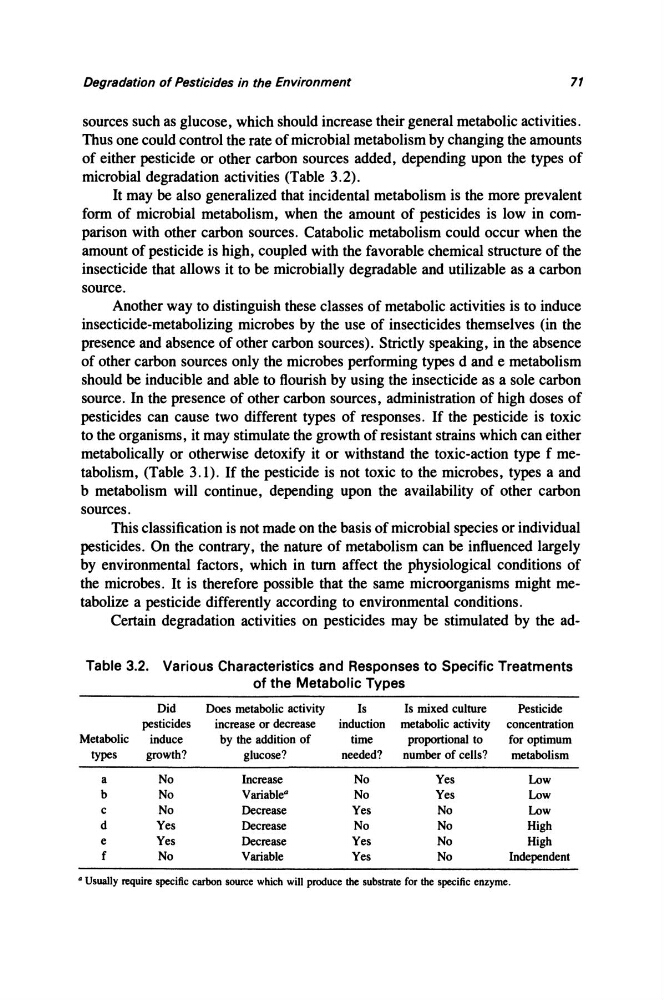
microbial degradation activities (Table 3.2).
It may be also generalized that incidental metabolism is the more prevalent
form of microbial metabolism, when the amount of pesticides is low in comparison with other carbon sources. Catabolic metabolism could occur when the
amount of pesticide is high, coupled with the favorable chemical structure of the
insecticide that allows it to be microbially degradable and utilizable as a carbon
source.
Another way to distinguish these classes of metabolic activities is to induce
insecticide-metabolizing microbes by the use of insecticides themselves (in the
presence and absence of other carbon sources). Strictly speaking, in the absence
of other carbon sources only the microbes performing types d and e metabolism
should be inducible and able to flourish by using the insecticide as a sole carbon
source. In the presence of other carbon sources, administration of high doses of
pesticides can cause two different types of responses. If the pesticide is toxic
to the organisms, it may stimulate the growth of resistant strains which can either
metabolically or otherwise detoxify it or withstand the toxic-action type f metabolism, (Table 3.1). If the pesticide is not toxic to the microbes, types a and
b metabolism will continue, depending upon the availability of other carbon
sources.
This classification is not made on the basis of microbial species or individual
pesticides. On the contrary, the nature of metabolism can be influenced largely
by environmental factors, which in tum affect the physiological conditions of
the microbes. It is therefore possible that the same microorganisms might metabolize a pesticide differently according to environmental conditions.
Certain degradation activities on pesticides may be stimulated by the adTable 3.2. Various Characteristics and Responses to Specific Treatments
of the Metabolic Types
Did
Does metabolic activity
Is
Is mixed culture
Pesticide
pesticides
increase or decrease
induction metabolic activity concentration
Metabolic
induce
by the addition of
time
proportional to
for optimum
types
growth?
glucose?
needed?
number of cells?
metabolism
a
No
Increase
No
Yes
Low
b
No
Variable·
No
Yes
Low
c
No
Decrease
Yes
No
Low
d
Yes
Decrease
No
No
High
e
Yes
Decrease
Yes
No
High
f
No
Variable
Yes
No
Independent
• Usually require specific carbon source which will produce the substrate for the specific enzyme.
71
sources such as glucose, which should increase their general metabolic activities.
Thus one could control the rate of microbial metabolism by changing the amounts
of either pesticide or other carbon sources added, depending upon the types of
microbial degradation activities (Table 3.2).
It may be also generalized that incidental metabolism is the more prevalent
form of microbial metabolism, when the amount of pesticides is low in comparison with other carbon sources. Catabolic metabolism could occur when the
amount of pesticide is high, coupled with the favorable chemical structure of the
insecticide that allows it to be microbially degradable and utilizable as a carbon
source.
Another way to distinguish these classes of metabolic activities is to induce
insecticide-metabolizing microbes by the use of insecticides themselves (in the
presence and absence of other carbon sources). Strictly speaking, in the absence
of other carbon sources only the microbes performing types d and e metabolism
should be inducible and able to flourish by using the insecticide as a sole carbon
source. In the presence of other carbon sources, administration of high doses of
pesticides can cause two different types of responses. If the pesticide is toxic
to the organisms, it may stimulate the growth of resistant strains which can either
metabolically or otherwise detoxify it or withstand the toxic-action type f metabolism, (Table 3.1). If the pesticide is not toxic to the microbes, types a and
b metabolism will continue, depending upon the availability of other carbon
sources.
This classification is not made on the basis of microbial species or individual
pesticides. On the contrary, the nature of metabolism can be influenced largely
by environmental factors, which in tum affect the physiological conditions of
the microbes. It is therefore possible that the same microorganisms might metabolize a pesticide differently according to environmental conditions.
Certain degradation activities on pesticides may be stimulated by the adTable 3.2. Various Characteristics and Responses to Specific Treatments
of the Metabolic Types
Did
Does metabolic activity
Is
Is mixed culture
Pesticide
pesticides
increase or decrease
induction metabolic activity concentration
Metabolic
induce
by the addition of
time
proportional to
for optimum
types
growth?
glucose?
needed?
number of cells?
metabolism
a
No
Increase
No
Yes
Low
b
No
Variable·
No
Yes
Low
c
No
Decrease
Yes
No
Low
d
Yes
Decrease
No
No
High
e
Yes
Decrease
Yes
No
High
f
No
Variable
Yes
No
Independent
• Usually require specific carbon source which will produce the substrate for the specific enzyme.