

30
Richard H. Shimabukuro et al.
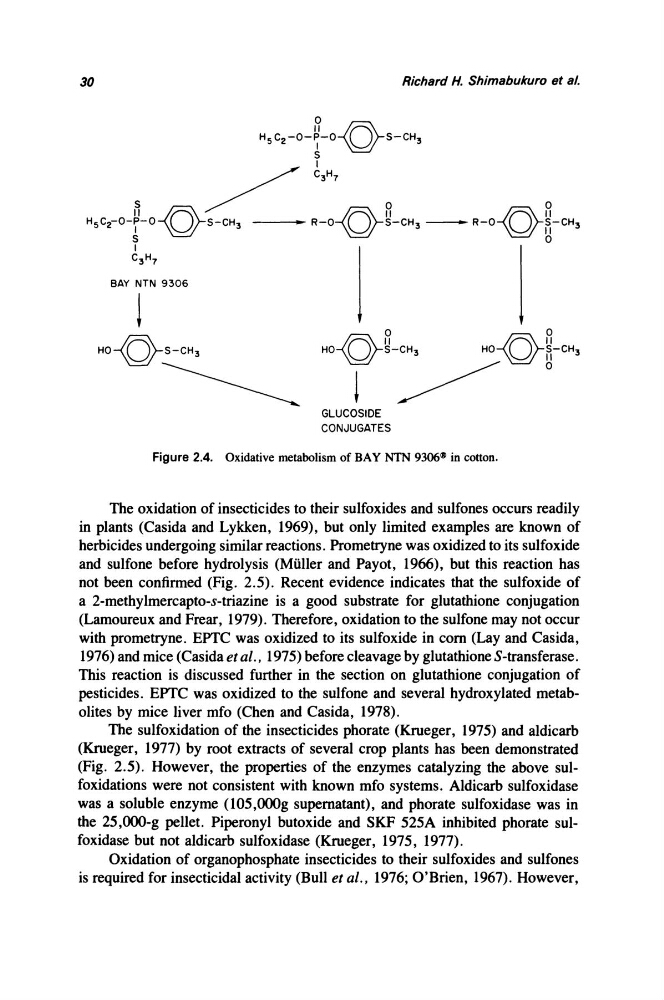
BAY NTN 9306
Figure 2.4. Oxidative metabolism of BAY NTN 9306® in cotton.
The oxidation of insecticides to their sulfoxides and sulfones occurs readily
in plants (Casida and Lykken, 1969), but only limited examples are known of
herbicides undergoing similar reactions. Prometryne was oxidized to its sulfoxide
and sulfone before hydrolysis (Miiller and Payot, 1966), but this reaction has
not been confirmed (Fig. 2.5). Recent evidence indicates that the sulfoxide of
a 2-methylmercapto-s-triazine is a good substrate for glutathione conjugation
(Lamoureux and Frear, 1979). Therefore, oxidation to the sulfone may not occur
with prometryne. EPTC was oxidized to its sulfoxide in com (Lay and Casida,
1976) and mice (Casida et al., 1975) before cleavage by glutathione S-transferase.
This reaction is discussed further in the section on glutathione conjugation of
pesticides. EPTC was oxidized to the sulfone and several hydroxylated metabolites by mice liver mfo (Chen and Casida, 1978).
The sulfoxidation of the insecticides phorate (Krueger, 1975) and aldicarb
(Krueger, 1977) by root extracts of several crop plants has been demonstrated
(Fig. 2.5). However, the properties of the enzymes catalyzing the above sulfoxidations were not consistent with known mfo systems. Aldicarb sulfoxidase
was a soluble enzyme (105,OOOg supernatant), and phorate sulfoxidase was in
the 25,OOO-g pellet. Piperonyl butoxide and SKF 525A inhibited phorate sulfoxidase but not aldicarb sulfoxidase (Krueger, 1975, 1977).
Oxidation of organophosphate insecticides to their sulfoxides and sulfones
is required for insecticidal activity (Bull et al., 1976; O'Brien, 1967). However,
Richard H. Shimabukuro et al.
BAY NTN 9306
Figure 2.4. Oxidative metabolism of BAY NTN 9306® in cotton.
The oxidation of insecticides to their sulfoxides and sulfones occurs readily
in plants (Casida and Lykken, 1969), but only limited examples are known of
herbicides undergoing similar reactions. Prometryne was oxidized to its sulfoxide
and sulfone before hydrolysis (Miiller and Payot, 1966), but this reaction has
not been confirmed (Fig. 2.5). Recent evidence indicates that the sulfoxide of
a 2-methylmercapto-s-triazine is a good substrate for glutathione conjugation
(Lamoureux and Frear, 1979). Therefore, oxidation to the sulfone may not occur
with prometryne. EPTC was oxidized to its sulfoxide in com (Lay and Casida,
1976) and mice (Casida et al., 1975) before cleavage by glutathione S-transferase.
This reaction is discussed further in the section on glutathione conjugation of
pesticides. EPTC was oxidized to the sulfone and several hydroxylated metabolites by mice liver mfo (Chen and Casida, 1978).
The sulfoxidation of the insecticides phorate (Krueger, 1975) and aldicarb
(Krueger, 1977) by root extracts of several crop plants has been demonstrated
(Fig. 2.5). However, the properties of the enzymes catalyzing the above sulfoxidations were not consistent with known mfo systems. Aldicarb sulfoxidase
was a soluble enzyme (105,OOOg supernatant), and phorate sulfoxidase was in
the 25,OOO-g pellet. Piperonyl butoxide and SKF 525A inhibited phorate sulfoxidase but not aldicarb sulfoxidase (Krueger, 1975, 1977).
Oxidation of organophosphate insecticides to their sulfoxides and sulfones
is required for insecticidal activity (Bull et al., 1976; O'Brien, 1967). However,