

Pesticides for Stored Products
245
malathion was imported into the U.S. in 1972. It is estimated that 3.6 million
kg A.1. of the U.S. stock was exported during that year.
Malathion has been widely used in food processing, packaging, and distribution establishments. In the north central U.S., where its major use is for
protection of food and feed grains, it is estimated that 0.5 million kg was used
in 1972 by industrial and commercial organization.
The U.S. producer of malathion is American Cyanamid. Its manufacture
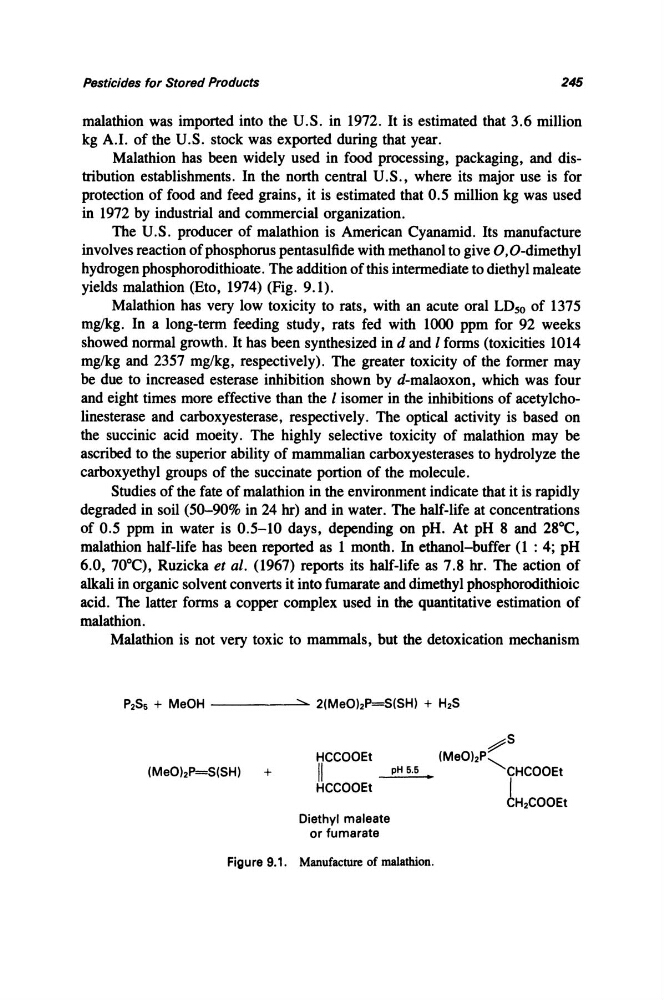
involves reaction of phosphorus pentasul6de with methanol to give O,O-dimethyl
hydrogen phosphorodithioate. The addition of this intermediate to diethyl maleate
yields malathion (Eto, 1974) (Fig. 9.1).
Malathion has very low toxicity to rats, with an acute oral LDso of 1375
mg/kg. In a long-term feeding study, rats fed with 1000 ppm for 92 weeks
showed normal growth. It has been synthesized in d and I forms (toxicities 1014
mglkg and 2357 mg/kg, respectively). The greater toxicity of the former may
be due to increased esterase inhibition shown by d-malaoxon, which was four
and eight times more effective than the I isomer in the inhibitions of acetylcholinesterase and carboxyesterase, respectively. The optical activity is based on
the succinic acid moeity. The highly selective toxicity of malathion may be
ascribed to the superior ability of mammalian carboxyesterases to hydrolyze the
carboxyethyl groups of the succinate portion of the molecule.
Studies of the fate of malathion in the environment indicate that it is rapidly
degraded in soil (50-90% in 24 hr) and in water. The half-life at concentrations
of 0.5 ppm in water is 0.5-10 days, depending on pH. At pH 8 and 28°C,
malathion half-life has been reported as 1 month. In ethanol-buffer (1 : 4; pH
6.0, 70°C), Ruzicka et al. (1967) reports its half-life as 7.8 hr. The action of
alkali in organic solvent converts it into fumarate and dimethyl phosphorodithioic
acid. The latter forms a copper complex used in the quantitative estimation of
malathion.
Malathion is not very toxic to mammals, but the detoxication mechanism
(MeOhP=S(SH)
+
HCCOOEt
II
pH 5.5
HCCOOEt
Diethyl maleate
or fumarate
Figure 9.1. Manufacture of malathion.
~S
(MeOhP"
CHCOOEt
6H2COOEt
245
malathion was imported into the U.S. in 1972. It is estimated that 3.6 million
kg A.1. of the U.S. stock was exported during that year.
Malathion has been widely used in food processing, packaging, and distribution establishments. In the north central U.S., where its major use is for
protection of food and feed grains, it is estimated that 0.5 million kg was used
in 1972 by industrial and commercial organization.
The U.S. producer of malathion is American Cyanamid. Its manufacture
involves reaction of phosphorus pentasul6de with methanol to give O,O-dimethyl
hydrogen phosphorodithioate. The addition of this intermediate to diethyl maleate
yields malathion (Eto, 1974) (Fig. 9.1).
Malathion has very low toxicity to rats, with an acute oral LDso of 1375
mg/kg. In a long-term feeding study, rats fed with 1000 ppm for 92 weeks
showed normal growth. It has been synthesized in d and I forms (toxicities 1014
mglkg and 2357 mg/kg, respectively). The greater toxicity of the former may
be due to increased esterase inhibition shown by d-malaoxon, which was four
and eight times more effective than the I isomer in the inhibitions of acetylcholinesterase and carboxyesterase, respectively. The optical activity is based on
the succinic acid moeity. The highly selective toxicity of malathion may be
ascribed to the superior ability of mammalian carboxyesterases to hydrolyze the
carboxyethyl groups of the succinate portion of the molecule.
Studies of the fate of malathion in the environment indicate that it is rapidly
degraded in soil (50-90% in 24 hr) and in water. The half-life at concentrations
of 0.5 ppm in water is 0.5-10 days, depending on pH. At pH 8 and 28°C,
malathion half-life has been reported as 1 month. In ethanol-buffer (1 : 4; pH
6.0, 70°C), Ruzicka et al. (1967) reports its half-life as 7.8 hr. The action of
alkali in organic solvent converts it into fumarate and dimethyl phosphorodithioic
acid. The latter forms a copper complex used in the quantitative estimation of
malathion.
Malathion is not very toxic to mammals, but the detoxication mechanism
(MeOhP=S(SH)
+
HCCOOEt
II
pH 5.5
HCCOOEt
Diethyl maleate
or fumarate
Figure 9.1. Manufacture of malathion.
~S
(MeOhP"
CHCOOEt
6H2COOEt