

Pesticides for Stored Products
241
9.2. FUMIGANTS
Few chemicals are suitable for use as fumigants because of the stringent
criteria that must be met. Fumigants must be biologically active and control pest
species without phytotoxicity or damage to the substrate. They should be sufficiently volatile to diffuse rapidly into the substrate. They should not be adsorbed, and they should be rapidly removed by aeration. They should not be
flammable. They should not react with metals. They should leave no residues
that are hazardous to man or animals consuming the substrate. They should not
adversely affect the nutritional quality, flavor, or processing characteristics of
the substrate. It can easily be seen that no chemical behaves adequately with
respect to each of the categories of desirable properties. The principal fumigants
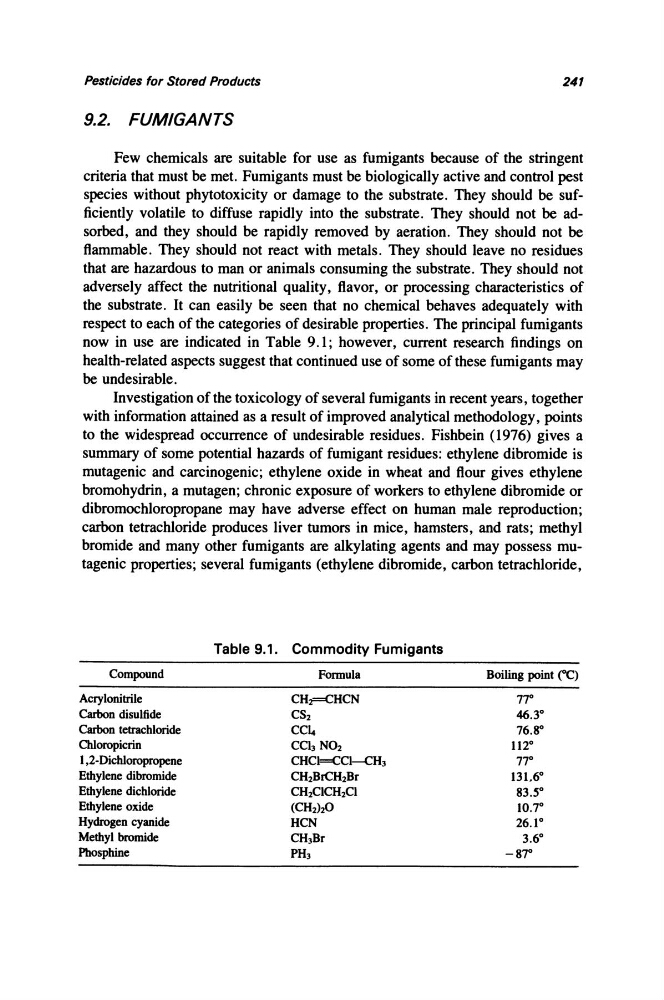
now in use are indicated in Table 9.1; however, current research findings on
health-related aspects suggest that continued use of some of these fumigants may
be undesirable.
Investigation of the toxicology of several fumigants in recent years, together
with information attained as a result of improved analytical methodology, points
to the widespread occurrence of undesirable residues. Fishbein (1976) gives a
summary of some potential hazards of fumigant residues: ethylene dibromide is
mutagenic and carcinogenic; ethylene oxide in wheat and flour gives ethylene
bromohydrin, a mutagen; chronic exposure of workers to ethylene dibromide or
dibromochloropropane may have adverse effect on human male reproduction;
carbon tetrachloride produces liver tumors in mice, hamsters, and rats; methyl
bromide and many other fumigants are alkylating agents and may possess mutagenic properties; several fumigants (ethylene dibromide, carbon tetrachloride,
Table 9.1. Commodity Fumigants
Compound
Fonnula
Boiling point fC)
Acrylonitrile
CH:z=CHCN
77"
Carbon disulfide
CS2
46.3°
Carbon tetrachloride
CCL.
76.8°
Chloropicrin
CCh N02
112°
1,2-Dichloropropene
CHCl=CCI-CH3
77°
Ethylene dibromide
CH2BrCH2Br
131.6°
Ethylene dichloride
CH2CICH2Cl
83's"
Ethylene oxide
(CH2hO
10.7°
Hydrogen cyanide
HCN
26.1°
Methyl bromide
CH3Br
3.6°
Phosphine
PH3
-87"
241
9.2. FUMIGANTS
Few chemicals are suitable for use as fumigants because of the stringent
criteria that must be met. Fumigants must be biologically active and control pest
species without phytotoxicity or damage to the substrate. They should be sufficiently volatile to diffuse rapidly into the substrate. They should not be adsorbed, and they should be rapidly removed by aeration. They should not be
flammable. They should not react with metals. They should leave no residues
that are hazardous to man or animals consuming the substrate. They should not
adversely affect the nutritional quality, flavor, or processing characteristics of
the substrate. It can easily be seen that no chemical behaves adequately with
respect to each of the categories of desirable properties. The principal fumigants
now in use are indicated in Table 9.1; however, current research findings on
health-related aspects suggest that continued use of some of these fumigants may
be undesirable.
Investigation of the toxicology of several fumigants in recent years, together
with information attained as a result of improved analytical methodology, points
to the widespread occurrence of undesirable residues. Fishbein (1976) gives a
summary of some potential hazards of fumigant residues: ethylene dibromide is
mutagenic and carcinogenic; ethylene oxide in wheat and flour gives ethylene
bromohydrin, a mutagen; chronic exposure of workers to ethylene dibromide or
dibromochloropropane may have adverse effect on human male reproduction;
carbon tetrachloride produces liver tumors in mice, hamsters, and rats; methyl
bromide and many other fumigants are alkylating agents and may possess mutagenic properties; several fumigants (ethylene dibromide, carbon tetrachloride,
Table 9.1. Commodity Fumigants
Compound
Fonnula
Boiling point fC)
Acrylonitrile
CH:z=CHCN
77"
Carbon disulfide
CS2
46.3°
Carbon tetrachloride
CCL.
76.8°
Chloropicrin
CCh N02
112°
1,2-Dichloropropene
CHCl=CCI-CH3
77°
Ethylene dibromide
CH2BrCH2Br
131.6°
Ethylene dichloride
CH2CICH2Cl
83's"
Ethylene oxide
(CH2hO
10.7°
Hydrogen cyanide
HCN
26.1°
Methyl bromide
CH3Br
3.6°
Phosphine
PH3
-87"