

Biodegradable Pesticides in Public Health Entomology
223
27 days of C. tarsalis and An. franciscanus from ponds treated at 0.0025 lb/
acre.
The general pattern of activity of IGRs against nontarget organisms has
been that a few nontarget populations show temporary reductions but soon recover
after treatment ceases. A number of investigators have studied the acute effects
ofmethoprene on nontarget aquatic organisms, with, in some cases, contradictory
conclusions (Breaud et al., 1977; Dunn et al., 1974; Miura and Takahashi, 1973;
Norland and Mulla, 1975; Schaefer etal., 1974; Steelman etal., 1975; Takahashi
and Miura, 1975). This is due in part to differences in species, water conditions,
formulation, and dosage rate, but Steelman et al. (1975) have pointed to the
importance of long-term evaluations of toxicity because of the long life cycles
of some nontarget organisms and the nature of the mechanisms of action of
IGRs. In evaluations of methoprene and three other IGRs made 80 days posttreatment in rice fields, they found significant reductions (P < 0.01) in Tropisternus ssp. adults (Coleoptera) and dragonfly immatures, a finding contrary to
previous reports by other investigators. Tropisternus larvae were in the fields at
the time of treatment and mortality probably occurred at a larval molt. They
found no significant reductions (P > 0.05) in Notonecta adults at application
rates as high as 0.25 lb/acre.
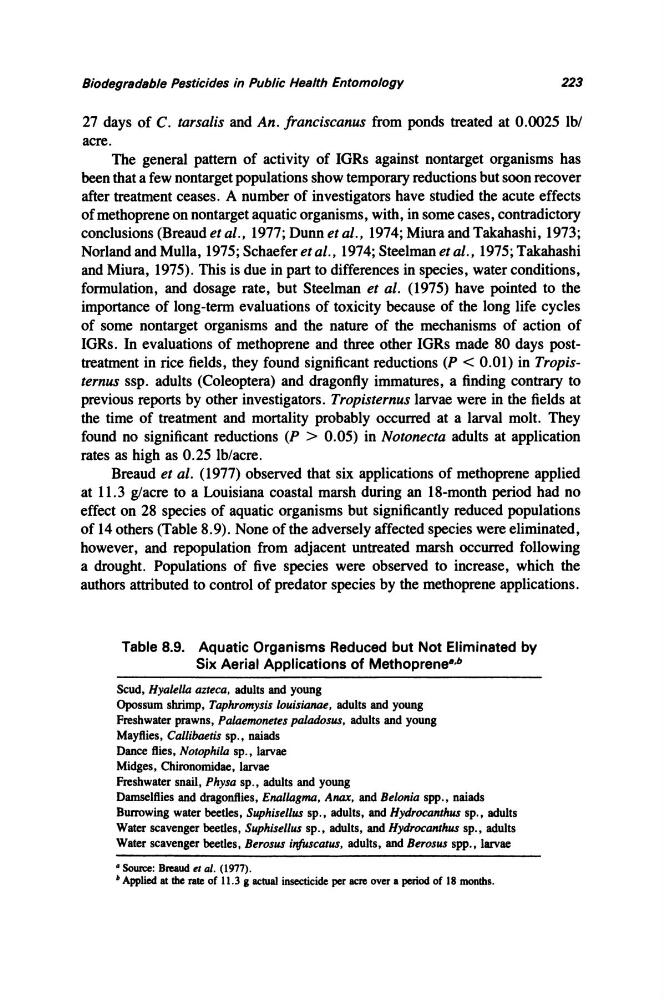
Breaud et al. (1977) observed that six applications of methoprene applied
at 11.3 glacre to a Louisiana coastal marsh during an 18-month period had no
effect on 28 species of aquatic organisms but significantly reduced populations
of 14 others (Table 8.9). None of the adversely affected species were eliminated,
however, and repopulation from adjacent untreated marsh occurred following
a drought. Populations of five species were observed to increase, which the
authors attributed to control of predator species by the methoprene applications.
Table 8.9. Aquatic Organisms Reduced but Not Eliminated by
Six Aerial Applications of Methoprene",b
Scud, Hyalella azteca, adults and young
Opossum shrimp, Taphromysis louisianae, adults and young
Freshwater prawns, Palaemonetes paladosus, adults and young
Mayflies, Callibaetis sp., naiads
Dance flies, Notophila sp., larvae
Midges, Chironomidae, larvae
Freshwater snail, Physa sp., adults and young
Damselflies and dragonflies, Enallagma, Anax, and Belonia spp., naiads
Burrowing water beetles, Suphisellus sp., adults, and Hydrocanthus sp., adults
Water scavenger beetles, Suphisellus sp., adults, and Hydrocanthus sp., adults
Water scavenger beetles, Berosus i'!fuscatus, adults, and Berosus spp., larvae
• Source: Breaud el al. (1977).
• Applied at the rate of 11.3 g actual insecticide per acre over a period of 18 months.
223
27 days of C. tarsalis and An. franciscanus from ponds treated at 0.0025 lb/
acre.
The general pattern of activity of IGRs against nontarget organisms has
been that a few nontarget populations show temporary reductions but soon recover
after treatment ceases. A number of investigators have studied the acute effects
ofmethoprene on nontarget aquatic organisms, with, in some cases, contradictory
conclusions (Breaud et al., 1977; Dunn et al., 1974; Miura and Takahashi, 1973;
Norland and Mulla, 1975; Schaefer etal., 1974; Steelman etal., 1975; Takahashi
and Miura, 1975). This is due in part to differences in species, water conditions,
formulation, and dosage rate, but Steelman et al. (1975) have pointed to the
importance of long-term evaluations of toxicity because of the long life cycles
of some nontarget organisms and the nature of the mechanisms of action of
IGRs. In evaluations of methoprene and three other IGRs made 80 days posttreatment in rice fields, they found significant reductions (P < 0.01) in Tropisternus ssp. adults (Coleoptera) and dragonfly immatures, a finding contrary to
previous reports by other investigators. Tropisternus larvae were in the fields at
the time of treatment and mortality probably occurred at a larval molt. They
found no significant reductions (P > 0.05) in Notonecta adults at application
rates as high as 0.25 lb/acre.
Breaud et al. (1977) observed that six applications of methoprene applied
at 11.3 glacre to a Louisiana coastal marsh during an 18-month period had no
effect on 28 species of aquatic organisms but significantly reduced populations
of 14 others (Table 8.9). None of the adversely affected species were eliminated,
however, and repopulation from adjacent untreated marsh occurred following
a drought. Populations of five species were observed to increase, which the
authors attributed to control of predator species by the methoprene applications.
Table 8.9. Aquatic Organisms Reduced but Not Eliminated by
Six Aerial Applications of Methoprene",b
Scud, Hyalella azteca, adults and young
Opossum shrimp, Taphromysis louisianae, adults and young
Freshwater prawns, Palaemonetes paladosus, adults and young
Mayflies, Callibaetis sp., naiads
Dance flies, Notophila sp., larvae
Midges, Chironomidae, larvae
Freshwater snail, Physa sp., adults and young
Damselflies and dragonflies, Enallagma, Anax, and Belonia spp., naiads
Burrowing water beetles, Suphisellus sp., adults, and Hydrocanthus sp., adults
Water scavenger beetles, Suphisellus sp., adults, and Hydrocanthus sp., adults
Water scavenger beetles, Berosus i'!fuscatus, adults, and Berosus spp., larvae
• Source: Breaud el al. (1977).
• Applied at the rate of 11.3 g actual insecticide per acre over a period of 18 months.