

Biodegradable Pesticides in Public Health Entomology
209
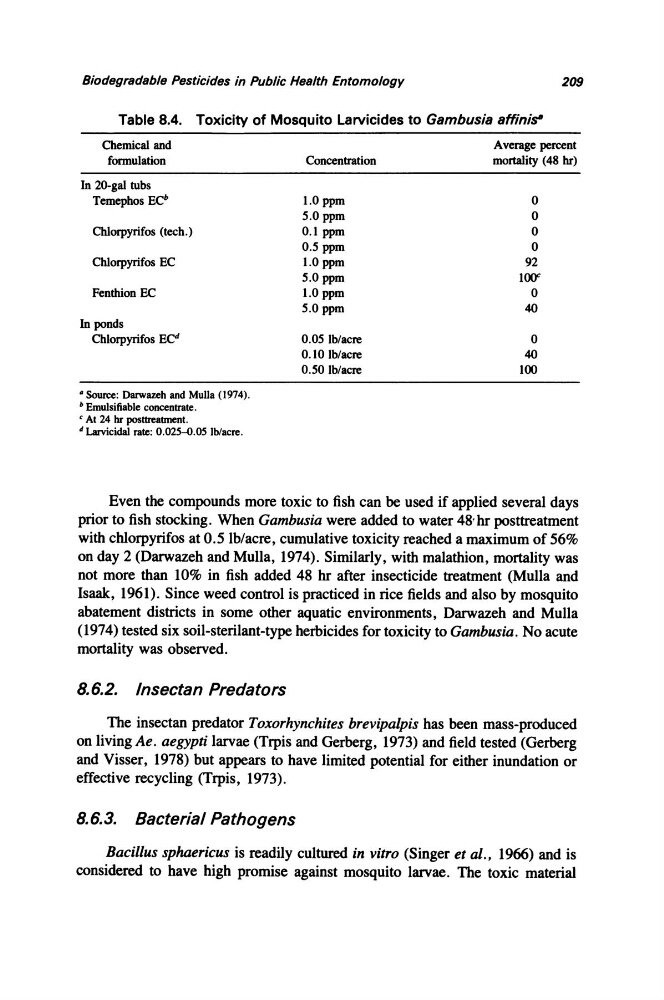
Table 8.4. Toxicity of Mosquito Larvicides to Gambusia affinis"
Chemical and
Average percent
fonnulation
Concentration
mortality (48 hr)
In 20-gal tubs
Temephos EC b
1.0 ppm
0
5.0 ppm
0
Chlorpyrifos (tech.)
0.1 ppm
0
0.5 ppm
0
Chlorpyrifos EC
1.0 ppm
92
5.0 ppm
100'
Fenthion EC
1.0 ppm
0
5.0 ppm
40
In ponds
Chlorpyrifos EC d
0.05 Ib/acre
0
0.10 Ib/acre
40
0.50 Ib/acre
100
• Source: Darwazeh and Mulla (1974).
b Emulsifiable concentrate.
, At 24 hr posttreatment.
d Larvicidal rate: O.025~.05 Ib/acre.
Even the compounds more toxic to fish can be used if applied several days
prior to fish stocking. When Gambusia were added to water 48'hr posttreatment
with chlorpyrifos at 0.5 lb/acre, cumulative toxicity reached a maximum of 56%
on day 2 (Darwazeh and Mulla, 1974). Similarly, with malathion, mortality was
not more than 10% in fish added 48 hr after insecticide treatment (Mulla and
Isaak, 1961). Since weed control is practiced in rice fields and also by mosquito
abatement districts in some other aquatic environments, Darwazeh and Mulla
(1974) tested six soil-sterilant-type herbicides for toxicity to Gambusia. No acute
mortality was observed.
8.6.2. Insectan Predators
The insectan predator Toxorhynchites brevipalpis has been mass-produced
on livingAe. aegypti larvae (Trpis and Gerberg, 1973) and field tested (Gerberg
and Visser, 1978) but appears to have limited potential for either inundation or
effective recycling (Trpis, 1973).
8.6.3. Bacterial Pathogens
Bacillus sphaericus is readily cultured in vitro (Singer et al., 1966) and is
considered to have high promise against mosquito larvae. The toxic material
209
Table 8.4. Toxicity of Mosquito Larvicides to Gambusia affinis"
Chemical and
Average percent
fonnulation
Concentration
mortality (48 hr)
In 20-gal tubs
Temephos EC b
1.0 ppm
0
5.0 ppm
0
Chlorpyrifos (tech.)
0.1 ppm
0
0.5 ppm
0
Chlorpyrifos EC
1.0 ppm
92
5.0 ppm
100'
Fenthion EC
1.0 ppm
0
5.0 ppm
40
In ponds
Chlorpyrifos EC d
0.05 Ib/acre
0
0.10 Ib/acre
40
0.50 Ib/acre
100
• Source: Darwazeh and Mulla (1974).
b Emulsifiable concentrate.
, At 24 hr posttreatment.
d Larvicidal rate: O.025~.05 Ib/acre.
Even the compounds more toxic to fish can be used if applied several days
prior to fish stocking. When Gambusia were added to water 48'hr posttreatment
with chlorpyrifos at 0.5 lb/acre, cumulative toxicity reached a maximum of 56%
on day 2 (Darwazeh and Mulla, 1974). Similarly, with malathion, mortality was
not more than 10% in fish added 48 hr after insecticide treatment (Mulla and
Isaak, 1961). Since weed control is practiced in rice fields and also by mosquito
abatement districts in some other aquatic environments, Darwazeh and Mulla
(1974) tested six soil-sterilant-type herbicides for toxicity to Gambusia. No acute
mortality was observed.
8.6.2. Insectan Predators
The insectan predator Toxorhynchites brevipalpis has been mass-produced
on livingAe. aegypti larvae (Trpis and Gerberg, 1973) and field tested (Gerberg
and Visser, 1978) but appears to have limited potential for either inundation or
effective recycling (Trpis, 1973).
8.6.3. Bacterial Pathogens
Bacillus sphaericus is readily cultured in vitro (Singer et al., 1966) and is
considered to have high promise against mosquito larvae. The toxic material