

Biodegradable Pesticides in Public Health Entomology
207
dersoni cannot transmit LAC virus (Watts et al. 1975). These two species differ
in their vertical stratification when studied with ovitraps, 60-76% of oviposition
by Ae. triseriatus being in basal (ground level) traps, and 74-96% of oviposition
by Ae. hendersoni being in arboreal traps (Loor and DeFoliart, 1970; Scholl and
DeFoliart, 1977; Sinsko and Grimstad, 1977). Closure of basal treeholes would
reduce the available ground-level habitat and force Ae. triseriatus to compete
with Ae. hendersoni on the latter's "home grounds." The probable outcome of
this competition is not known, but regardless of the outcome, Ae. triseriatus
populations could probably be further reduced, if necessary, by the supplementary use of ovitraps containing slow-release formulations of insecticides.
8.6. MASS-PRODUCED BIOCONTROL AGENTS
Except for larvivorous fish, the current armamentarium is quite slender, but
a number of promising pathogens are under development. The status of various
candidate biological control agents in WHO's five-stage scheme for screening
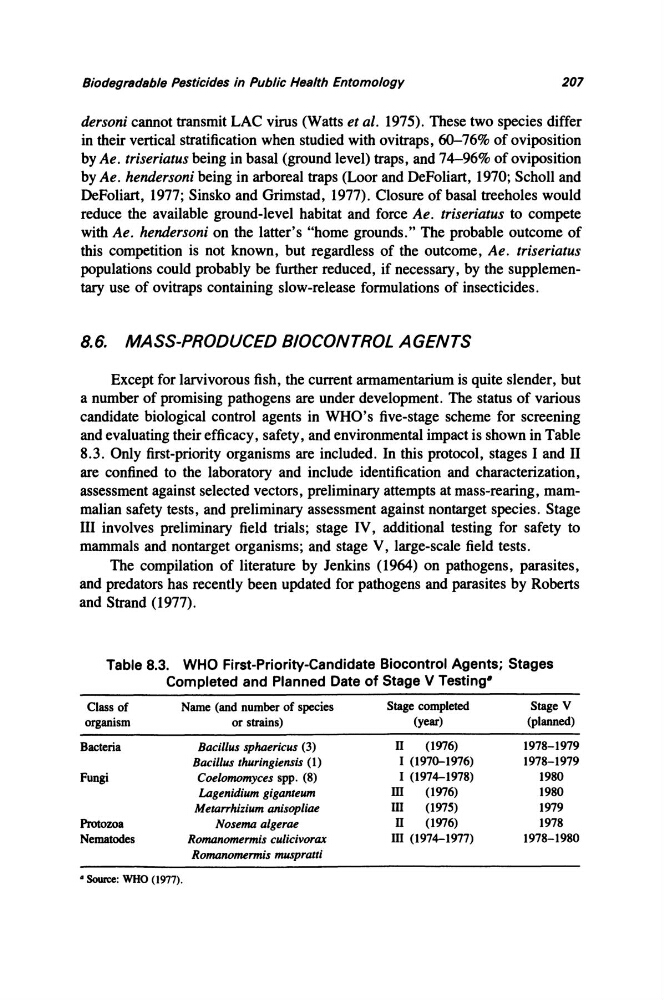
and evaluating their efficacy, safety, and environmental impact is shown in Table
8.3. Only first-priority organisms are included. In this protocol, stages I and II
are confined to the laboratory and include identification and characterization,
assessment against selected vectors, preliminary attempts at mass-rearing, mammalian safety tests, and preliminary assessment against nontarget species. Stage
III involves preliminary field trials; stage IV, additional testing for safety to
mammals and nontarget organisms; and stage V, large-scale field tests.
The compilation of literature by Jenkins (1964) on pathogens, parasites,
and predators has recently been updated for pathogens and parasites by Roberts
and Strand (1977).
Table 8.3. WHO First-Priority-Candidate Biocontrol Agents; Stages
Completed and Planned Date of Stage V TestingClass of
organism
Bacteria
Fungi
Protozoa
Nematodes
Name (and number of species
or strains)
Bacillus spluJericus (3)
Bacillus thuringiensis (1)
Coelomomyces spp. (8)
Lagenidium giganteum
Metarrhizium anisopliae
Nosema algerae
Romanomermis culicivorax
Romanomermis muspratti
• Source: WHO (1977).
Stage completed
(year)
n (1976)
I (1970-1976)
I (1974-1978)
m (1976)
m (1975)
n (1976)
m (1974-1977)
Stage V
(planned)
1978-1979
1978-1979
1980
1980
1979
1978
1978-1980
207
dersoni cannot transmit LAC virus (Watts et al. 1975). These two species differ
in their vertical stratification when studied with ovitraps, 60-76% of oviposition
by Ae. triseriatus being in basal (ground level) traps, and 74-96% of oviposition
by Ae. hendersoni being in arboreal traps (Loor and DeFoliart, 1970; Scholl and
DeFoliart, 1977; Sinsko and Grimstad, 1977). Closure of basal treeholes would
reduce the available ground-level habitat and force Ae. triseriatus to compete
with Ae. hendersoni on the latter's "home grounds." The probable outcome of
this competition is not known, but regardless of the outcome, Ae. triseriatus
populations could probably be further reduced, if necessary, by the supplementary use of ovitraps containing slow-release formulations of insecticides.
8.6. MASS-PRODUCED BIOCONTROL AGENTS
Except for larvivorous fish, the current armamentarium is quite slender, but
a number of promising pathogens are under development. The status of various
candidate biological control agents in WHO's five-stage scheme for screening
and evaluating their efficacy, safety, and environmental impact is shown in Table
8.3. Only first-priority organisms are included. In this protocol, stages I and II
are confined to the laboratory and include identification and characterization,
assessment against selected vectors, preliminary attempts at mass-rearing, mammalian safety tests, and preliminary assessment against nontarget species. Stage
III involves preliminary field trials; stage IV, additional testing for safety to
mammals and nontarget organisms; and stage V, large-scale field tests.
The compilation of literature by Jenkins (1964) on pathogens, parasites,
and predators has recently been updated for pathogens and parasites by Roberts
and Strand (1977).
Table 8.3. WHO First-Priority-Candidate Biocontrol Agents; Stages
Completed and Planned Date of Stage V TestingClass of
organism
Bacteria
Fungi
Protozoa
Nematodes
Name (and number of species
or strains)
Bacillus spluJericus (3)
Bacillus thuringiensis (1)
Coelomomyces spp. (8)
Lagenidium giganteum
Metarrhizium anisopliae
Nosema algerae
Romanomermis culicivorax
Romanomermis muspratti
• Source: WHO (1977).
Stage completed
(year)
n (1976)
I (1970-1976)
I (1974-1978)
m (1976)
m (1975)
n (1976)
m (1974-1977)
Stage V
(planned)
1978-1979
1978-1979
1980
1980
1979
1978
1978-1980