

Biodegradation of Agricultural Fungicides
149
A variety of metabolites (Fig. 6.12) were found in melon plants exposed
for 2 months to 20 /-Lg/ml of benomyl in the nutrient solution. The plants contained
the following metabolites in the relative proportions indicated: MBC (free and
conjugated), 53.5%; 2AB (free and conjugated), 27.5%; benzimidazole, 8.8%;
o-aminobenzonitrile, 8.4%; and aniline, 1.8% (Rouchaud et al., 1974). Photochemical reactions may be involved in the formation of the last two compounds
(Rouchaud et al., 1974). More recent studies demonstrated the conversion of
benzimidazole and 2AB in melon plants to aniline, o-aminobenzonitrile, and 0phenylenediamine (Rouchaud et al., 1977a). The degradation products of benomyl found in melon plants were also found in carrot, strawberry, and apple
tissue (Rouchaud et al., 1977b). The pathway of conversion in plant tissue
appears to be
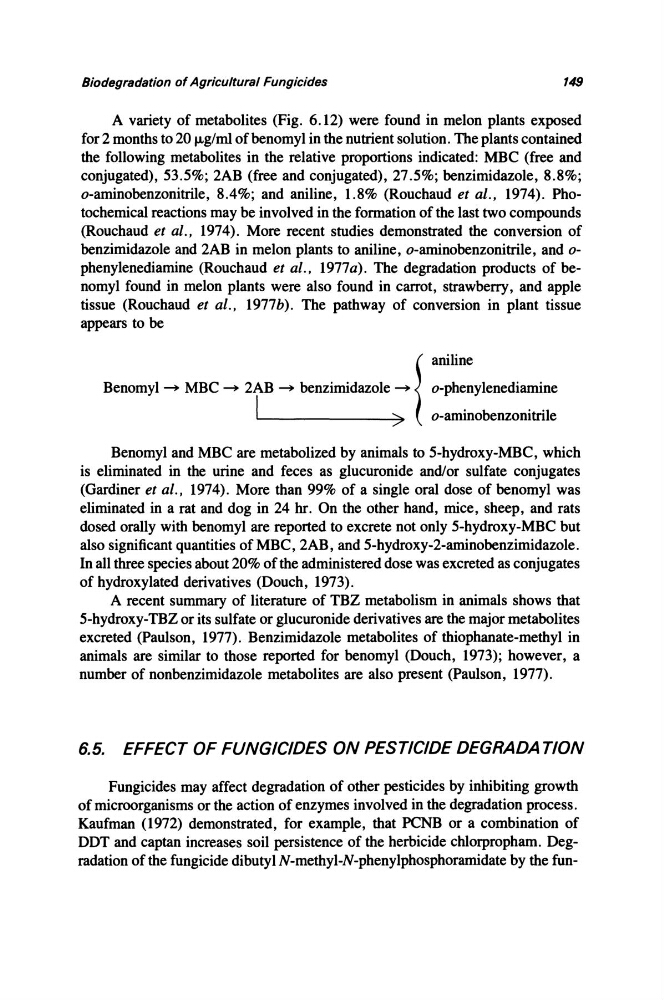
Benomyl - MBC - 2AB - benzimidazole -
o-phenylenediamine
{
aniline
I
> o-aminobenzonitrile
Benomyl and MBC are metabolized by animals to 5-hydroxy-MBC, which
is eliminated in the urine and feces as glucuronide and/or sulfate conjugates
(Gardiner et al., 1974). More than 99% of a single oral dose of benomyl was
eliminated in a rat and dog in 24 hr. On the other hand, mice, sheep, and rats
dosed orally with benomyl are reported to excrete not only 5-hydroxy-MBC but
also significant quantities of MBC, 2AB, and 5-hydroxy-2-aminobenzimidazole.
In all three species about 20% of the administered dose was excreted as conjugates
of hydroxylated derivatives (Douch, 1973).
A recent summary of literature of TBZ metabolism in animals shows that
5-hydroxy-TBZ or its sulfate or glucuronide derivatives are the major metabolites
excreted (Paulson, 1977). Benzimidazole metabolites of thiophanate-methyl in
animals are similar to those reported for benomyl (Douch, 1973); however, a
number of nonbenzimidazole metabolites are also present (Paulson, 1977).
6.5. EFFECT OF FUNGICIDES ON PESTICIDE DEGRADA TION
Fungicides may affect degradation of other pesticides by inhibiting growth
of microorganisms or the action of enzymes involved in the degradation process.
Kaufman (1972) demonstrated, for example, that PCNB or a combination of
DDT and captan increases soil persistence of the herbicide chlorpropham. Degradation of the fungicide dibutyl N-methyl-N-phenylphosphoramidate by the fun-
149
A variety of metabolites (Fig. 6.12) were found in melon plants exposed
for 2 months to 20 /-Lg/ml of benomyl in the nutrient solution. The plants contained
the following metabolites in the relative proportions indicated: MBC (free and
conjugated), 53.5%; 2AB (free and conjugated), 27.5%; benzimidazole, 8.8%;
o-aminobenzonitrile, 8.4%; and aniline, 1.8% (Rouchaud et al., 1974). Photochemical reactions may be involved in the formation of the last two compounds
(Rouchaud et al., 1974). More recent studies demonstrated the conversion of
benzimidazole and 2AB in melon plants to aniline, o-aminobenzonitrile, and 0phenylenediamine (Rouchaud et al., 1977a). The degradation products of benomyl found in melon plants were also found in carrot, strawberry, and apple
tissue (Rouchaud et al., 1977b). The pathway of conversion in plant tissue
appears to be
Benomyl - MBC - 2AB - benzimidazole -
o-phenylenediamine
{
aniline
I
> o-aminobenzonitrile
Benomyl and MBC are metabolized by animals to 5-hydroxy-MBC, which
is eliminated in the urine and feces as glucuronide and/or sulfate conjugates
(Gardiner et al., 1974). More than 99% of a single oral dose of benomyl was
eliminated in a rat and dog in 24 hr. On the other hand, mice, sheep, and rats
dosed orally with benomyl are reported to excrete not only 5-hydroxy-MBC but
also significant quantities of MBC, 2AB, and 5-hydroxy-2-aminobenzimidazole.
In all three species about 20% of the administered dose was excreted as conjugates
of hydroxylated derivatives (Douch, 1973).
A recent summary of literature of TBZ metabolism in animals shows that
5-hydroxy-TBZ or its sulfate or glucuronide derivatives are the major metabolites
excreted (Paulson, 1977). Benzimidazole metabolites of thiophanate-methyl in
animals are similar to those reported for benomyl (Douch, 1973); however, a
number of nonbenzimidazole metabolites are also present (Paulson, 1977).
6.5. EFFECT OF FUNGICIDES ON PESTICIDE DEGRADA TION
Fungicides may affect degradation of other pesticides by inhibiting growth
of microorganisms or the action of enzymes involved in the degradation process.
Kaufman (1972) demonstrated, for example, that PCNB or a combination of
DDT and captan increases soil persistence of the herbicide chlorpropham. Degradation of the fungicide dibutyl N-methyl-N-phenylphosphoramidate by the fun-