

Biodegradation of Agricultural Fungicides
147
H
H
H
H
O N I
H+
ON I
I >-N-COOCH 3 •
•
I )-N-COOCH 3
~
N
pK I = 3.95
~
N
I
H(f)
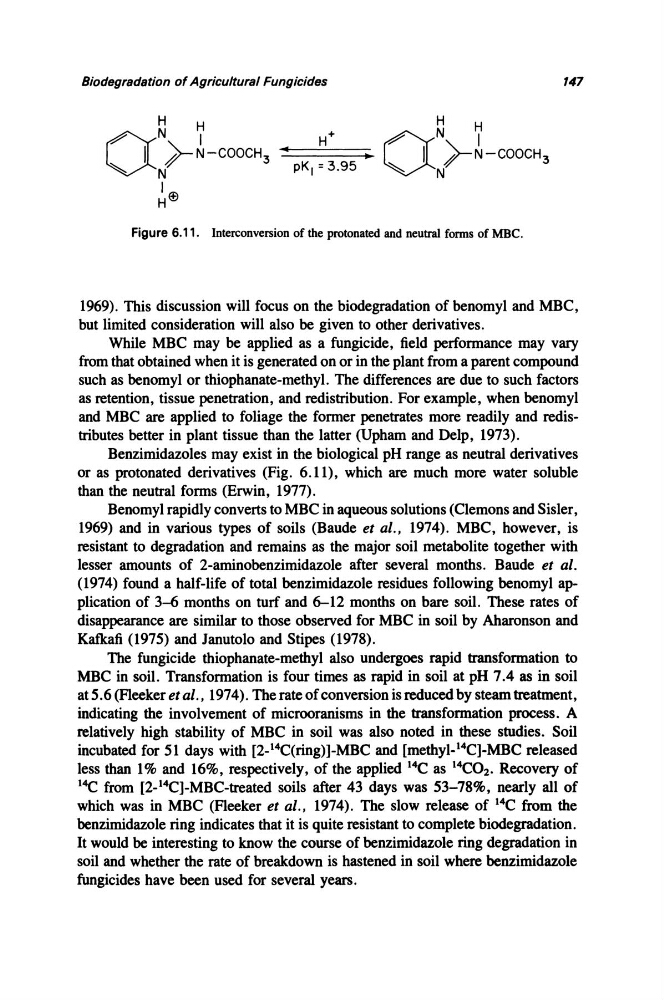
Figure 6.11. Interconversion of the protonated and neutral forms of MBC.
1969). This discussion will focus on the biodegradation of benomyl and MBC,
but limited consideration will also be given to other derivatives.
While MBC may be applied as a fungicide, field performance may vary
from that obtained when it is generated on or in the plant from a parent compound
such as benomyl or thiophanate-methyl. The differences are due to such factors
as retention, tissue penetration, and redistribution. For example, when benomyl
and MBC are applied to foliage the former penetrates more readily and redistributes better in plant tissue than the latter (Upham and Delp, 1973).
Benzimidazoles may exist in the biological pH range as neutral derivatives
or as protonated derivatives (Fig. 6.11), which are much more water soluble
than the neutral forms (Erwin, 1977).
Benomyl rapidly converts to MBC in aqueous solutions (Clemons and Sisler,
1969) and in various types of soils (Baude et al., 1974). MBC, however, is
resistant to degradation and remains as the major soil metabolite together with
lesser amounts of 2-aminobenzimidazole after several months. Baude et al.
(1974) found a half-life of total benzimidazole residues following benomyl application of 3-6 months on turf and 6-12 months on bare soil. These rates of
disappearance are similar to those observed for MBC in soil by Aharonson and
Kafkafi (1975) and lanutolo and Stipes (1978).
The fungicide thiophanate-methyl also undergoes rapid transformation to
MBC in soil. Transformation is four times as rapid in soil at pH 7.4 as in soil
at 5.6 (Fleeker et al., 1974). The rate of conversion is reduced by steam treatment,
indicating the involvement of microoranisms in the transformation process. A
relatively high stability of MBC in soil was also noted in these studies. Soil
incubated for 51 days with [2_14C(ring)]-MBC and [methyl-14C]-MBC released
less than 1 % and 16%, respectively, of the applied 14C as 14C02. Recovery of
14C from [2- 14 C]-MBC-treated soils after 43 days was 53-78%, nearly all of
which was in MBC (Fleeker et al., 1974). The slow release of 14C from the
benzimidazole ring indicates that it is quite resistant to complete biodegradation.
It would be interesting to know the course of benzimidazole ring degradation in
soil and whether the rate of breakdown is hastened in soil where benzimidazole
fungicides have been used for several years.
147
H
H
H
H
O N I
H+
ON I
I >-N-COOCH 3 •
•
I )-N-COOCH 3
~
N
pK I = 3.95
~
N
I
H(f)
Figure 6.11. Interconversion of the protonated and neutral forms of MBC.
1969). This discussion will focus on the biodegradation of benomyl and MBC,
but limited consideration will also be given to other derivatives.
While MBC may be applied as a fungicide, field performance may vary
from that obtained when it is generated on or in the plant from a parent compound
such as benomyl or thiophanate-methyl. The differences are due to such factors
as retention, tissue penetration, and redistribution. For example, when benomyl
and MBC are applied to foliage the former penetrates more readily and redistributes better in plant tissue than the latter (Upham and Delp, 1973).
Benzimidazoles may exist in the biological pH range as neutral derivatives
or as protonated derivatives (Fig. 6.11), which are much more water soluble
than the neutral forms (Erwin, 1977).
Benomyl rapidly converts to MBC in aqueous solutions (Clemons and Sisler,
1969) and in various types of soils (Baude et al., 1974). MBC, however, is
resistant to degradation and remains as the major soil metabolite together with
lesser amounts of 2-aminobenzimidazole after several months. Baude et al.
(1974) found a half-life of total benzimidazole residues following benomyl application of 3-6 months on turf and 6-12 months on bare soil. These rates of
disappearance are similar to those observed for MBC in soil by Aharonson and
Kafkafi (1975) and lanutolo and Stipes (1978).
The fungicide thiophanate-methyl also undergoes rapid transformation to
MBC in soil. Transformation is four times as rapid in soil at pH 7.4 as in soil
at 5.6 (Fleeker et al., 1974). The rate of conversion is reduced by steam treatment,
indicating the involvement of microoranisms in the transformation process. A
relatively high stability of MBC in soil was also noted in these studies. Soil
incubated for 51 days with [2_14C(ring)]-MBC and [methyl-14C]-MBC released
less than 1 % and 16%, respectively, of the applied 14C as 14C02. Recovery of
14C from [2- 14 C]-MBC-treated soils after 43 days was 53-78%, nearly all of
which was in MBC (Fleeker et al., 1974). The slow release of 14C from the
benzimidazole ring indicates that it is quite resistant to complete biodegradation.
It would be interesting to know the course of benzimidazole ring degradation in
soil and whether the rate of breakdown is hastened in soil where benzimidazole
fungicides have been used for several years.