

Biodegradation of Agricultural Fungicides
139
version products which differ in many respects from those of dialkyldithiocarbamates (Kaars Sijpesteijn et al., 1977). With the exception of the soil fungicide
sodium methyldithiocarbamate, the practical monoalkyldithiocarbamate fungicides are derivatives of ethylenediamine, whereas dialkyldithiocarbamate fungicides are derivatives of dimethylamine.
6.4.3.1. Monoalkyldithiocarbamates
Fungicides in this group include maneb, zineb (Fig. 2.3), and the closely
related derivatives mancozeb and metriam (Kaars Sijpesteijn et al., 1977). The
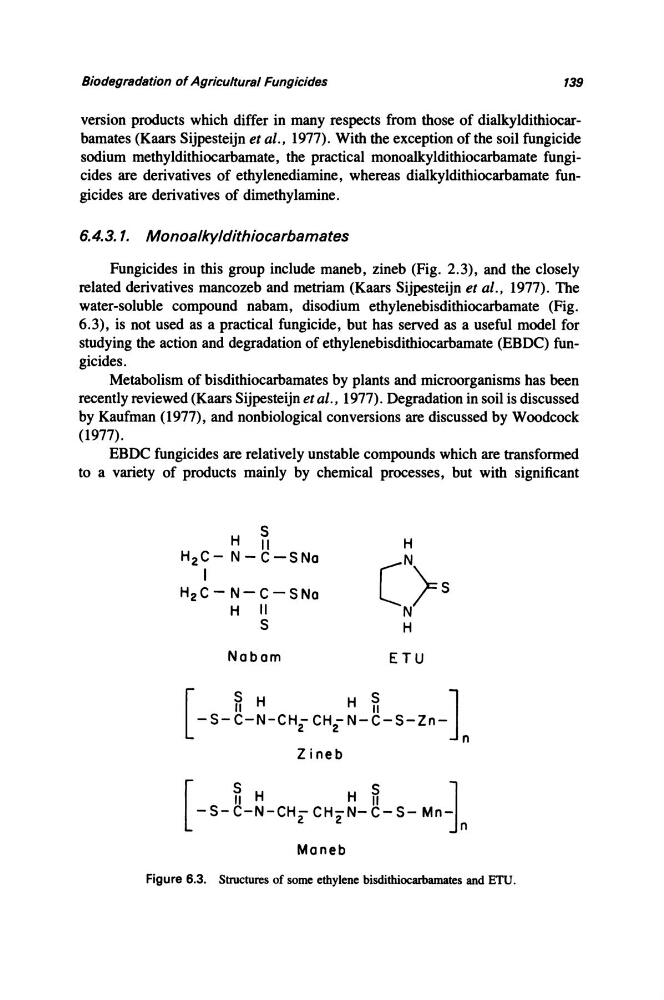
water-soluble compound nabam, disodium ethylenebisdithiocarbamate (Fig.
6.3), is not used as a practical fungicide, but has served as a useful model for
studying the action and degradation of ethylenebisdithiocarbamate (EBDC) fungicides.
Metabolism of bisdithiocarbamates by plants and microorganisms has been
recently reviewed (Kaars Sijpesteijn et al., 1977). Degradation in soil is discussed
by Kaufman (1977), and nonbiological conversions are discussed by Woodcock
(1977).
EBDC fungicides are relatively unstable compounds which are transformed
to a variety of products mainly by chemical processes, but with significant
5
H II
H 2 C- N-C-5Na
I
H 2 C- N-C-5Na
H II
5
Nabam
H
()=s
N
H
ETU
[
IT H
HIT]
- 5- C-N-CHi CH 2 - N-C-5-Zn- n
Z i neb
[
TI H
H IT
j
- 5- C-N-CH- CH-N- C- 5- Mn2
2
n
Maneb
Figure 6.3. Structures of some ethylene bisdithiocarbamates and ETU.
139
version products which differ in many respects from those of dialkyldithiocarbamates (Kaars Sijpesteijn et al., 1977). With the exception of the soil fungicide
sodium methyldithiocarbamate, the practical monoalkyldithiocarbamate fungicides are derivatives of ethylenediamine, whereas dialkyldithiocarbamate fungicides are derivatives of dimethylamine.
6.4.3.1. Monoalkyldithiocarbamates
Fungicides in this group include maneb, zineb (Fig. 2.3), and the closely
related derivatives mancozeb and metriam (Kaars Sijpesteijn et al., 1977). The
water-soluble compound nabam, disodium ethylenebisdithiocarbamate (Fig.
6.3), is not used as a practical fungicide, but has served as a useful model for
studying the action and degradation of ethylenebisdithiocarbamate (EBDC) fungicides.
Metabolism of bisdithiocarbamates by plants and microorganisms has been
recently reviewed (Kaars Sijpesteijn et al., 1977). Degradation in soil is discussed
by Kaufman (1977), and nonbiological conversions are discussed by Woodcock
(1977).
EBDC fungicides are relatively unstable compounds which are transformed
to a variety of products mainly by chemical processes, but with significant
5
H II
H 2 C- N-C-5Na
I
H 2 C- N-C-5Na
H II
5
Nabam
H
()=s
N
H
ETU
[
IT H
HIT]
- 5- C-N-CHi CH 2 - N-C-5-Zn- n
Z i neb
[
TI H
H IT
j
- 5- C-N-CH- CH-N- C- 5- Mn2
2
n
Maneb
Figure 6.3. Structures of some ethylene bisdithiocarbamates and ETU.