

Persistence and Biodegradation of Herbicides
125
1974; Kaufman and Kearney, 1970, 1976; Miekle, 1972; Plimmer, etal., 1973).
Classes of microorganisms reported to degrade herbicides include algae, actinomycetes, bacteria, and fungi. Specific microorganisms found to degrade particular herbicides have been cataloged (Audus, 1960, 1964; Kaufman, 1974;
Kaufman and Kearney, 1970, 1976; Loos, 1975). There is evidence that some
herbicides may be degraded in the soil by extracellular enzymes (Bartha et al.,
1968; Burge, 1972, 1973; Kaufman et al., 1971).
A particularly interesting phenomenon of microbial degradation of herbicides that has practical significance is that of enrichment. Enrichment is an
increase in the number and/or activity of the microorganisms capable of metabolizing a particular herbicide following the addition of that herbicide to the soil.
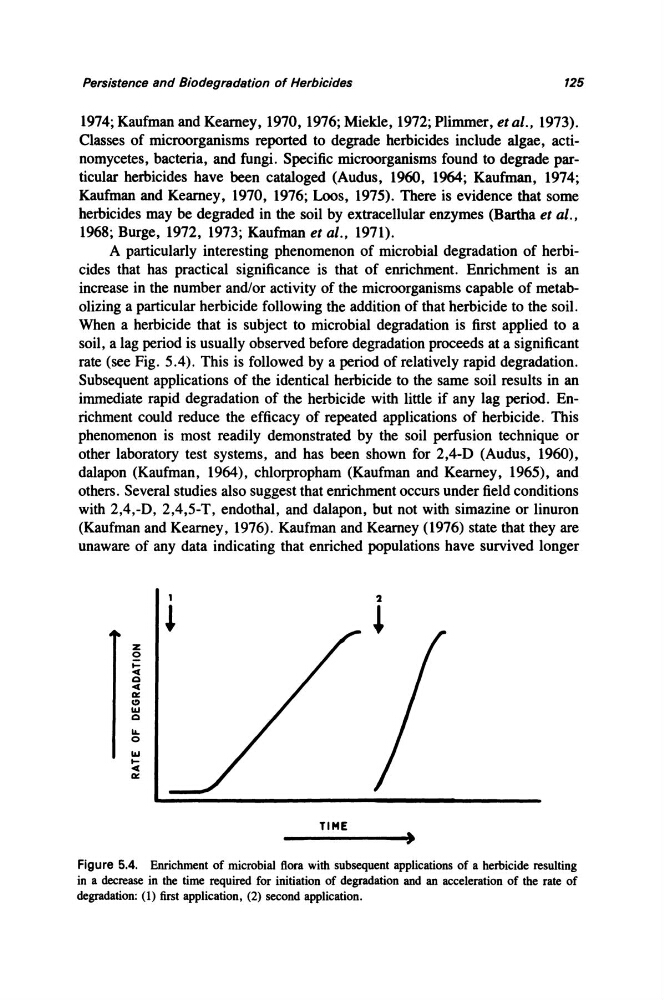
When a herbicide that is subject to microbial degradation is first applied to a
soil, a lag period is usually observed before degradation proceeds at a significant
rate (see Fig. 5.4). This is followed by a period of relatively rapid degradation.
Subsequent applications of the identical herbicide to the same soil results in an
immediate rapid degradation of the herbicide with little if any lag period. Enrichment could reduce the efficacy of repeated applications of herbicide. This
phenomenon is most readily demonstrated by the soil perfusion technique or
other laboratory test systems, and has been shown for 2,4-0 (Audus, 1960),
dalapon (Kaufman, 1964), chlorpropham (Kaufman and Kearney, 1965), and
others. Several studies also suggest that enrichment occurs under field conditions
with 2,4,-0, 2,4,5-T, endothal, and dalapon, but not with simazine or linuron
(Kaufman and Kearney, 1976). Kaufman and Kearney (1976) state that they are
unaware of any data indicating that enriched populations have survived longer
TIME
Figure 5.4. Enrichment of microbial flora with subsequent applications of a herbicide resulting
in a decrease in the time required for initiation of degradation and an acceleration of the rate of
degradation: (l) first application, (2) second application.
125
1974; Kaufman and Kearney, 1970, 1976; Miekle, 1972; Plimmer, etal., 1973).
Classes of microorganisms reported to degrade herbicides include algae, actinomycetes, bacteria, and fungi. Specific microorganisms found to degrade particular herbicides have been cataloged (Audus, 1960, 1964; Kaufman, 1974;
Kaufman and Kearney, 1970, 1976; Loos, 1975). There is evidence that some
herbicides may be degraded in the soil by extracellular enzymes (Bartha et al.,
1968; Burge, 1972, 1973; Kaufman et al., 1971).
A particularly interesting phenomenon of microbial degradation of herbicides that has practical significance is that of enrichment. Enrichment is an
increase in the number and/or activity of the microorganisms capable of metabolizing a particular herbicide following the addition of that herbicide to the soil.
When a herbicide that is subject to microbial degradation is first applied to a
soil, a lag period is usually observed before degradation proceeds at a significant
rate (see Fig. 5.4). This is followed by a period of relatively rapid degradation.
Subsequent applications of the identical herbicide to the same soil results in an
immediate rapid degradation of the herbicide with little if any lag period. Enrichment could reduce the efficacy of repeated applications of herbicide. This
phenomenon is most readily demonstrated by the soil perfusion technique or
other laboratory test systems, and has been shown for 2,4-0 (Audus, 1960),
dalapon (Kaufman, 1964), chlorpropham (Kaufman and Kearney, 1965), and
others. Several studies also suggest that enrichment occurs under field conditions
with 2,4,-0, 2,4,5-T, endothal, and dalapon, but not with simazine or linuron
(Kaufman and Kearney, 1976). Kaufman and Kearney (1976) state that they are
unaware of any data indicating that enriched populations have survived longer
TIME
Figure 5.4. Enrichment of microbial flora with subsequent applications of a herbicide resulting
in a decrease in the time required for initiation of degradation and an acceleration of the rate of
degradation: (l) first application, (2) second application.