

136
9
•
Méthodes multipas
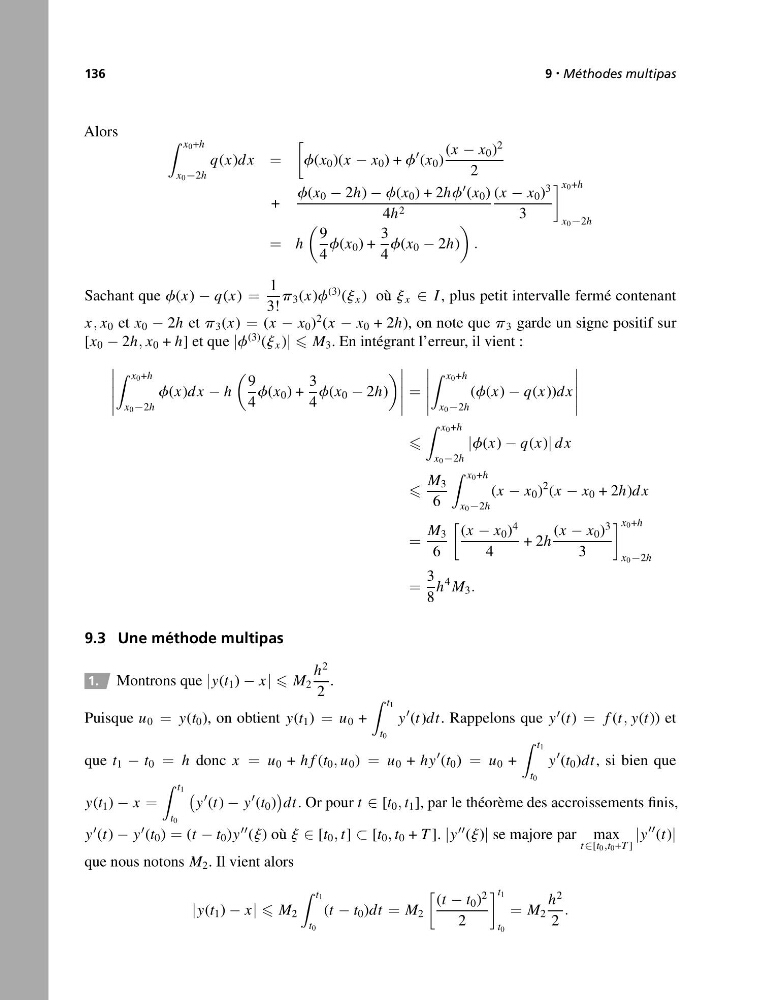
Alors
x 0 + h
x 0 − 2 h
q ( x ) dx =
f ( x 0 )(x − x 0 )+f
( x 0 )
( x − x 0 )
2
2
+
f ( x 0 − 2 h ) − f ( x 0 )+2h f
( x 0 )
4 h 2
( x − x 0 )
3
3
x 0 + h
x 0 − 2 h
= h
9
4
f ( x 0 )+
3
4
f ( x 0 − 2 h )
.
Sachant que f ( x ) − q ( x ) =
1
3!
p 3 ( x ) f
(3)
( j x )o ù j x ∈ I ,plus petit intervalle fermé contenant
x , x 0 et x 0 − 2 h et p 3 ( x ) = ( x − x 0 )
2
( x − x 0 +2h ), on note que p 3 garde un signe positif sur
[ x 0 − 2 h , x 0 + h ]etque | f
(3)
( j x ) | M 3 .Enintégrant l’erreur,ilvient :
x 0 + h
x 0 − 2 h
f ( x ) dx − h
9
4
f ( x 0 )+
3
4
f ( x 0 − 2 h )
=
x 0 + h
x 0 − 2 h
( f ( x ) − q ( x ))dx
x 0 + h
x 0 − 2 h
| f ( x ) − q ( x ) | dx
M 3
6
x 0 + h
x 0 − 2 h
( x − x 0 )
2
( x − x 0 +2h ) dx
=
M 3
6
( x − x 0 )
4
4
+2h
( x − x 0 )
3
3
x 0 + h
x 0 − 2 h
=
3
8
h
4
M 3 .
9.3 Une méthode multipas
1. Montrons que | y ( t 1 ) − x | M 2
h
2
2
.
Puisque u 0 = y ( t 0 ), on obtient y ( t 1 ) = u 0 +
t 1
t 0
y
( t ) dt.R appelons que y
( t ) = f ( t , y ( t )) et
que t 1 − t 0 = h donc x = u 0 + hf( t 0 , u 0 ) = u 0 + hy
( t 0 ) = u 0 +
t 1
t 0
y
( t 0 ) dt,s ib ien que
y ( t 1 ) − x =
t 1
t 0
y
( t ) − y
( t 0 )
dt.Orpour t ∈ [ t 0 , t 1 ], par le théorème des accroissements finis,
y
( t ) − y
( t 0 ) = ( t − t 0 ) y
( j )où j ∈ [ t 0 , t ] ⊂ [ t 0 , t 0 + T ]. | y
( j ) | se majore par max
t ∈ [ t 0 , t 0 + T ]
| y
( t ) |
que nous notons M 2 .Ilvient alors
| y ( t 1 ) − x | M 2
t 1
t 0
( t − t 0 ) dt = M 2
( t − t 0 )
2
2
t 1
t 0
= M 2
h
2
2
.
9
•
Méthodes multipas
Alors
x 0 + h
x 0 − 2 h
q ( x ) dx =
f ( x 0 )(x − x 0 )+f
( x 0 )
( x − x 0 )
2
2
+
f ( x 0 − 2 h ) − f ( x 0 )+2h f
( x 0 )
4 h 2
( x − x 0 )
3
3
x 0 + h
x 0 − 2 h
= h
9
4
f ( x 0 )+
3
4
f ( x 0 − 2 h )
.
Sachant que f ( x ) − q ( x ) =
1
3!
p 3 ( x ) f
(3)
( j x )o ù j x ∈ I ,plus petit intervalle fermé contenant
x , x 0 et x 0 − 2 h et p 3 ( x ) = ( x − x 0 )
2
( x − x 0 +2h ), on note que p 3 garde un signe positif sur
[ x 0 − 2 h , x 0 + h ]etque | f
(3)
( j x ) | M 3 .Enintégrant l’erreur,ilvient :
x 0 + h
x 0 − 2 h
f ( x ) dx − h
9
4
f ( x 0 )+
3
4
f ( x 0 − 2 h )
=
x 0 + h
x 0 − 2 h
( f ( x ) − q ( x ))dx
x 0 + h
x 0 − 2 h
| f ( x ) − q ( x ) | dx
M 3
6
x 0 + h
x 0 − 2 h
( x − x 0 )
2
( x − x 0 +2h ) dx
=
M 3
6
( x − x 0 )
4
4
+2h
( x − x 0 )
3
3
x 0 + h
x 0 − 2 h
=
3
8
h
4
M 3 .
9.3 Une méthode multipas
1. Montrons que | y ( t 1 ) − x | M 2
h
2
2
.
Puisque u 0 = y ( t 0 ), on obtient y ( t 1 ) = u 0 +
t 1
t 0
y
( t ) dt.R appelons que y
( t ) = f ( t , y ( t )) et
que t 1 − t 0 = h donc x = u 0 + hf( t 0 , u 0 ) = u 0 + hy
( t 0 ) = u 0 +
t 1
t 0
y
( t 0 ) dt,s ib ien que
y ( t 1 ) − x =
t 1
t 0
y
( t ) − y
( t 0 )
dt.Orpour t ∈ [ t 0 , t 1 ], par le théorème des accroissements finis,
y
( t ) − y
( t 0 ) = ( t − t 0 ) y
( j )où j ∈ [ t 0 , t ] ⊂ [ t 0 , t 0 + T ]. | y
( j ) | se majore par max
t ∈ [ t 0 , t 0 + T ]
| y
( t ) |
que nous notons M 2 .Ilvient alors
| y ( t 1 ) − x | M 2
t 1
t 0
( t − t 0 ) dt = M 2
( t − t 0 )
2
2
t 1
t 0
= M 2
h
2
2
.