

.
ADAPTATION
.
253
But when the upper lobe reaches to the huge dimensions
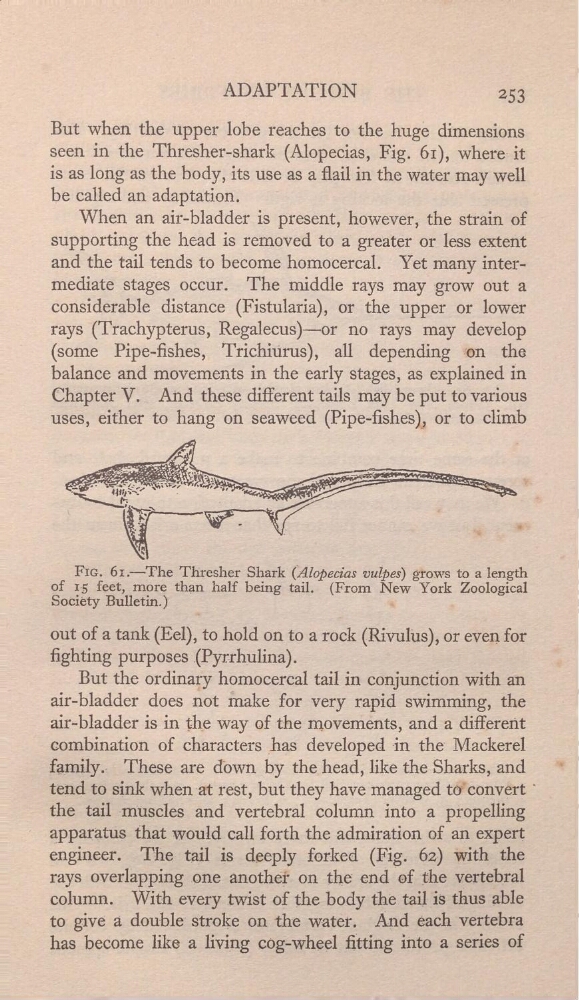
seen in the Thresher-shark (Alopecias, Fig. 61), Where it ‘
is as long as the body, its use as a ail in the water may well
be called an adaptation.
’
_
'
_
When an air-bladder is present, however, the strain of
supporting the head is removed to a greater or less extent
and the tail tends to become homocercal.
Yet many intermediate stages occur.
_
The middle rayS may grow out a
considerable distance (Fistularia), or the upper or lower
rays (Trachypterus, Regalecus)——or no
may develop
(some Pipe—shes, Trichiürus), all depending
the
balance and movements in the early stages, as explained in
Chapter V.
,_
“And
_
these di"erent tails may be put to various
uses, either to bang on seaweed (Pipe—shes), or to climb
FIG. 61.—The'Threshér Shark (Àlopeciäs vulgb‘es) gîows to a length
of 15 ffeet,.more than half being tail… (From New York Zoological—
So'ciètyBulletin.)'
'
:
,
_
of atank (Bel), to hold on toa rock (Rivulus), oreverifor
-
ghting purp05ès (Pyrrhulinzi). — '
'
j
_
,
'
,
But the ordinary homocercal tail
with an
air—bladder does not 'inake for very rapid swimming, the
—
air—bladder is'in the way of the movements, and a different
combination of characters has developed in the Mackerel
These are down by the,head,‘ like the Sharks,and
sink_whenat rest, but they have managed _to‘Îconvert
-,
_
,
the
and vertebral column into a ptopellig ,
'
apparatus that would call forth the admiration of
_
an
,
deeply forläed (Fig.
lWithÏ_tl_1e[
?
‘
rays overlappingfoneÏ'another on
=vert‘ebr‘al
-
column. = W1th
the body the tail—fis thus able
;
-
to give a double“
:“ And each vertebra__{
has…become like
into a
of
_
_
_
ADAPTATION
.
253
But when the upper lobe reaches to the huge dimensions
seen in the Thresher-shark (Alopecias, Fig. 61), Where it ‘
is as long as the body, its use as a ail in the water may well
be called an adaptation.
’
_
'
_
When an air-bladder is present, however, the strain of
supporting the head is removed to a greater or less extent
and the tail tends to become homocercal.
Yet many intermediate stages occur.
_
The middle rayS may grow out a
considerable distance (Fistularia), or the upper or lower
rays (Trachypterus, Regalecus)——or no
may develop
(some Pipe—shes, Trichiürus), all depending
the
balance and movements in the early stages, as explained in
Chapter V.
,_
“And
_
these di"erent tails may be put to various
uses, either to bang on seaweed (Pipe—shes), or to climb
FIG. 61.—The'Threshér Shark (Àlopeciäs vulgb‘es) gîows to a length
of 15 ffeet,.more than half being tail… (From New York Zoological—
So'ciètyBulletin.)'
'
:
,
_
of atank (Bel), to hold on toa rock (Rivulus), oreverifor
-
ghting purp05ès (Pyrrhulinzi). — '
'
j
_
,
'
,
But the ordinary homocercal tail
with an
air—bladder does not 'inake for very rapid swimming, the
—
air—bladder is'in the way of the movements, and a different
combination of characters has developed in the Mackerel
These are down by the,head,‘ like the Sharks,and
sink_whenat rest, but they have managed _to‘Îconvert
-,
_
,
the
and vertebral column into a ptopellig ,
'
apparatus that would call forth the admiration of
_
an
,
deeply forläed (Fig.
lWithÏ_tl_1e[
?
‘
rays overlappingfoneÏ'another on
=vert‘ebr‘al
-
column. = W1th
the body the tail—fis thus able
;
-
to give a double“
:“ And each vertebra__{
has…become like
into a
of
_
_
_