

DISTRIBUTION IN TIME
SPACE 241
south
end of South America.
One and the same species is,
beheved to be common to New Zealand, Australia and South
America (Bouienger).— We can hardly supposethat this «
points
to the earlier connection between these parts ; the
distribution
would have been more extensive in. that case.
..
ItiS more probable that they” have come later froin'some
common marine species like the Clupeids, as, indeed,their '
form suggests.
-
.
_
Turning novv to more typically freshwater forms, the
'
Ostariophysi,
Which have practically lost all connection
With marine forms, we obtain a picture of azvvide dispersal
of some 4,000 species of shes (Regan, 1922) Since the
,Üe:?
.
.ï
'
\
'
,
,
…
—_
à,
'
"
r-nbh md
…
beginning of the Tertiary period; Some
may
have existed in the Cretaceous, for the Characinidæ, the
'
oldest group, are
not far removed from the Clupeids of
that-period, but no fossils older than the
have
yetbeenfoùnd;
_
'
,
—
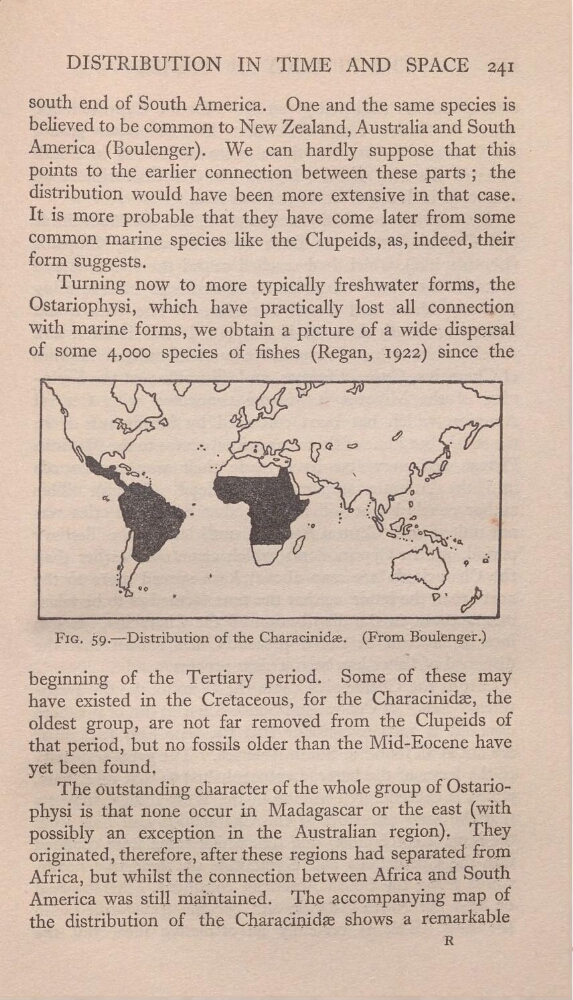
ThCOUÎStandmg character of the whole gr0up
,
f
phym isthatnone occur in Madagascar or theeast (With ; ,
possiblyfsan_‘ièâçcéièÿti@n_ .in the
’
Australian regmn)They : ,
‘
0figiñät9d,,-'thefëï9fe, :äfier:chese régions’had‘ separatedfrom ;
"
Africa, butwhsttheconnecüonbetweenAfncaandSouth î f
'
América Was °lStÿillimamtamed
9f
'
'
'
the distribution
shows, a'
,
_R
SPACE 241
south
end of South America.
One and the same species is,
beheved to be common to New Zealand, Australia and South
America (Bouienger).— We can hardly supposethat this «
points
to the earlier connection between these parts ; the
distribution
would have been more extensive in. that case.
..
ItiS more probable that they” have come later froin'some
common marine species like the Clupeids, as, indeed,their '
form suggests.
-
.
_
Turning novv to more typically freshwater forms, the
'
Ostariophysi,
Which have practically lost all connection
With marine forms, we obtain a picture of azvvide dispersal
of some 4,000 species of shes (Regan, 1922) Since the
,Üe:?
.
.ï
'
\
'
,
,
…
—_
à,
'
"
r-nbh md
…
beginning of the Tertiary period; Some
may
have existed in the Cretaceous, for the Characinidæ, the
'
oldest group, are
not far removed from the Clupeids of
that-period, but no fossils older than the
have
yetbeenfoùnd;
_
'
,
—
ThCOUÎStandmg character of the whole gr0up
,
f
phym isthatnone occur in Madagascar or theeast (With ; ,
possiblyfsan_‘ièâçcéièÿti@n_ .in the
’
Australian regmn)They : ,
‘
0figiñät9d,,-'thefëï9fe, :äfier:chese régions’had‘ separatedfrom ;
"
Africa, butwhsttheconnecüonbetweenAfncaandSouth î f
'
América Was °lStÿillimamtamed
9f
'
'
'
the distribution
shows, a'
,
_R