

DISTRIBUTION,IN TIME
SPACE
,
individual and specic abundance and for their extreme
range in time.
Represented Only by Cheirolepis in the
,.
Middle Old Red Sandstone, and ;Devonian, the family
attained its maximum' development in the later Èalæozoic
,
rocks (Carboniferous and Lower Permianj, became rare
in' the Mesozoic, nally dwindling-Ïaway at thé-close,er the
]urassic period… Their geographical distribution;si
'
,
past is hardly less ,remarkable. … In, various geological,
formations they have been found in Great Britain—and
'
Ireland, in widely remote parts of continental Europe, and
’
in North America, South Africa, and;Australia
The Southern Atlantic and the Eastern_Pacic are not
represented; the former because Africaand South America
were probably continuous, the latter be“caùse the Palàeoæ
,
'
_
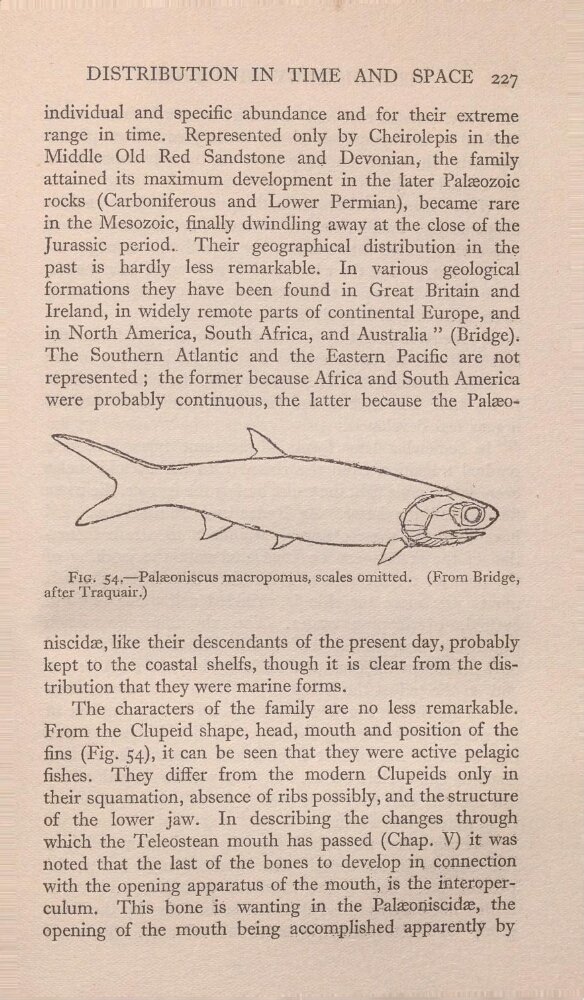
omitted. (From Badge;— .?
?
,_
f,
_
,
,
ÏÏ,‘
-
’
' ,
niscidæÏ,like their descendantsjot—the‘prje‘sièhïc dan—proablÿï
.
}
kept to the coastal shelfs, though it,is
{from-the d18- '
'
tribution that they were marine forms.
'
Ï
l
,
,,
The characters of the family are no less remarkablé.
,
,Clupeid shape, head, mouth and positi0n of the
:
"
ns (Fig. 54), it can be seen that they were active pelagiC
shes.
,
They differ from the modern Clupeids Only_in
'
'
their squaniation, absence of ribs possibly, and
'
"of the lower jaw. In— describing the changesthrough
_
which the Tele0Stean mouth has passed (ChapV)1twas
'
,
noœd tha—t the last of the_…bones:to devebplnœnnewonî
,
With the,openi‘ng'appàràtus—Ôf th€1n01Itha13themïempeï'
__
ThÏS-ÏYÔHQ 18wantlnglnth€Palæ0lSCldæ,Îhe
:
bpenî—ng- If<‘>f
.
th}è im0uthbemgaccomphshedaPPaœnY bY _,
SPACE
,
individual and specic abundance and for their extreme
range in time.
Represented Only by Cheirolepis in the
,.
Middle Old Red Sandstone, and ;Devonian, the family
attained its maximum' development in the later Èalæozoic
,
rocks (Carboniferous and Lower Permianj, became rare
in' the Mesozoic, nally dwindling-Ïaway at thé-close,er the
]urassic period… Their geographical distribution;si
'
,
past is hardly less ,remarkable. … In, various geological,
formations they have been found in Great Britain—and
'
Ireland, in widely remote parts of continental Europe, and
’
in North America, South Africa, and;Australia
The Southern Atlantic and the Eastern_Pacic are not
represented; the former because Africaand South America
were probably continuous, the latter be“caùse the Palàeoæ
,
'
_
omitted. (From Badge;— .?
?
,_
f,
_
,
,
ÏÏ,‘
-
’
' ,
niscidæÏ,like their descendantsjot—the‘prje‘sièhïc dan—proablÿï
.
}
kept to the coastal shelfs, though it,is
{from-the d18- '
'
tribution that they were marine forms.
'
Ï
l
,
,,
The characters of the family are no less remarkablé.
,
,Clupeid shape, head, mouth and positi0n of the
:
"
ns (Fig. 54), it can be seen that they were active pelagiC
shes.
,
They differ from the modern Clupeids Only_in
'
'
their squaniation, absence of ribs possibly, and
'
"of the lower jaw. In— describing the changesthrough
_
which the Tele0Stean mouth has passed (ChapV)1twas
'
,
noœd tha—t the last of the_…bones:to devebplnœnnewonî
,
With the,openi‘ng'appàràtus—Ôf th€1n01Itha13themïempeï'
__
ThÏS-ÏYÔHQ 18wantlnglnth€Palæ0lSCldæ,Îhe
:
bpenî—ng- If<‘>f
.
th}è im0uthbemgaccomphshedaPPaœnY bY _,