

1.88
THE BIOLOGY OF FISHES,;
‘
On the other hand, we have the environment Which tends to;
make the characters vary.
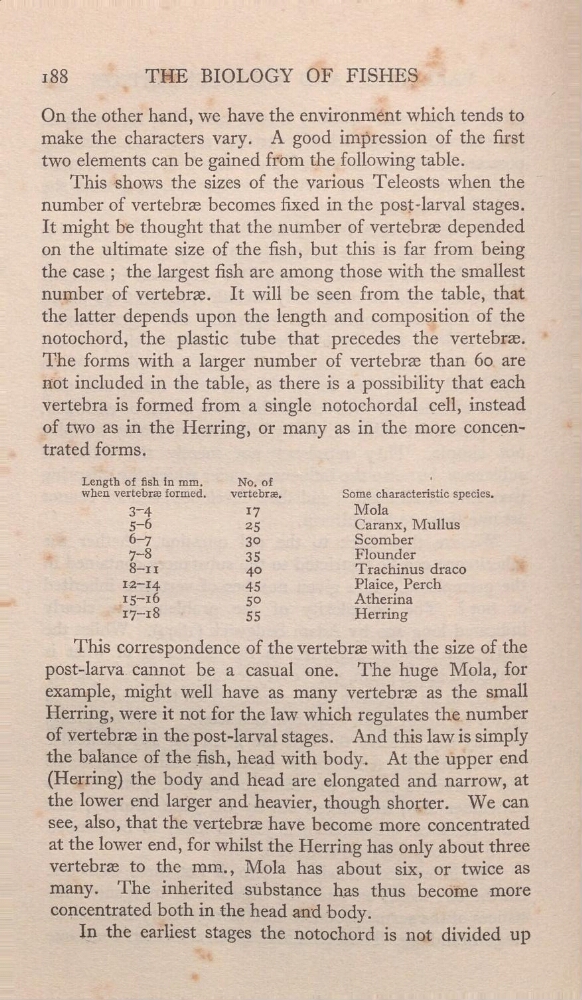
A good impression of the rst:
"
'
two elements can be gained fr0m the ÎOllowing table.
»
_
This Shows the sizes of the various Teleosts when the
{_
number of vertebræ becomes xed in the post»larval stages.
'
It might be thought that the number of vertebræ depended
,
on the ultimate size of the sh, but this is far from being
'à
the case ; the largest sh are among those With the smalle'st
number of vertebræ. It Will be seen from the table, that
4
the latter depends upon the length and composition of the
_
notochord, the plastic tube that _precedes the
'
The forms with a larger number of vertebræ than 60 are
'
not included in the table, as there is a possibility that each '
Vertebra is formed from a single notochordal cell, instead
Pf two as_in the Herring, or many as in the more concen—
..
trated forms.
_,
of sh in
No; of
'
,
'
when vertebræ formed.
vertebræ.
Some characteristic species.
.
3—4
17
Mola
5—6
25
Caranx, Mullus
.
.
6—7
30
Scomber
-
«
7—8
35
Flounder
'
‘
8—11
40
—
Trachinus draco
'
12—14 —
45
Plaice, Perch
.
-
'
.
50
Atherina
”
,_
""'I7—18
—
55
Herring
_'
This correSpondence of the vertebràe With the size of the
f
post—larva. cannot be a casual, one., The huge Mola, for
,
example,'nght well have
'
as many vertebræ as the small , j
Herring,
notf0tthe; law which regulates the number
ÔfÿVeïtebræ -in'»the"post-laryal stages. And this law is simply 1
the balance of
Atthe upper endand narrow, at
thelOwered larger '_and-__heaVier,though shorter. We cari
'
‘
866, 3150, that the Ÿerte“bræ have become more concentrated
;
at the lower end, for whilst the-Herring has only about three
_
,
vertebræ to
about six,“.or twice as
:*
:
?
many; Theÿ inherited substance has thus become more
'
Concentrated:b0th m the head and; body;
g …"
Î_
l
—
stagesthe_gnotochord is Il_Ôt diyidçd UP
THE BIOLOGY OF FISHES,;
‘
On the other hand, we have the environment Which tends to;
make the characters vary.
A good impression of the rst:
"
'
two elements can be gained fr0m the ÎOllowing table.
»
_
This Shows the sizes of the various Teleosts when the
{_
number of vertebræ becomes xed in the post»larval stages.
'
It might be thought that the number of vertebræ depended
,
on the ultimate size of the sh, but this is far from being
'à
the case ; the largest sh are among those With the smalle'st
number of vertebræ. It Will be seen from the table, that
4
the latter depends upon the length and composition of the
_
notochord, the plastic tube that _precedes the
'
The forms with a larger number of vertebræ than 60 are
'
not included in the table, as there is a possibility that each '
Vertebra is formed from a single notochordal cell, instead
Pf two as_in the Herring, or many as in the more concen—
..
trated forms.
_,
of sh in
No; of
'
,
'
when vertebræ formed.
vertebræ.
Some characteristic species.
.
3—4
17
Mola
5—6
25
Caranx, Mullus
.
.
6—7
30
Scomber
-
«
7—8
35
Flounder
'
‘
8—11
40
—
Trachinus draco
'
12—14 —
45
Plaice, Perch
.
-
'
.
50
Atherina
”
,_
""'I7—18
—
55
Herring
_'
This correSpondence of the vertebràe With the size of the
f
post—larva. cannot be a casual, one., The huge Mola, for
,
example,'nght well have
'
as many vertebræ as the small , j
Herring,
notf0tthe; law which regulates the number
ÔfÿVeïtebræ -in'»the"post-laryal stages. And this law is simply 1
the balance of
Atthe upper endand narrow, at
thelOwered larger '_and-__heaVier,though shorter. We cari
'
‘
866, 3150, that the Ÿerte“bræ have become more concentrated
;
at the lower end, for whilst the-Herring has only about three
_
,
vertebræ to
about six,“.or twice as
:*
:
?
many; Theÿ inherited substance has thus become more
'
Concentrated:b0th m the head and; body;
g …"
Î_
l
—
stagesthe_gnotochord is Il_Ôt diyidçd UP