

176
THE BIOEOGY OF FISHES'
.
In the same way we can estimate hoW far the average of the
_
"
sample of individuals is likely to representthe real
ï
average of the species in nature.
For this purp05e Some
,
Well—known rules and formulæ are given by mathematicians.
,
When the frequencies have been plotted out on a curve,
_
the latter forms a polygon whose characteristics can be
”
calculated and expressed by means of certain factors or
moments.
The average is the rst moment.
The Second
î
moment is obtained by calculating the error of mean square
_
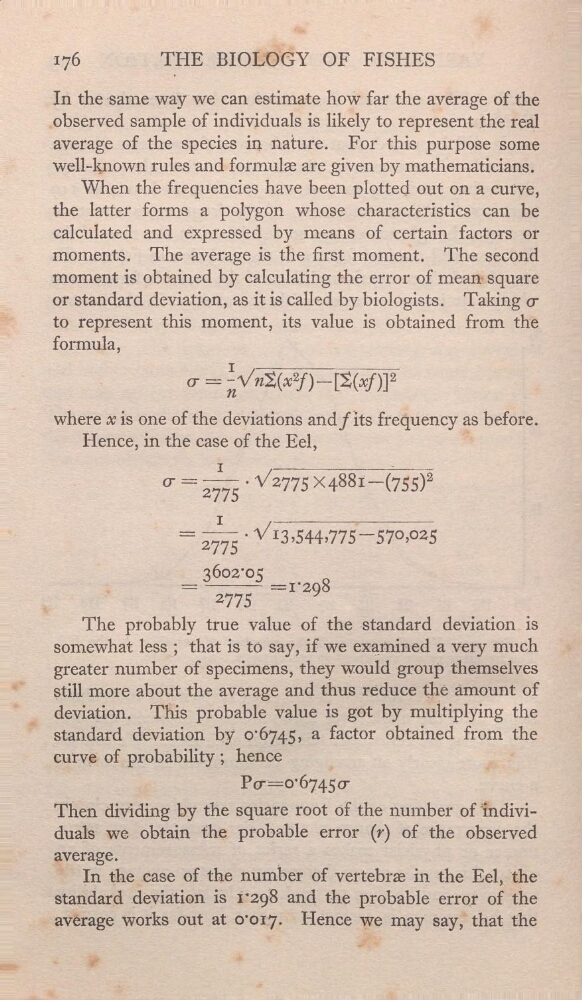
or standard deviation, as it is called by biologists. Taking o_
Îçt‘
to represent this moment, its value is obtained from the
_
f0rmula,
.
-
—a
=—;ÏVnE
…:
Where 90 is one of the deviations and f its frec‘iuency as before.
—.
_
Hence, in the case of the Bel,
'
,
I
-—————‘——:
__
__
_
_
-_
,
2
.
_
V2775 ><4881 (755)
'_
1
‘
_
—Ï
_
_
_
2775
13,544,775
570,025
-
'
_
'
__
___3_60_225 =I'298 _
_
’
_
,
-‘
.
2775
,
‘
_
The probably true value of the standard deviationis
_
someWhat less; that is to say, ifWe
vcry_much
greater number of
they Would ‘i'gi-oup themseIVes
_
still more about the average and thus reduce the amount of
,Î
_
deviation. This probable Value is got bÿstnùltiplying the
”?
standard,
by_ o_‘_6_745,— __‘aÏ factor obtained from
_Ï
.
…
of the number of indivi-f
.
,
”dualsï We 'Obtainflthe ”probable error (7) of, the Observed
…
__ __
_
_
_
_
__
__ __
vertèbræ in.—the
'
I”fï29’8 and! the probable-error- offthe
’;
:
…
__
-;—avëi‘age ,_—Woi‘ksÏ out—' at
HenCe' weÏmay‘_
that the
THE BIOEOGY OF FISHES'
.
In the same way we can estimate hoW far the average of the
_
"
sample of individuals is likely to representthe real
ï
average of the species in nature.
For this purp05e Some
,
Well—known rules and formulæ are given by mathematicians.
,
When the frequencies have been plotted out on a curve,
_
the latter forms a polygon whose characteristics can be
”
calculated and expressed by means of certain factors or
moments.
The average is the rst moment.
The Second
î
moment is obtained by calculating the error of mean square
_
or standard deviation, as it is called by biologists. Taking o_
Îçt‘
to represent this moment, its value is obtained from the
_
f0rmula,
.
-
—a
=—;ÏVnE
…:
Where 90 is one of the deviations and f its frec‘iuency as before.
—.
_
Hence, in the case of the Bel,
'
,
I
-—————‘——:
__
__
_
_
-_
,
2
.
_
V2775 ><4881 (755)
'_
1
‘
_
—Ï
_
_
_
2775
13,544,775
570,025
-
'
_
'
__
___3_60_225 =I'298 _
_
’
_
,
-‘
.
2775
,
‘
_
The probably true value of the standard deviationis
_
someWhat less; that is to say, ifWe
vcry_much
greater number of
they Would ‘i'gi-oup themseIVes
_
still more about the average and thus reduce the amount of
,Î
_
deviation. This probable Value is got bÿstnùltiplying the
”?
standard,
by_ o_‘_6_745,— __‘aÏ factor obtained from
_Ï
.
…
of the number of indivi-f
.
,
”dualsï We 'Obtainflthe ”probable error (7) of, the Observed
…
__ __
_
_
_
_
__
__ __
vertèbræ in.—the
'
I”fï29’8 and! the probable-error- offthe
’;
:
…
__
-;—avëi‘age ,_—Woi‘ksÏ out—' at
HenCe' weÏmay‘_
that the