

-
ECONOMY .OF THE BODY—«ll
169
of the upper surface of the brain corresponding to the slope
of the skull (Fig. 24). In the Dipnoi where the lower jaw
art10ulates d1rectly with the skull‘opposite the optic lobes,
the latter are pressed together and fusedinto one.
_
In the
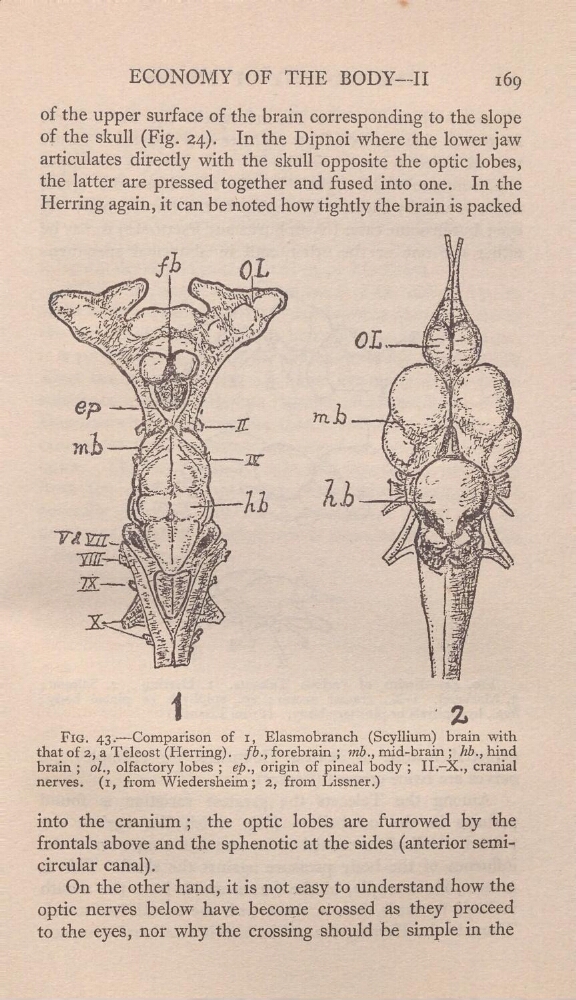
Herring again, it can be oted how tightly the braingis packed
_
-…r—4'/îî
“‘“s.
4,1
3% :-,{\/«fj_l_{ ""'.
-',‘
.
"
,
ÛL—
»
-£…
,
:”;
“:x—rf—
,
î—'-—
_’: a“ _g4. _.g
‘.
ÎË-Ïf
———_..‘
’1
_‘2
.
ep
?
«“‘ÎL
1
mb
,
.
,.Æ:—:_
.
’s
,
—
‘
'
'»
3‘:‘:_
;'—313—"
_
‘
'_
.
_
.-_.
!.‘ÿ
.
,
FIG. 43.—Comparison of I, Elasmobranch (Scyllium) brain With
that of 2, aTeleost (Herring). fb.,forebrain; mb.,mid—brain; hb., hind
,
,
f
.
brain ; al., olfactor'y lobes ; 'ep., origin of pineal body ; II.—X., craiàl
nerves.
.(1 ,
from Wiedersheim; 2, from Lissner.)
'
-
-
'
,
into the Crânium; the optio lobes are furrowed by the,
,
*
frontals_;aboye and the —_sphenotic' at» the sides
circular canal);
_
f
,_
_
'
.
,
On the other hand, it.isËnot .eàs'yto understand—:‘how the
_
'
’_
optio nerves' below’ have. become
they prooeed
to the eyes, nor why the crossing
the
ECONOMY .OF THE BODY—«ll
169
of the upper surface of the brain corresponding to the slope
of the skull (Fig. 24). In the Dipnoi where the lower jaw
art10ulates d1rectly with the skull‘opposite the optic lobes,
the latter are pressed together and fusedinto one.
_
In the
Herring again, it can be oted how tightly the braingis packed
_
-…r—4'/îî
“‘“s.
4,1
3% :-,{\/«fj_l_{ ""'.
-',‘
.
"
,
ÛL—
»
-£…
,
:”;
“:x—rf—
,
î—'-—
_’: a“ _g4. _.g
‘.
ÎË-Ïf
———_..‘
’1
_‘2
.
ep
?
«“‘ÎL
1
mb
,
.
,.Æ:—:_
.
’s
,
—
‘
'
'»
3‘:‘:_
;'—313—"
_
‘
'_
.
_
.-_.
!.‘ÿ
.
,
FIG. 43.—Comparison of I, Elasmobranch (Scyllium) brain With
that of 2, aTeleost (Herring). fb.,forebrain; mb.,mid—brain; hb., hind
,
,
f
.
brain ; al., olfactor'y lobes ; 'ep., origin of pineal body ; II.—X., craiàl
nerves.
.(1 ,
from Wiedersheim; 2, from Lissner.)
'
-
-
'
,
into the Crânium; the optio lobes are furrowed by the,
,
*
frontals_;aboye and the —_sphenotic' at» the sides
circular canal);
_
f
,_
_
'
.
,
On the other hand, it.isËnot .eàs'yto understand—:‘how the
_
'
’_
optio nerves' below’ have. become
they prooeed
to the eyes, nor why the crossing
the