

164
THE BIOLOGY OF FISHES
of “the phenomena. Very small eyes like those of the“
,
Gastrostomids (Fig. 10) may react to the violet rays of the
,
spectrum, which are still appreciable at depths of a thousand
_
metres, but the large eyes are in the gray of darkness long
before that depth is reached. ,It is probable that the shes
Which live at these and greater depths are dependent on their
_
other organs and not on the eyes, which in all probability _
have become functionless partly from lack of use and partly
'
from the great pressures acting upon them. The retention
_
_
of eyes
at all by these forms is due
_,.%,\
/”“’
perhaps
to the1r comparatwely
recent
_
em1gratron out from the littoral waters
_
.
—
,
’
(
The peculiar structure of the eyes, ,
_
\
nature of the lens and cornea may be
'»
_
of service in the refraction and dis…
-_
’
persion of the light rays. In those
,
'
_/
shes which live near the surface or
g
"
,
/ ’
.
..
.
//
1n shallower waters, the image on the *: ’
'
retina may be a coloured one and the
Ï
sense
of colour in these shes has
,
‘.
reached a nenes_s and delicacy un—
'
Η
».
\__ _
surpassed in any other group of ani‘
mals.
That their perception of colour
,
_
,
is controlled by the eyes Was con-…
:l3
clusively
_
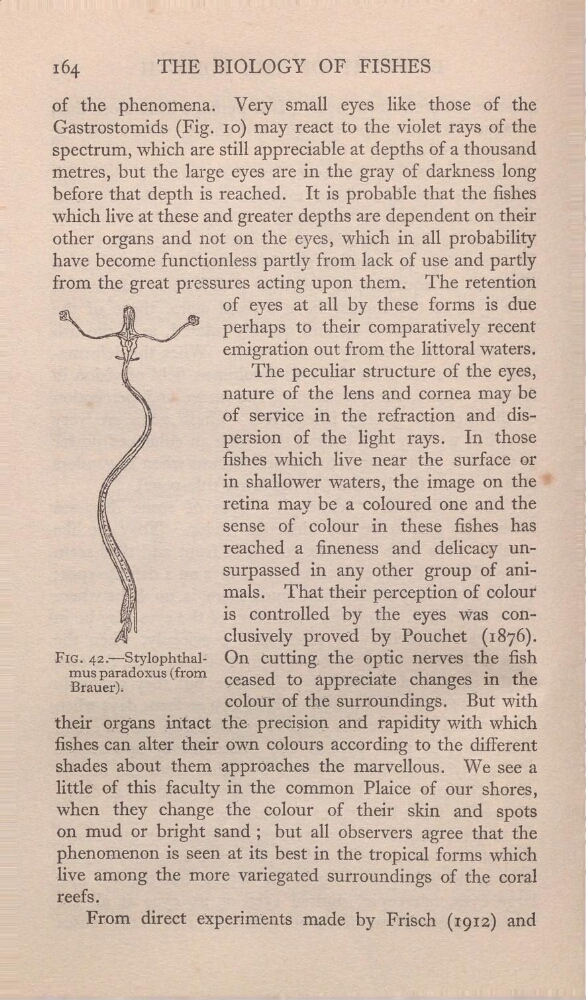
42.“———Stylophthal£ On
the—;,ôpt‘ic new—es : the =îsh
Ç@ä$Ï€ ::toi «appreciate hng ihiï*the
colourgof1 thesurroundmgs , But with
the1r
iaÏh‘d: fap‘idity with which -jf‘z
_
shes can alter their own colours according to the different
'
gapproaChes the marvellous. We see a
fllittl'é- of this,faculty in the common Plaiee of our shores,
'
When they change the colour of their skin and
on mud or— bright sand; but all observers agree that the
phenomehon is seen at its best in the tropical forms which
'
f live“ among
the more variegated surroundings _Ofïthe. c0ral - Ï
-,
.
…
'
_
;__ _
From
experiments
by Fri”Sch_ (19i2) and
_
THE BIOLOGY OF FISHES
of “the phenomena. Very small eyes like those of the“
,
Gastrostomids (Fig. 10) may react to the violet rays of the
,
spectrum, which are still appreciable at depths of a thousand
_
metres, but the large eyes are in the gray of darkness long
before that depth is reached. ,It is probable that the shes
Which live at these and greater depths are dependent on their
_
other organs and not on the eyes, which in all probability _
have become functionless partly from lack of use and partly
'
from the great pressures acting upon them. The retention
_
_
of eyes
at all by these forms is due
_,.%,\
/”“’
perhaps
to the1r comparatwely
recent
_
em1gratron out from the littoral waters
_
.
—
,
’
(
The peculiar structure of the eyes, ,
_
\
nature of the lens and cornea may be
'»
_
of service in the refraction and dis…
-_
’
persion of the light rays. In those
,
'
_/
shes which live near the surface or
g
"
,
/ ’
.
..
.
//
1n shallower waters, the image on the *: ’
'
retina may be a coloured one and the
Ï
sense
of colour in these shes has
,
‘.
reached a nenes_s and delicacy un—
'
Η
».
\__ _
surpassed in any other group of ani‘
mals.
That their perception of colour
,
_
,
is controlled by the eyes Was con-…
:l3
clusively
_
42.“———Stylophthal£ On
the—;,ôpt‘ic new—es : the =îsh
Ç@ä$Ï€ ::toi «appreciate hng ihiï*the
colourgof1 thesurroundmgs , But with
the1r
iaÏh‘d: fap‘idity with which -jf‘z
_
shes can alter their own colours according to the different
'
gapproaChes the marvellous. We see a
fllittl'é- of this,faculty in the common Plaiee of our shores,
'
When they change the colour of their skin and
on mud or— bright sand; but all observers agree that the
phenomehon is seen at its best in the tropical forms which
'
f live“ among
the more variegated surroundings _Ofïthe. c0ral - Ï
-,
.
…
'
_
;__ _
From
experiments
by Fri”Sch_ (19i2) and
_