

160
THE BIOLOGY OF FISHES
»_
,
or statocyst as it should be called”, is the specialised anterior
portion of this system, the innervation of both coming from
' _
’
the VIII. cranial nerve (Mayser,
1908).
The
…
olfactory or smelling organs have developed from similar
…
,
pits on the front of the head and are supplied by the I.
(
cranial nerve.
In addition, there are several other branches
'
,
of the lateral line system on the head, above and below the
:
eyes and on the lower jaw, the principal innervation of which
seems also to come from the VIII. nerve.
_
-
The part played by these organs in the life of shes has
been the subject of much discussion and research. The
‘
diffuse end—buds or‘pit-organs as well as the olfactory organs
-
seem able to detect differences in the chemical nature of
the surroundings. Whilst the majority of shes seek their
.
food bysight, Bateson found in his experiments at Plymouth
that many-(Eds, Flat—shes, etc.) do not start in quest of
food, when it is rst put into the tanks, until the scent has
become dilfused.
Then they begin to swim vaguel'y about
Ï
and appear to seek the food by examining the whole” area
.
pervaded by the scent. Hérrick (1903) came to the conclusion, With regard _to the Cat-sh”, that the organs of taste
or smell must pervade the Wholesldn. The sh Will seize
unseen
great precision provided it« is brought_
near the skin; '
end—buds largely replace the- eyes
_
Ï
547
5
'
_'
"
as a means of discovering
,
j
food.
_
'_
._
‘
’
\3
h
On the- pthÊr_ihandî
__
'
*“af\_,
't e organS_
t e atera
,
…,
line have- quite a different
“
"
function. - '
They
have
:
hb
been clOsely studied by
‘
W
'
many workers and the
"
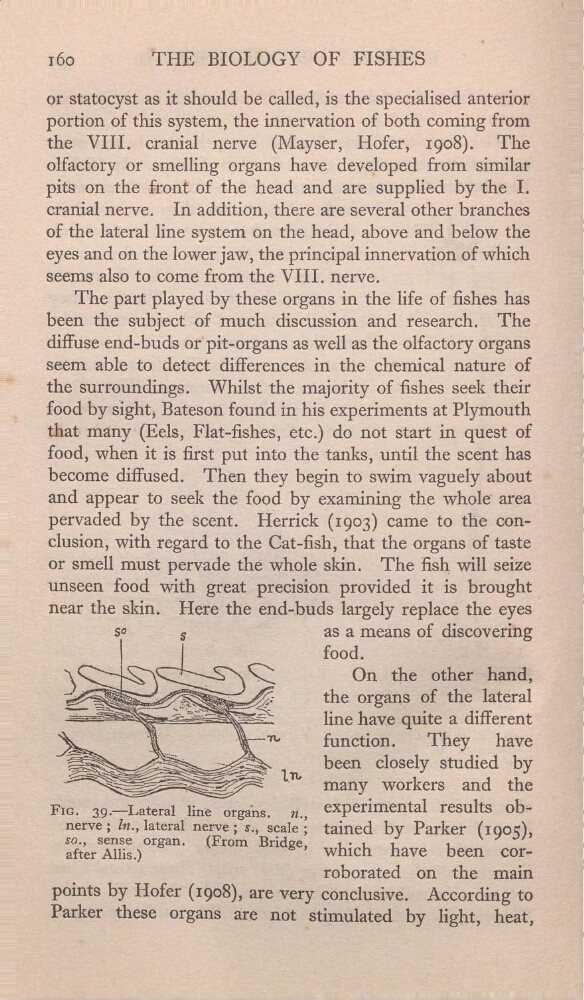
FIé.
n-,
experimental reSults ,ob;
.
_
_nerVe;"ln;, lateral nerve ;
scale; tained by Parker (1905),
f
_
which
been
'
cor—
£,.
.'
.
-—
'
‘
roborated
on
the
main
f
points bY
very conclusiVe; …According to
"
Parker
are
stimulated ’ by light, heat,
THE BIOLOGY OF FISHES
»_
,
or statocyst as it should be called”, is the specialised anterior
portion of this system, the innervation of both coming from
' _
’
the VIII. cranial nerve (Mayser,
1908).
The
…
olfactory or smelling organs have developed from similar
…
,
pits on the front of the head and are supplied by the I.
(
cranial nerve.
In addition, there are several other branches
'
,
of the lateral line system on the head, above and below the
:
eyes and on the lower jaw, the principal innervation of which
seems also to come from the VIII. nerve.
_
-
The part played by these organs in the life of shes has
been the subject of much discussion and research. The
‘
diffuse end—buds or‘pit-organs as well as the olfactory organs
-
seem able to detect differences in the chemical nature of
the surroundings. Whilst the majority of shes seek their
.
food bysight, Bateson found in his experiments at Plymouth
that many-(Eds, Flat—shes, etc.) do not start in quest of
food, when it is rst put into the tanks, until the scent has
become dilfused.
Then they begin to swim vaguel'y about
Ï
and appear to seek the food by examining the whole” area
.
pervaded by the scent. Hérrick (1903) came to the conclusion, With regard _to the Cat-sh”, that the organs of taste
or smell must pervade the Wholesldn. The sh Will seize
unseen
great precision provided it« is brought_
near the skin; '
end—buds largely replace the- eyes
_
Ï
547
5
'
_'
"
as a means of discovering
,
j
food.
_
'_
._
‘
’
\3
h
On the- pthÊr_ihandî
__
'
*“af\_,
't e organS_
t e atera
,
…,
line have- quite a different
“
"
function. - '
They
have
:
hb
been clOsely studied by
‘
W
'
many workers and the
"
FIé.
n-,
experimental reSults ,ob;
.
_
_nerVe;"ln;, lateral nerve ;
scale; tained by Parker (1905),
f
_
which
been
'
cor—
£,.
.'
.
-—
'
‘
roborated
on
the
main
f
points bY
very conclusiVe; …According to
"
Parker
are
stimulated ’ by light, heat,