

on the other hand, copper and lead were positively correlated
with body size of caged fish and wild one, respectively (Fig.
3). Even more so some positive inter-metallic correlation was
found in fish from cages. It is suggested that these metals are
linked with each other and that their accumulation behavior in
muscle is identical. Our results were opposite to those of Merciai
et al. (2014) that report no correlation between metal accumulation and body size in the Mediterranean Sea.
Heavy metal levels in fishes showed a strong correlation
with their habitat (Zhao et al. 2012; Yigit et al. 2018). Lead
and zinc were bioaccumulated in fish muscle (Askary Sary
and Mohammadi 2012). This correlation is due to bioavailability of metal and proximity to coastal: Sparus aurata is a
euryhaline species and the fish farm was close to the shoreline
(coastal mariculture) where gasoline leaks from fishing boats
in harbors and contaminate local environment (Lounas et al.
2020). Copper is essential for the growth, spawning, and
swimming performance of the fish (Grosell 2011), while zinc
is a cofactor of proteins and functions (Hogstrand 2011).
Thus, Cu and Zn were easier to accumulate in fish than nonessential elements (Cd and Pb) (Qiu 2015) while arsenic is a
toxic element, particularly in its inorganic form, without nutritional or metabolic known functions (Ferrante et al. 2019)
and whose concentrations decrease as trophic level increases
(McIntyre and Linton 2011). For the other metals, there was
no significant relationship, mainly due to food abundance and
composition (composed feed or carnivorous) (Ouellet et al.
2013), as well as the season (Ongeri et al. 2012). Previous
studies have exhibited that particular fish parasites can accumulate toxic metals from the aquatic environment (Dural et al.
2011). In brief, all metal levels were significantly different
among areas (Friedman’s test, p < 0.05).
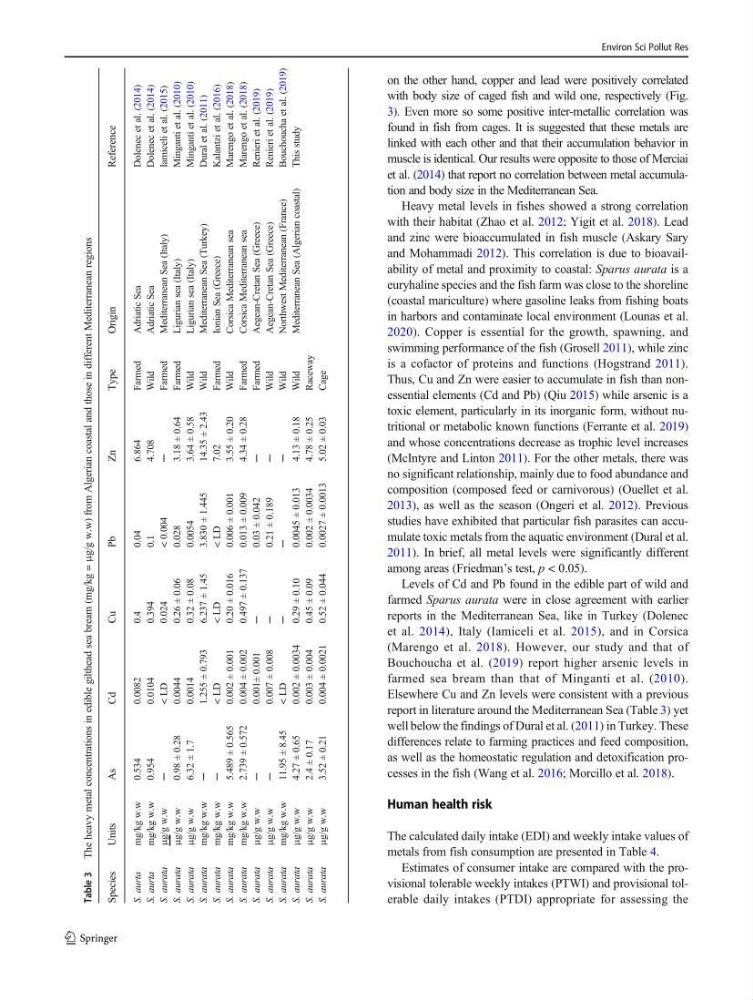
Levels of Cd and Pb found in the edible part of wild and
farmed Sparus aurata were in close agreement with earlier
reports in the Mediterranean Sea, like in Turkey (Dolenec
et al. 2014), Italy (Iamiceli et al. 2015), and in Corsica
(Marengo et al. 2018). However, our study and that of
Bouchoucha et al. (2019) report higher arsenic levels in
farmed sea bream than that of Minganti et al. (2010).
Elsewhere Cu and Zn levels were consistent with a previous
report in literature around the Mediterranean Sea (Table 3) yet
well below the findings of Dural et al. (2011) in Turkey. These
differences relate to farming practices and feed composition,
as well as the homeostatic regulation and detoxification processes in the fish (Wang et al. 2016; Morcillo et al. 2018).
Human health risk
The calculated daily intake (EDI) and weekly intake values of
metals from fish consumption are presented in Table 4.
Estimates of consumer intake are compared with the provisional tolerable weekly intakes (PTWI) and provisional tolerable daily intakes (PTDI) appropriate for assessing the
Table 3
The heavy metal concentrations in edible gilthead sea bream (mg/kg =
μg/g w.w) from Algerian coastal and those in different Mediterranean regions
Species
Units
As
Cd
Cu
Pb
Zn
Type
Origin
Reference
S. aurta
mg/kg w.w
0.534
0.0082
0.4
0.04
6.864
Farmed
Adriatic Sea
Dolenec et al. (2014)
S. aurta
mg/kg w.w
0.954
0.0104
0.394
0.1
4.708
Wild
Adriatic Sea
Dolenec et al. (2014)
S. aurata
μg/g w.w
─
< LD
0.024
< 0.004
─
Farmed
Mediterranean Sea (Italy)
Iamiceli et al. (2015)
S. aurata
μg/g w.w
0.98 ± 0.28
0.0044
0.26 ± 0.06
0.028
3.18 ± 0.64
Farmed
Ligurian sea (Italy)
Minganti et al. (2010)
S. aurata
μg/g w.w
6.32 ± 1.7
0.0014
0.32 ± 0.08
0.0054
3.64 ± 0.58
Wild
Ligurian sea (Italy)
Minganti et al. (2010)
S. aurata
mg/kg w.w
─
1.255 ± 0.793
6.237 ± 1.45
3.830 ± 1.445
14.35 ± 2.43
Wild
Mediterranean Sea (Turkey)
Dural et al. (2011)
S. aurata
mg/kg w.w
─
< LD
< LD
< LD
7.02
Farmed
Ionian Sea (Greece)
Kalantzi et al. (2016)
S. aurata
mg/kg w.w
5.489 ± 0.565
0.002 ± 0.001
0.20 ± 0.016
0.006 ± 0.001
3.55 ± 0.20
Wild
Corsica Mediterranean sea
Marengo et al. (2018)
S. aurata
mg/kg w.w
2.739 ± 0.572
0.004 ± 0.002
0.497 ± 0.137
0.013 ± 0.009
4.34 ± 0.28
Farmed
Corsica Mediterranean sea
Marengo et al. (2018)
S. aurata
μg/g w.w
─
0.001± 0.001
─
0.03 ± 0.042
─
Farmed
Aegean-Cretan Sea (Greece)
Renieri et al. (2019)
S. aurata
μg/g w.w
─
0.007 ± 0.008
─
0.21 ± 0.189
─
Wild
Aegean-Cretan Sea (Greece)
Renieri et al. (2019)
S. aurata
mg/kg w.w
11.95 ± 8.45
< LD
─
─
─
Wild
Northwest Mediterranean (France)
Bouchoucha et al. (2019)
S. aurata
μg/g w.w
4.27 ± 0.65
0.002 ± 0.0034
0.29 ± 0.10
0.0045 ± 0.013
4.13 ± 0.18
Wild
Mediterranean Sea (Algerian coastal)
This study
S. aurata
μg/g w.w
2.4 ± 0.17
0.003 ± 0.004
0.45 ± 0.09
0.002 ± 0.0034
4.78 ± 0.25
Raceway
S. aurata
μg/g w.w
3.52 ± 0.21
0.004 ± 0.0021
0.52 ± 0.044
0.0027 ± 0.0013
5.02 ± 0.03
Cage
Environ Sci Pollut Res
with body size of caged fish and wild one, respectively (Fig.
3). Even more so some positive inter-metallic correlation was
found in fish from cages. It is suggested that these metals are
linked with each other and that their accumulation behavior in
muscle is identical. Our results were opposite to those of Merciai
et al. (2014) that report no correlation between metal accumulation and body size in the Mediterranean Sea.
Heavy metal levels in fishes showed a strong correlation
with their habitat (Zhao et al. 2012; Yigit et al. 2018). Lead
and zinc were bioaccumulated in fish muscle (Askary Sary
and Mohammadi 2012). This correlation is due to bioavailability of metal and proximity to coastal: Sparus aurata is a
euryhaline species and the fish farm was close to the shoreline
(coastal mariculture) where gasoline leaks from fishing boats
in harbors and contaminate local environment (Lounas et al.
2020). Copper is essential for the growth, spawning, and
swimming performance of the fish (Grosell 2011), while zinc
is a cofactor of proteins and functions (Hogstrand 2011).
Thus, Cu and Zn were easier to accumulate in fish than nonessential elements (Cd and Pb) (Qiu 2015) while arsenic is a
toxic element, particularly in its inorganic form, without nutritional or metabolic known functions (Ferrante et al. 2019)
and whose concentrations decrease as trophic level increases
(McIntyre and Linton 2011). For the other metals, there was
no significant relationship, mainly due to food abundance and
composition (composed feed or carnivorous) (Ouellet et al.
2013), as well as the season (Ongeri et al. 2012). Previous
studies have exhibited that particular fish parasites can accumulate toxic metals from the aquatic environment (Dural et al.
2011). In brief, all metal levels were significantly different
among areas (Friedman’s test, p < 0.05).
Levels of Cd and Pb found in the edible part of wild and
farmed Sparus aurata were in close agreement with earlier
reports in the Mediterranean Sea, like in Turkey (Dolenec
et al. 2014), Italy (Iamiceli et al. 2015), and in Corsica
(Marengo et al. 2018). However, our study and that of
Bouchoucha et al. (2019) report higher arsenic levels in
farmed sea bream than that of Minganti et al. (2010).
Elsewhere Cu and Zn levels were consistent with a previous
report in literature around the Mediterranean Sea (Table 3) yet
well below the findings of Dural et al. (2011) in Turkey. These
differences relate to farming practices and feed composition,
as well as the homeostatic regulation and detoxification processes in the fish (Wang et al. 2016; Morcillo et al. 2018).
Human health risk
The calculated daily intake (EDI) and weekly intake values of
metals from fish consumption are presented in Table 4.
Estimates of consumer intake are compared with the provisional tolerable weekly intakes (PTWI) and provisional tolerable daily intakes (PTDI) appropriate for assessing the
Table 3
The heavy metal concentrations in edible gilthead sea bream (mg/kg =
μg/g w.w) from Algerian coastal and those in different Mediterranean regions
Species
Units
As
Cd
Cu
Pb
Zn
Type
Origin
Reference
S. aurta
mg/kg w.w
0.534
0.0082
0.4
0.04
6.864
Farmed
Adriatic Sea
Dolenec et al. (2014)
S. aurta
mg/kg w.w
0.954
0.0104
0.394
0.1
4.708
Wild
Adriatic Sea
Dolenec et al. (2014)
S. aurata
μg/g w.w
─
< LD
0.024
< 0.004
─
Farmed
Mediterranean Sea (Italy)
Iamiceli et al. (2015)
S. aurata
μg/g w.w
0.98 ± 0.28
0.0044
0.26 ± 0.06
0.028
3.18 ± 0.64
Farmed
Ligurian sea (Italy)
Minganti et al. (2010)
S. aurata
μg/g w.w
6.32 ± 1.7
0.0014
0.32 ± 0.08
0.0054
3.64 ± 0.58
Wild
Ligurian sea (Italy)
Minganti et al. (2010)
S. aurata
mg/kg w.w
─
1.255 ± 0.793
6.237 ± 1.45
3.830 ± 1.445
14.35 ± 2.43
Wild
Mediterranean Sea (Turkey)
Dural et al. (2011)
S. aurata
mg/kg w.w
─
< LD
< LD
< LD
7.02
Farmed
Ionian Sea (Greece)
Kalantzi et al. (2016)
S. aurata
mg/kg w.w
5.489 ± 0.565
0.002 ± 0.001
0.20 ± 0.016
0.006 ± 0.001
3.55 ± 0.20
Wild
Corsica Mediterranean sea
Marengo et al. (2018)
S. aurata
mg/kg w.w
2.739 ± 0.572
0.004 ± 0.002
0.497 ± 0.137
0.013 ± 0.009
4.34 ± 0.28
Farmed
Corsica Mediterranean sea
Marengo et al. (2018)
S. aurata
μg/g w.w
─
0.001± 0.001
─
0.03 ± 0.042
─
Farmed
Aegean-Cretan Sea (Greece)
Renieri et al. (2019)
S. aurata
μg/g w.w
─
0.007 ± 0.008
─
0.21 ± 0.189
─
Wild
Aegean-Cretan Sea (Greece)
Renieri et al. (2019)
S. aurata
mg/kg w.w
11.95 ± 8.45
< LD
─
─
─
Wild
Northwest Mediterranean (France)
Bouchoucha et al. (2019)
S. aurata
μg/g w.w
4.27 ± 0.65
0.002 ± 0.0034
0.29 ± 0.10
0.0045 ± 0.013
4.13 ± 0.18
Wild
Mediterranean Sea (Algerian coastal)
This study
S. aurata
μg/g w.w
2.4 ± 0.17
0.003 ± 0.004
0.45 ± 0.09
0.002 ± 0.0034
4.78 ± 0.25
Raceway
S. aurata
μg/g w.w
3.52 ± 0.21
0.004 ± 0.0021
0.52 ± 0.044
0.0027 ± 0.0013
5.02 ± 0.03
Cage
Environ Sci Pollut Res