

§ 3. Some Applications of Cauchy’s Method
89
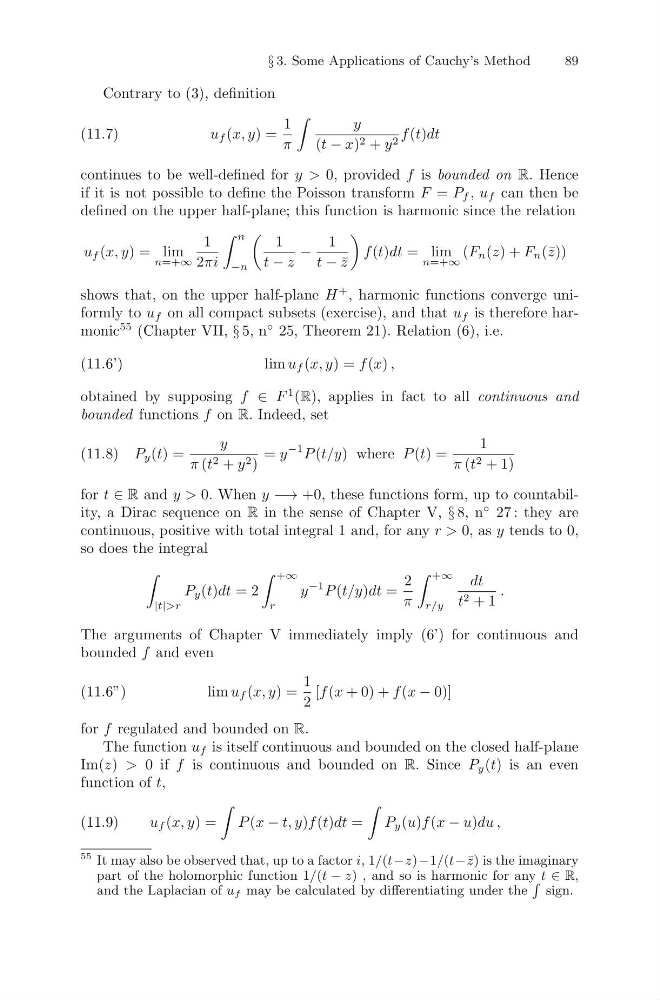
Contrary to (3), definition
u f (x, y) =
1
π
y
(t − x) 2 + y 2 f (t)dt
(11.7)
continues to be well-defined for y > 0, provided f is bounded on R. Hence
if it is not possible to define the Poisson transform F = P f , u f can then be
defined on the upper half-plane; this function is harmonic since the relation
u f (x, y) = lim
n=+∞
1
2πi
n
−n
1
t − z
−
1
t − ¯
z
f (t)dt = lim
n=+∞
(F n (z) + F n (¯ z))
shows that, on the upper half-plane H
+ , harmonic functions converge uniformly to u f on all compact subsets (exercise), and that u f is therefore harmonic
55 (Chapter VII, § 5, n
◦ 25, Theorem 21). Relation (6), i.e.
lim u f (x, y) = f (x) ,
(11.6’)
obtained by supposing f ∈ F
1 (R), applies in fact to all continuous and
bounded functions f on R. Indeed, set
P y (t) =
y
π (t 2 + y 2 )
= y
−1 P (t/y) where P (t) =
1
π (t 2 + 1)
(11.8)
for t ∈ R and y > 0. When y −→ +0, these functions form, up to countability, a Dirac sequence on R in the sense of Chapter V, § 8, n
◦ 27 : they are
continuous, positive with total integral 1 and, for any r > 0, as y tends to 0,
so does the integral
|t|>r
P y (t)dt = 2
+∞
r
y
−1 P (t/y)dt =
2
π
+∞
r/y
dt
t 2 + 1
.
The arguments of Chapter V immediately imply (6’) for continuous and
bounded f and even
lim u f (x, y) =
1
2
[f (x + 0) + f (x − 0)]
(11.6”)
for f regulated and bounded on R.
The function u f is itself continuous and bounded on the closed half-plane
Im(z) > 0 if f is continuous and bounded on R. Since P y (t) is an even
function of t,
u f (x, y) =
P (x − t, y)f (t)dt =
P y (u)f (x − u)du ,
(11.9)
55 It may also be observed that, up to a factor i, 1/(t−z)−1/(t− ¯
z) is the imaginary
part of the holomorphic function 1/(t − z) , and so is harmonic for any t ∈ R,
and the Laplacian of u f may be calculated by differentiating under the
sign.
89
Contrary to (3), definition
u f (x, y) =
1
π
y
(t − x) 2 + y 2 f (t)dt
(11.7)
continues to be well-defined for y > 0, provided f is bounded on R. Hence
if it is not possible to define the Poisson transform F = P f , u f can then be
defined on the upper half-plane; this function is harmonic since the relation
u f (x, y) = lim
n=+∞
1
2πi
n
−n
1
t − z
−
1
t − ¯
z
f (t)dt = lim
n=+∞
(F n (z) + F n (¯ z))
shows that, on the upper half-plane H
+ , harmonic functions converge uniformly to u f on all compact subsets (exercise), and that u f is therefore harmonic
55 (Chapter VII, § 5, n
◦ 25, Theorem 21). Relation (6), i.e.
lim u f (x, y) = f (x) ,
(11.6’)
obtained by supposing f ∈ F
1 (R), applies in fact to all continuous and
bounded functions f on R. Indeed, set
P y (t) =
y
π (t 2 + y 2 )
= y
−1 P (t/y) where P (t) =
1
π (t 2 + 1)
(11.8)
for t ∈ R and y > 0. When y −→ +0, these functions form, up to countability, a Dirac sequence on R in the sense of Chapter V, § 8, n
◦ 27 : they are
continuous, positive with total integral 1 and, for any r > 0, as y tends to 0,
so does the integral
|t|>r
P y (t)dt = 2
+∞
r
y
−1 P (t/y)dt =
2
π
+∞
r/y
dt
t 2 + 1
.
The arguments of Chapter V immediately imply (6’) for continuous and
bounded f and even
lim u f (x, y) =
1
2
[f (x + 0) + f (x − 0)]
(11.6”)
for f regulated and bounded on R.
The function u f is itself continuous and bounded on the closed half-plane
Im(z) > 0 if f is continuous and bounded on R. Since P y (t) is an even
function of t,
u f (x, y) =
P (x − t, y)f (t)dt =
P y (u)f (x − u)du ,
(11.9)
55 It may also be observed that, up to a factor i, 1/(t−z)−1/(t− ¯
z) is the imaginary
part of the holomorphic function 1/(t − z) , and so is harmonic for any t ∈ R,
and the Laplacian of u f may be calculated by differentiating under the
sign.