

76
VIII – Cauchy Theory
Res(h, n) = (−1)
n f (n)/(n − z) = −(−1)
n f (n)/(z − n) ,
(9.3)
and, also a simple pole at z, where
Res(h, z) = g(z) .
(9.4)
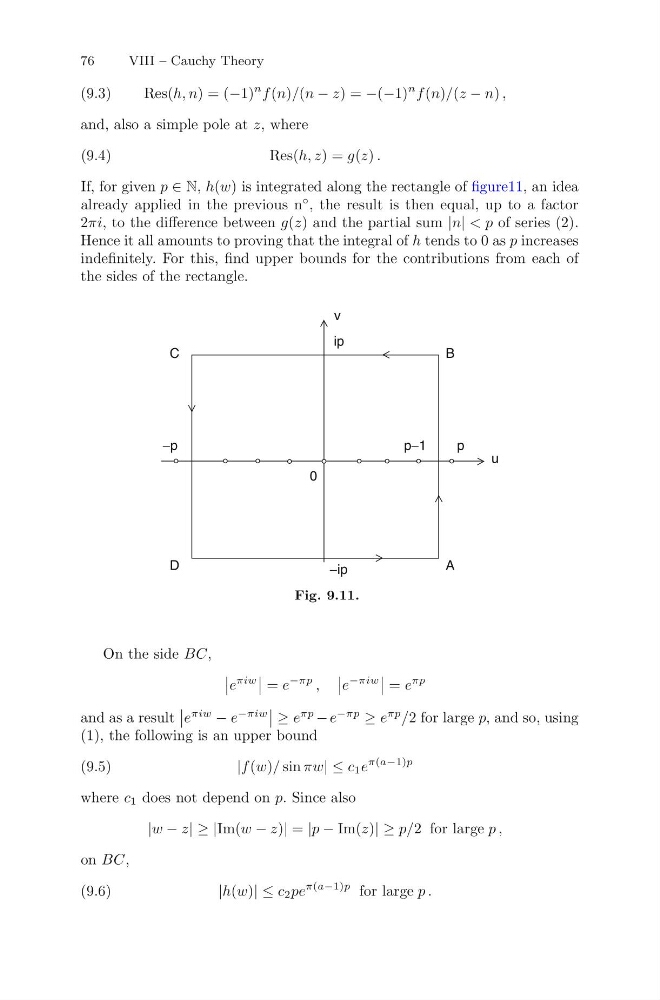
If, for given p ∈ N, h(w) is integrated along the rectangle of figure11, an idea
already applied in the previous n
◦ , the result is then equal, up to a factor
2πi, to the difference between g(z) and the partial sum |n| < p of series (2).
Hence it all amounts to proving that the integral of h tends to 0 as p increases
indefinitely. For this, find upper bounds for the contributions from each of
the sides of the rectangle.
C
B
A
D
v
ip
−ip
0
u
−p
p 1
−
p
Fig. 9.11.
On the side BC,
e
πiw
= e
−πp ,
e
−πiw
= e
πp
and as a result
e
πiw
− e
−πiw
≥ e
πp
− e
−πp
≥ e
πp /2 for large p, and so, using
(1), the following is an upper bound
|f (w)/ sin πw| ≤ c 1 e
π(a−1)p
(9.5)
where c 1 does not depend on p. Since also
|w − z| ≥ |Im(w − z)| = |p − Im(z)| ≥ p/2 for large p ,
on BC,
|h(w)| ≤ c 2 pe
π(a−1)p for large p .
(9.6)
VIII – Cauchy Theory
Res(h, n) = (−1)
n f (n)/(n − z) = −(−1)
n f (n)/(z − n) ,
(9.3)
and, also a simple pole at z, where
Res(h, z) = g(z) .
(9.4)
If, for given p ∈ N, h(w) is integrated along the rectangle of figure11, an idea
already applied in the previous n
◦ , the result is then equal, up to a factor
2πi, to the difference between g(z) and the partial sum |n| < p of series (2).
Hence it all amounts to proving that the integral of h tends to 0 as p increases
indefinitely. For this, find upper bounds for the contributions from each of
the sides of the rectangle.
C
B
A
D
v
ip
−ip
0
u
−p
p 1
−
p
Fig. 9.11.
On the side BC,
e
πiw
= e
−πp ,
e
−πiw
= e
πp
and as a result
e
πiw
− e
−πiw
≥ e
πp
− e
−πp
≥ e
πp /2 for large p, and so, using
(1), the following is an upper bound
|f (w)/ sin πw| ≤ c 1 e
π(a−1)p
(9.5)
where c 1 does not depend on p. Since also
|w − z| ≥ |Im(w − z)| = |p − Im(z)| ≥ p/2 for large p ,
on BC,
|h(w)| ≤ c 2 pe
π(a−1)p for large p .
(9.6)