

60
VIII – Cauchy Theory
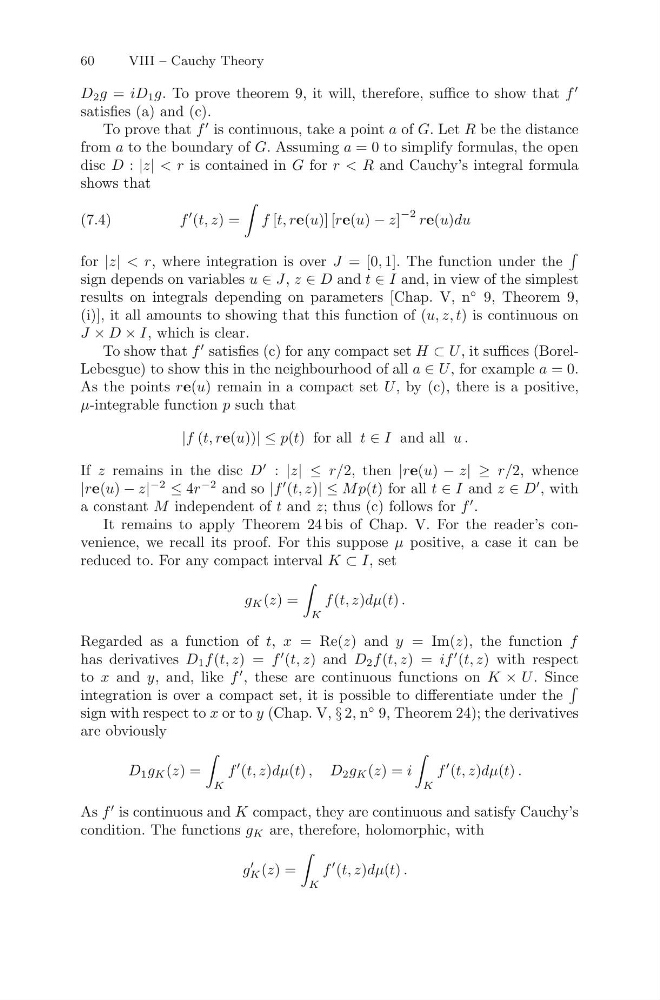
D 2 g = iD 1 g. To prove theorem 9, it will, therefore, suffice to show that f
satisfies (a) and (c).
To prove that f
is continuous, take a point a of G. Let R be the distance
from a to the boundary of G. Assuming a = 0 to simplify formulas, the open
disc D : |z| < r is contained in G for r < R and Cauchy’s integral formula
shows that
f
(t, z) =
f [t, re(u)] [re(u) − z]
−2 re(u)du
(7.4)
for |z| < r, where integration is over J = [0, 1]. The function under the
sign depends on variables u ∈ J, z ∈ D and t ∈ I and, in view of the simplest
results on integrals depending on parameters [Chap. V, n
◦ 9, Theorem 9,
(i)], it all amounts to showing that this function of (u, z, t) is continuous on
J × D × I, which is clear.
To show that f
satisfies (c) for any compact set H ⊂ U , it suffices (BorelLebesgue) to show this in the neighbourhood of all a ∈ U , for example a = 0.
As the points re(u) remain in a compact set U , by (c), there is a positive,
μ-integrable function p such that
|f (t, re(u))| ≤ p(t) for all t ∈ I and all u .
If z remains in the disc D
: |z| ≤ r/2, then |re(u) − z| ≥ r/2, whence
|re(u) − z|
−2
≤ 4r
−2 and so |f
(t, z)| ≤ Mp(t) for all t ∈ I and z ∈ D
, with
a constant M independent of t and z; thus (c) follows for f
.
It remains to apply Theorem 24 bis of Chap. V. For the reader’s convenience, we recall its proof. For this suppose μ positive, a case it can be
reduced to. For any compact interval K ⊂ I, set
g K (z) =
K
f (t, z)dμ(t) .
Regarded as a function of t, x = Re(z) and y = Im(z), the function f
has derivatives D 1 f (t, z) = f
(t, z) and D 2 f (t, z) = if
(t, z) with respect
to x and y, and, like f
, these are continuous functions on K × U . Since
integration is over a compact set, it is possible to differentiate under the
sign with respect to x or to y (Chap. V, § 2, n
◦ 9, Theorem 24); the derivatives
are obviously
D 1 g K (z) =
K
f
(t, z)dμ(t) , D 2 g K (z) = i
K
f
(t, z)dμ(t) .
As f
is continuous and K compact, they are continuous and satisfy Cauchy’s
condition. The functions g K are, therefore, holomorphic, with
g
K (z) =
K
f
(t, z)dμ(t) .
VIII – Cauchy Theory
D 2 g = iD 1 g. To prove theorem 9, it will, therefore, suffice to show that f
satisfies (a) and (c).
To prove that f
is continuous, take a point a of G. Let R be the distance
from a to the boundary of G. Assuming a = 0 to simplify formulas, the open
disc D : |z| < r is contained in G for r < R and Cauchy’s integral formula
shows that
f
(t, z) =
f [t, re(u)] [re(u) − z]
−2 re(u)du
(7.4)
for |z| < r, where integration is over J = [0, 1]. The function under the
sign depends on variables u ∈ J, z ∈ D and t ∈ I and, in view of the simplest
results on integrals depending on parameters [Chap. V, n
◦ 9, Theorem 9,
(i)], it all amounts to showing that this function of (u, z, t) is continuous on
J × D × I, which is clear.
To show that f
satisfies (c) for any compact set H ⊂ U , it suffices (BorelLebesgue) to show this in the neighbourhood of all a ∈ U , for example a = 0.
As the points re(u) remain in a compact set U , by (c), there is a positive,
μ-integrable function p such that
|f (t, re(u))| ≤ p(t) for all t ∈ I and all u .
If z remains in the disc D
: |z| ≤ r/2, then |re(u) − z| ≥ r/2, whence
|re(u) − z|
−2
≤ 4r
−2 and so |f
(t, z)| ≤ Mp(t) for all t ∈ I and z ∈ D
, with
a constant M independent of t and z; thus (c) follows for f
.
It remains to apply Theorem 24 bis of Chap. V. For the reader’s convenience, we recall its proof. For this suppose μ positive, a case it can be
reduced to. For any compact interval K ⊂ I, set
g K (z) =
K
f (t, z)dμ(t) .
Regarded as a function of t, x = Re(z) and y = Im(z), the function f
has derivatives D 1 f (t, z) = f
(t, z) and D 2 f (t, z) = if
(t, z) with respect
to x and y, and, like f
, these are continuous functions on K × U . Since
integration is over a compact set, it is possible to differentiate under the
sign with respect to x or to y (Chap. V, § 2, n
◦ 9, Theorem 24); the derivatives
are obviously
D 1 g K (z) =
K
f
(t, z)dμ(t) , D 2 g K (z) = i
K
f
(t, z)dμ(t) .
As f
is continuous and K compact, they are continuous and satisfy Cauchy’s
condition. The functions g K are, therefore, holomorphic, with
g
K (z) =
K
f
(t, z)dμ(t) .