

58
VIII – Cauchy Theory
V
G
U
U
U
K
K
μ
Ext( )
μ
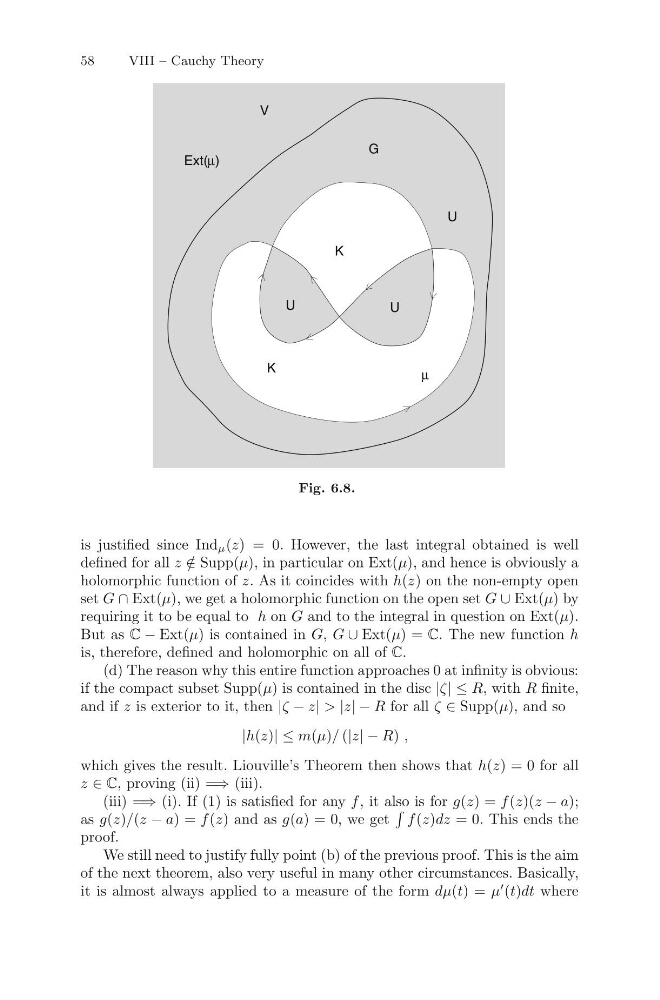
Fig. 6.8.
is justified since Ind μ (z) = 0. However, the last integral obtained is well
defined for all z /
∈ Supp(μ), in particular on Ext(μ), and hence is obviously a
holomorphic function of z. As it coincides with h(z) on the non-empty open
set G ∩ Ext(μ), we get a holomorphic function on the open set G ∪ Ext(μ) by
requiring it to be equal to h on G and to the integral in question on Ext(μ).
But as C − Ext(μ) is contained in G, G ∪ Ext(μ) = C. The new function h
is, therefore, defined and holomorphic on all of C.
(d) The reason why this entire function approaches 0 at infinity is obvious:
if the compact subset Supp(μ) is contained in the disc |ζ| ≤ R, with R finite,
and if z is exterior to it, then |ζ − z| > |z| − R for all ζ ∈ Supp(μ), and so
|h(z)| ≤ m(μ)/ (|z| − R) ,
which gives the result. Liouville’s Theorem then shows that h(z) = 0 for all
z ∈ C, proving (ii) =⇒ (iii).
(iii) =⇒ (i). If (1) is satisfied for any f , it also is for g(z) = f (z)(z − a);
as g(z)/(z − a) = f (z) and as g(a) = 0, we get
f (z)dz = 0. This ends the
proof.
We still need to justify fully point (b) of the previous proof. This is the aim
of the next theorem, also very useful in many other circumstances. Basically,
it is almost always applied to a measure of the form dμ(t) = μ
(t)dt where
VIII – Cauchy Theory
V
G
U
U
U
K
K
μ
Ext( )
μ
Fig. 6.8.
is justified since Ind μ (z) = 0. However, the last integral obtained is well
defined for all z /
∈ Supp(μ), in particular on Ext(μ), and hence is obviously a
holomorphic function of z. As it coincides with h(z) on the non-empty open
set G ∩ Ext(μ), we get a holomorphic function on the open set G ∪ Ext(μ) by
requiring it to be equal to h on G and to the integral in question on Ext(μ).
But as C − Ext(μ) is contained in G, G ∪ Ext(μ) = C. The new function h
is, therefore, defined and holomorphic on all of C.
(d) The reason why this entire function approaches 0 at infinity is obvious:
if the compact subset Supp(μ) is contained in the disc |ζ| ≤ R, with R finite,
and if z is exterior to it, then |ζ − z| > |z| − R for all ζ ∈ Supp(μ), and so
|h(z)| ≤ m(μ)/ (|z| − R) ,
which gives the result. Liouville’s Theorem then shows that h(z) = 0 for all
z ∈ C, proving (ii) =⇒ (iii).
(iii) =⇒ (i). If (1) is satisfied for any f , it also is for g(z) = f (z)(z − a);
as g(z)/(z − a) = f (z) and as g(a) = 0, we get
f (z)dz = 0. This ends the
proof.
We still need to justify fully point (b) of the previous proof. This is the aim
of the next theorem, also very useful in many other circumstances. Basically,
it is almost always applied to a measure of the form dμ(t) = μ
(t)dt where