

50
VIII – Cauchy Theory
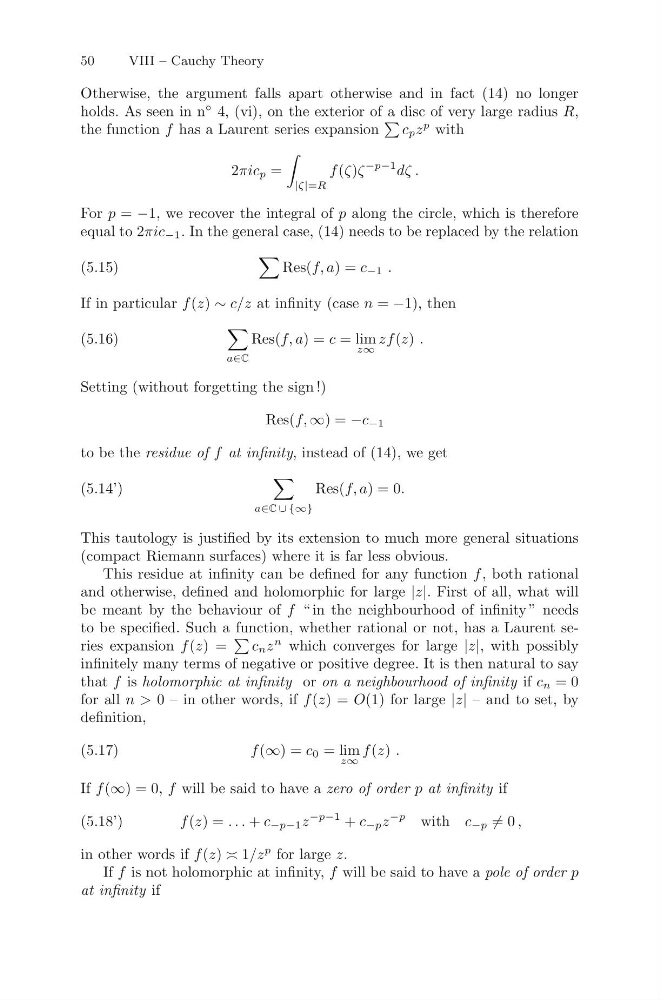
Otherwise, the argument falls apart otherwise and in fact (14) no longer
holds. As seen in n
◦ 4, (vi), on the exterior of a disc of very large radius R,
the function f has a Laurent series expansion
c p z
p with
2πic p =
|ζ|=R
f (ζ)ζ
−p−1 dζ .
For p = −1, we recover the integral of p along the circle, which is therefore
equal to 2πic −1 . In the general case, (14) needs to be replaced by the relation
Res(f, a) = c −1 .
(5.15)
If in particular f (z) ∼ c/z at infinity (case n = −1), then
a∈C
Res(f, a) = c = lim
z∞
zf (z) .
(5.16)
Setting (without forgetting the sign !)
Res(f, ∞) = −c −1
to be the residue of f at infinity, instead of (14), we get
a∈C ∪ {∞}
Res(f, a) = 0.
(5.14’)
This tautology is justified by its extension to much more general situations
(compact Riemann surfaces) where it is far less obvious.
This residue at infinity can be defined for any function f , both rational
and otherwise, defined and holomorphic for large |z|. First of all, what will
be meant by the behaviour of f “ in the neighbourhood of infinity ” needs
to be specified. Such a function, whether rational or not, has a Laurent series expansion f (z) =
c n z
n which converges for large |z|, with possibly
infinitely many terms of negative or positive degree. It is then natural to say
that f is holomorphic at infinity or on a neighbourhood of infinity if c n = 0
for all n > 0 – in other words, if f (z) = O(1) for large |z| – and to set, by
definition,
f (∞) = c 0 = lim
z∞
f (z) .
(5.17)
If f (∞) = 0, f will be said to have a zero of order p at infinity if
f (z) = . . . + c −p−1 z
−p−1 + c −p z
−p
with c −p = 0 ,
(5.18’)
in other words if f (z) 1/z
p for large z.
If f is not holomorphic at infinity, f will be said to have a pole of order p
at infinity if
VIII – Cauchy Theory
Otherwise, the argument falls apart otherwise and in fact (14) no longer
holds. As seen in n
◦ 4, (vi), on the exterior of a disc of very large radius R,
the function f has a Laurent series expansion
c p z
p with
2πic p =
|ζ|=R
f (ζ)ζ
−p−1 dζ .
For p = −1, we recover the integral of p along the circle, which is therefore
equal to 2πic −1 . In the general case, (14) needs to be replaced by the relation
Res(f, a) = c −1 .
(5.15)
If in particular f (z) ∼ c/z at infinity (case n = −1), then
a∈C
Res(f, a) = c = lim
z∞
zf (z) .
(5.16)
Setting (without forgetting the sign !)
Res(f, ∞) = −c −1
to be the residue of f at infinity, instead of (14), we get
a∈C ∪ {∞}
Res(f, a) = 0.
(5.14’)
This tautology is justified by its extension to much more general situations
(compact Riemann surfaces) where it is far less obvious.
This residue at infinity can be defined for any function f , both rational
and otherwise, defined and holomorphic for large |z|. First of all, what will
be meant by the behaviour of f “ in the neighbourhood of infinity ” needs
to be specified. Such a function, whether rational or not, has a Laurent series expansion f (z) =
c n z
n which converges for large |z|, with possibly
infinitely many terms of negative or positive degree. It is then natural to say
that f is holomorphic at infinity or on a neighbourhood of infinity if c n = 0
for all n > 0 – in other words, if f (z) = O(1) for large |z| – and to set, by
definition,
f (∞) = c 0 = lim
z∞
f (z) .
(5.17)
If f (∞) = 0, f will be said to have a zero of order p at infinity if
f (z) = . . . + c −p−1 z
−p−1 + c −p z
−p
with c −p = 0 ,
(5.18’)
in other words if f (z) 1/z
p for large z.
If f is not holomorphic at infinity, f will be said to have a pole of order p
at infinity if