

§ 2. Cauchy’s Integral Formulas
45
Corollary. A holomorphic function f on G − S,where G in simply connected, has a primitive on G − S if and only if Res(f, a) = 0 for all a ∈ S.
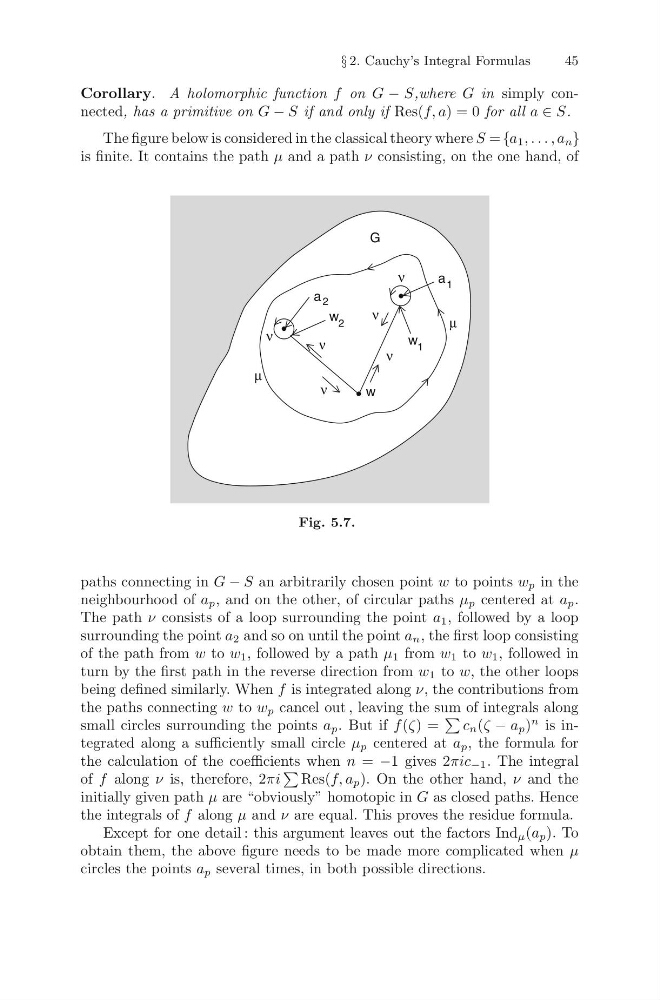
The figure below is considered in the classical theory where S = {a 1 , . . . , a n }
is finite. It contains the path μ and a path ν consisting, on the one hand, of
G
a
a
w
w
w
μ
μ
ν
ν
ν
ν
ν
ν
1
1
2
2
Fig. 5.7.
paths connecting in G − S an arbitrarily chosen point w to points w p in the
neighbourhood of a p , and on the other, of circular paths μ p centered at a p .
The path ν consists of a loop surrounding the point a 1 , followed by a loop
surrounding the point a 2 and so on until the point a n , the first loop consisting
of the path from w to w 1 , followed by a path μ 1 from w 1 to w 1 , followed in
turn by the first path in the reverse direction from w 1 to w, the other loops
being defined similarly. When f is integrated along ν, the contributions from
the paths connecting w to w p cancel out , leaving the sum of integrals along
small circles surrounding the points a p . But if f (ζ) =
c n (ζ − a p )
n is integrated along a sufficiently small circle μ p centered at a p , the formula for
the calculation of the coefficients when n = −1 gives 2πic −1 . The integral
of f along ν is, therefore, 2πi
Res(f, a p ). On the other hand, ν and the
initially given path μ are “obviously” homotopic in G as closed paths. Hence
the integrals of f along μ and ν are equal. This proves the residue formula.
Except for one detail : this argument leaves out the factors Ind μ (a p ). To
obtain them, the above figure needs to be made more complicated when μ
circles the points a p several times, in both possible directions.
45
Corollary. A holomorphic function f on G − S,where G in simply connected, has a primitive on G − S if and only if Res(f, a) = 0 for all a ∈ S.
The figure below is considered in the classical theory where S = {a 1 , . . . , a n }
is finite. It contains the path μ and a path ν consisting, on the one hand, of
G
a
a
w
w
w
μ
μ
ν
ν
ν
ν
ν
ν
1
1
2
2
Fig. 5.7.
paths connecting in G − S an arbitrarily chosen point w to points w p in the
neighbourhood of a p , and on the other, of circular paths μ p centered at a p .
The path ν consists of a loop surrounding the point a 1 , followed by a loop
surrounding the point a 2 and so on until the point a n , the first loop consisting
of the path from w to w 1 , followed by a path μ 1 from w 1 to w 1 , followed in
turn by the first path in the reverse direction from w 1 to w, the other loops
being defined similarly. When f is integrated along ν, the contributions from
the paths connecting w to w p cancel out , leaving the sum of integrals along
small circles surrounding the points a p . But if f (ζ) =
c n (ζ − a p )
n is integrated along a sufficiently small circle μ p centered at a p , the formula for
the calculation of the coefficients when n = −1 gives 2πic −1 . The integral
of f along ν is, therefore, 2πi
Res(f, a p ). On the other hand, ν and the
initially given path μ are “obviously” homotopic in G as closed paths. Hence
the integrals of f along μ and ν are equal. This proves the residue formula.
Except for one detail : this argument leaves out the factors Ind μ (a p ). To
obtain them, the above figure needs to be made more complicated when μ
circles the points a p several times, in both possible directions.