

§ 2. Cauchy’s Integral Formulas
41
z
0
A
B
D
μ
μ
μ
μ
μ
γ
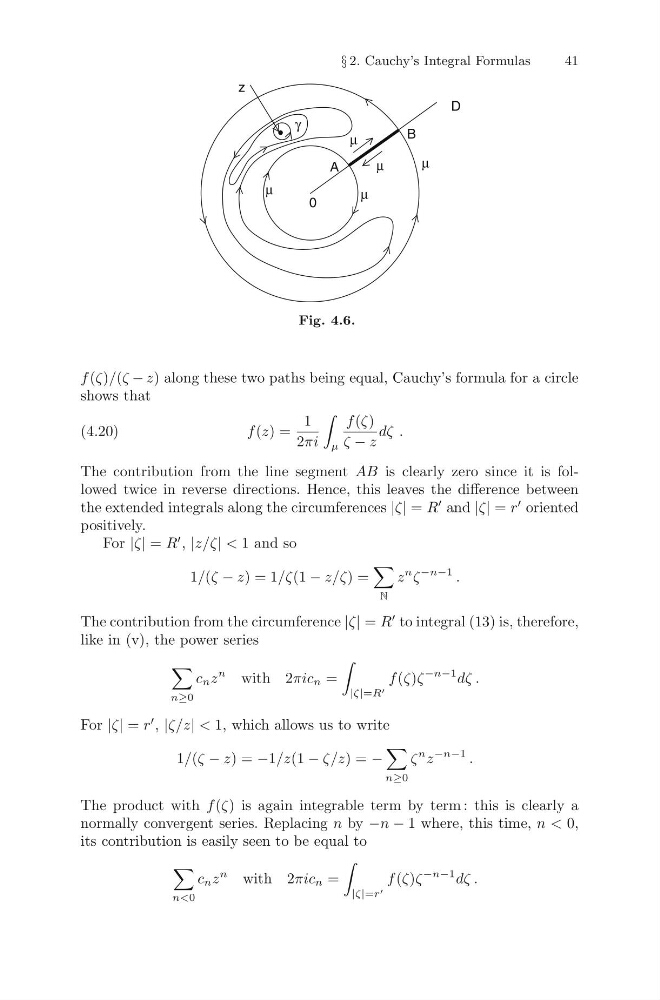
Fig. 4.6.
f (ζ)/(ζ − z) along these two paths being equal, Cauchy’s formula for a circle
shows that
f (z) =
1
2πi
μ
f (ζ)
ζ − z
dζ .
(4.20)
The contribution from the line segment AB is clearly zero since it is followed twice in reverse directions. Hence, this leaves the difference between
the extended integrals along the circumferences |ζ| = R
and |ζ| = r
oriented
positively.
For |ζ| = R
, |z/ζ| < 1 and so
1/(ζ − z) = 1/ζ(1 − z/ζ) =
N
z
n ζ
−n−1 .
The contribution from the circumference |ζ| = R
to integral (13) is, therefore,
like in (v), the power series
n≥0
c n z
n
with 2πic n =
|ζ|=R
f (ζ)ζ
−n−1 dζ .
For |ζ| = r
, |ζ/z| < 1, which allows us to write
1/(ζ − z) = −1/z(1 − ζ/z) = −
n≥0
ζ
n z
−n−1 .
The product with f (ζ) is again integrable term by term : this is clearly a
normally convergent series. Replacing n by −n − 1 where, this time, n < 0,
its contribution is easily seen to be equal to
n<0
c n z
n
with 2πic n =
|ζ|=r
f (ζ)ζ
−n−1 dζ .
41
z
0
A
B
D
μ
μ
μ
μ
μ
γ
Fig. 4.6.
f (ζ)/(ζ − z) along these two paths being equal, Cauchy’s formula for a circle
shows that
f (z) =
1
2πi
μ
f (ζ)
ζ − z
dζ .
(4.20)
The contribution from the line segment AB is clearly zero since it is followed twice in reverse directions. Hence, this leaves the difference between
the extended integrals along the circumferences |ζ| = R
and |ζ| = r
oriented
positively.
For |ζ| = R
, |z/ζ| < 1 and so
1/(ζ − z) = 1/ζ(1 − z/ζ) =
N
z
n ζ
−n−1 .
The contribution from the circumference |ζ| = R
to integral (13) is, therefore,
like in (v), the power series
n≥0
c n z
n
with 2πic n =
|ζ|=R
f (ζ)ζ
−n−1 dζ .
For |ζ| = r
, |ζ/z| < 1, which allows us to write
1/(ζ − z) = −1/z(1 − ζ/z) = −
n≥0
ζ
n z
−n−1 .
The product with f (ζ) is again integrable term by term : this is clearly a
normally convergent series. Replacing n by −n − 1 where, this time, n < 0,
its contribution is easily seen to be equal to
n<0
c n z
n
with 2πic n =
|ζ|=r
f (ζ)ζ
−n−1 dζ .