

§ 2. Cauchy’s Integral Formulas
37
where integration is over the given open set G
26 with respect to the usual
measure dm(z) = dxdy. We need to show that for holomorphic functions on
G, the relation
lim f − f n p = 0 implies lim f n (z) = f (z)
(4.15)
uniformly on any compact subset K of G, i.e. that there is an upper bound
f K ≤ M K f p
(4.16)
valid for any compact subset K ⊂ G and any function f holomorphic on G.
In fact, since under these conditions, for all r, lim f
(r)
n (z) = f
(r) (z) uniformly
on every compact subset, we also get upper bounds
f
(r)
K
≤ M K,r f p
(4.16)
for all r ∈ N.
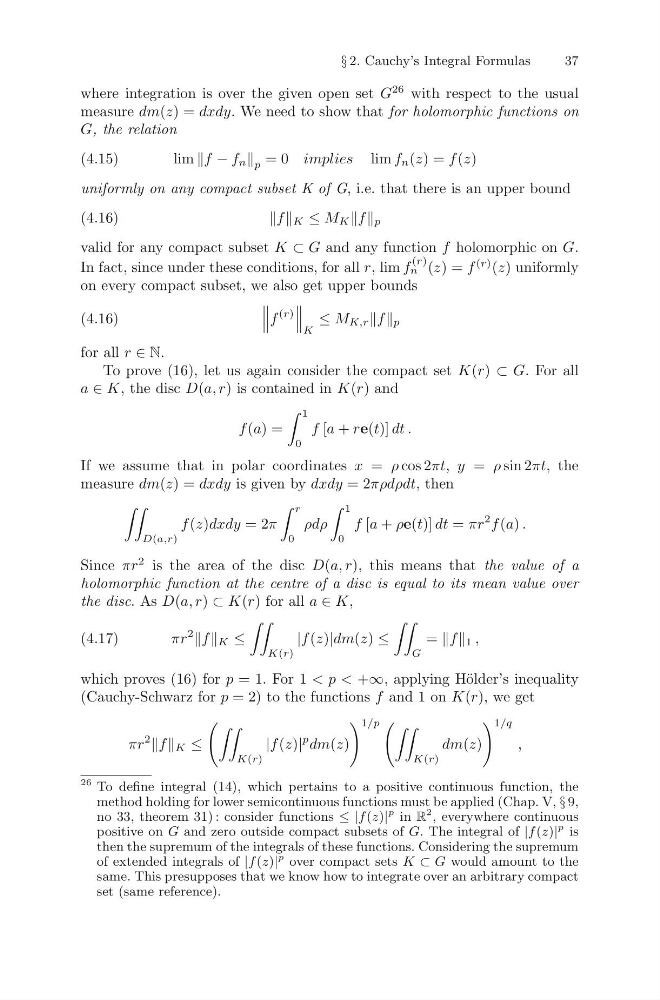
To prove (16), let us again consider the compact set K(r) ⊂ G. For all
a ∈ K, the disc D(a, r) is contained in K(r) and
f (a) =
1
0
f [a + re(t)] dt .
If we assume that in polar coordinates x = ρ cos 2πt, y = ρ sin 2πt, the
measure dm(z) = dxdy is given by dxdy = 2πρdρdt, then
D(a,r)
f (z)dxdy = 2π
r
0
ρdρ
1
0
f [a + ρe(t)] dt = πr
2 f (a) .
Since πr
2 is the area of the disc D(a, r), this means that the value of a
holomorphic function at the centre of a disc is equal to its mean value over
the disc. As D(a, r) ⊂ K(r) for all a ∈ K,
πr
2
f K ≤
K(r)
|f (z)|dm(z) ≤
G
= f 1 ,
(4.17)
which proves (16) for p = 1. For 1 < p < +∞, applying H¨ older’s inequality
(Cauchy-Schwarz for p = 2) to the functions f and 1 on K(r), we get
πr
2
f K ≤
K(r)
|f (z)|
p dm(z)
1/p
K(r)
dm(z)
1/q
,
26 To define integral (14), which pertains to a positive continuous function, the
method holding for lower semicontinuous functions must be applied (Chap. V, § 9,
no 33, theorem 31) : consider functions ≤ |f (z)|
p in R
2 , everywhere continuous
positive on G and zero outside compact subsets of G. The integral of |f (z)|
p is
then the supremum of the integrals of these functions. Considering the supremum
of extended integrals of |f (z)|
p over compact sets K ⊂ G would amount to the
same. This presupposes that we know how to integrate over an arbitrary compact
set (same reference).
37
where integration is over the given open set G
26 with respect to the usual
measure dm(z) = dxdy. We need to show that for holomorphic functions on
G, the relation
lim f − f n p = 0 implies lim f n (z) = f (z)
(4.15)
uniformly on any compact subset K of G, i.e. that there is an upper bound
f K ≤ M K f p
(4.16)
valid for any compact subset K ⊂ G and any function f holomorphic on G.
In fact, since under these conditions, for all r, lim f
(r)
n (z) = f
(r) (z) uniformly
on every compact subset, we also get upper bounds
f
(r)
K
≤ M K,r f p
(4.16)
for all r ∈ N.
To prove (16), let us again consider the compact set K(r) ⊂ G. For all
a ∈ K, the disc D(a, r) is contained in K(r) and
f (a) =
1
0
f [a + re(t)] dt .
If we assume that in polar coordinates x = ρ cos 2πt, y = ρ sin 2πt, the
measure dm(z) = dxdy is given by dxdy = 2πρdρdt, then
D(a,r)
f (z)dxdy = 2π
r
0
ρdρ
1
0
f [a + ρe(t)] dt = πr
2 f (a) .
Since πr
2 is the area of the disc D(a, r), this means that the value of a
holomorphic function at the centre of a disc is equal to its mean value over
the disc. As D(a, r) ⊂ K(r) for all a ∈ K,
πr
2
f K ≤
K(r)
|f (z)|dm(z) ≤
G
= f 1 ,
(4.17)
which proves (16) for p = 1. For 1 < p < +∞, applying H¨ older’s inequality
(Cauchy-Schwarz for p = 2) to the functions f and 1 on K(r), we get
πr
2
f K ≤
K(r)
|f (z)|
p dm(z)
1/p
K(r)
dm(z)
1/q
,
26 To define integral (14), which pertains to a positive continuous function, the
method holding for lower semicontinuous functions must be applied (Chap. V, § 9,
no 33, theorem 31) : consider functions ≤ |f (z)|
p in R
2 , everywhere continuous
positive on G and zero outside compact subsets of G. The integral of |f (z)|
p is
then the supremum of the integrals of these functions. Considering the supremum
of extended integrals of |f (z)|
p over compact sets K ⊂ G would amount to the
same. This presupposes that we know how to integrate over an arbitrary compact
set (same reference).