

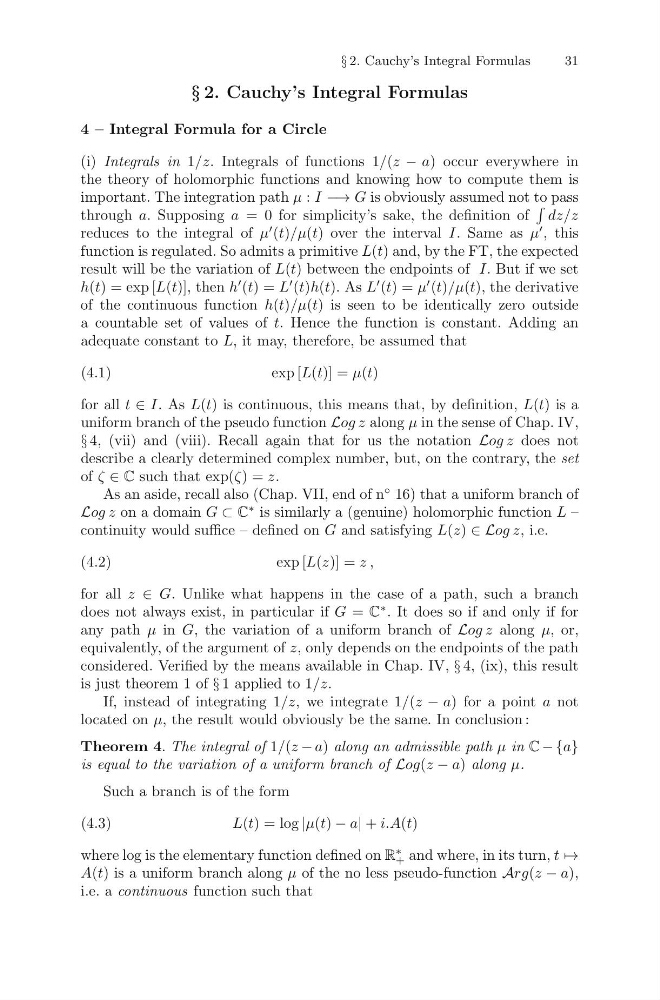
§ 2. Cauchy’s Integral Formulas
31
§ 2. Cauchy’s Integral Formulas
4 – Integral Formula for a Circle
(i) Integrals in 1/z. Integrals of functions 1/(z − a) occur everywhere in
the theory of holomorphic functions and knowing how to compute them is
important. The integration path μ : I −→ G is obviously assumed not to pass
through a. Supposing a = 0 for simplicity’s sake, the definition of
dz/z
reduces to the integral of μ
(t)/μ(t) over the interval I. Same as μ
, this
function is regulated. So admits a primitive L(t) and, by the FT, the expected
result will be the variation of L(t) between the endpoints of I. But if we set
h(t) = exp [L(t)], then h
(t) = L
(t)h(t). As L
(t) = μ
(t)/μ(t), the derivative
of the continuous function h(t)/μ(t) is seen to be identically zero outside
a countable set of values of t. Hence the function is constant. Adding an
adequate constant to L, it may, therefore, be assumed that
exp [L(t)] = μ(t)
(4.1)
for all t ∈ I. As L(t) is continuous, this means that, by definition, L(t) is a
uniform branch of the pseudo function Log z along μ in the sense of Chap. IV,
§ 4, (vii) and (viii). Recall again that for us the notation Log z does not
describe a clearly determined complex number, but, on the contrary, the set
of ζ ∈ C such that exp(ζ) = z.
As an aside, recall also (Chap. VII, end of n
◦ 16) that a uniform branch of
Log z on a domain G ⊂ C
∗ is similarly a (genuine) holomorphic function L –
continuity would suffice – defined on G and satisfying L(z) ∈ Log z, i.e.
exp [L(z)] = z ,
(4.2)
for all z ∈ G. Unlike what happens in the case of a path, such a branch
does not always exist, in particular if G = C
∗ . It does so if and only if for
any path μ in G, the variation of a uniform branch of Log z along μ, or,
equivalently, of the argument of z, only depends on the endpoints of the path
considered. Verified by the means available in Chap. IV, § 4, (ix), this result
is just theorem 1 of § 1 applied to 1/z.
If, instead of integrating 1/z, we integrate 1/(z − a) for a point a not
located on μ, the result would obviously be the same. In conclusion :
Theorem 4. The integral of 1/(z − a) along an admissible path μ in C − {a}
is equal to the variation of a uniform branch of Log(z − a) along μ.
Such a branch is of the form
L(t) = log |μ(t) − a| + i.A(t)
(4.3)
where log is the elementary function defined on R
∗
+ and where, in its turn, t →
A(t) is a uniform branch along μ of the no less pseudo-function Arg(z − a),
i.e. a continuous function such that
31
§ 2. Cauchy’s Integral Formulas
4 – Integral Formula for a Circle
(i) Integrals in 1/z. Integrals of functions 1/(z − a) occur everywhere in
the theory of holomorphic functions and knowing how to compute them is
important. The integration path μ : I −→ G is obviously assumed not to pass
through a. Supposing a = 0 for simplicity’s sake, the definition of
dz/z
reduces to the integral of μ
(t)/μ(t) over the interval I. Same as μ
, this
function is regulated. So admits a primitive L(t) and, by the FT, the expected
result will be the variation of L(t) between the endpoints of I. But if we set
h(t) = exp [L(t)], then h
(t) = L
(t)h(t). As L
(t) = μ
(t)/μ(t), the derivative
of the continuous function h(t)/μ(t) is seen to be identically zero outside
a countable set of values of t. Hence the function is constant. Adding an
adequate constant to L, it may, therefore, be assumed that
exp [L(t)] = μ(t)
(4.1)
for all t ∈ I. As L(t) is continuous, this means that, by definition, L(t) is a
uniform branch of the pseudo function Log z along μ in the sense of Chap. IV,
§ 4, (vii) and (viii). Recall again that for us the notation Log z does not
describe a clearly determined complex number, but, on the contrary, the set
of ζ ∈ C such that exp(ζ) = z.
As an aside, recall also (Chap. VII, end of n
◦ 16) that a uniform branch of
Log z on a domain G ⊂ C
∗ is similarly a (genuine) holomorphic function L –
continuity would suffice – defined on G and satisfying L(z) ∈ Log z, i.e.
exp [L(z)] = z ,
(4.2)
for all z ∈ G. Unlike what happens in the case of a path, such a branch
does not always exist, in particular if G = C
∗ . It does so if and only if for
any path μ in G, the variation of a uniform branch of Log z along μ, or,
equivalently, of the argument of z, only depends on the endpoints of the path
considered. Verified by the means available in Chap. IV, § 4, (ix), this result
is just theorem 1 of § 1 applied to 1/z.
If, instead of integrating 1/z, we integrate 1/(z − a) for a point a not
located on μ, the result would obviously be the same. In conclusion :
Theorem 4. The integral of 1/(z − a) along an admissible path μ in C − {a}
is equal to the variation of a uniform branch of Log(z − a) along μ.
Such a branch is of the form
L(t) = log |μ(t) − a| + i.A(t)
(4.3)
where log is the elementary function defined on R
∗
+ and where, in its turn, t →
A(t) is a uniform branch along μ of the no less pseudo-function Arg(z − a),
i.e. a continuous function such that