

306
X – The Riemann Surface of an Algebraic Function
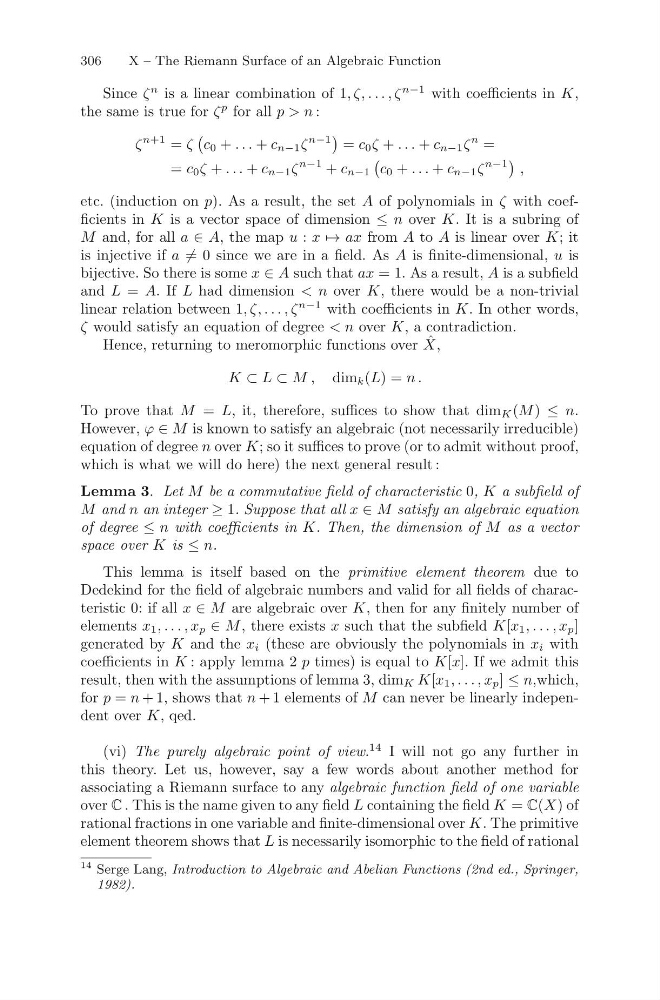
Since ζ
n is a linear combination of 1, ζ, . . . , ζ
n−1 with coefficients in K,
the same is true for ζ
p for all p > n :
ζ
n+1 = ζ
c 0 + . . . + c n−1 ζ
n−1
= c 0 ζ + . . . + c n−1 ζ
n =
= c 0 ζ + . . . + c n−1 ζ
n−1 + c n−1
c 0 + . . . + c n−1 ζ
n−1
,
etc. (induction on p). As a result, the set A of polynomials in ζ with coefficients in K is a vector space of dimension ≤ n over K. It is a subring of
M and, for all a ∈ A, the map u : x → ax from A to A is linear over K; it
is injective if a = 0 since we are in a field. As A is finite-dimensional, u is
bijective. So there is some x ∈ A such that ax = 1. As a result, A is a subfield
and L = A. If L had dimension < n over K, there would be a non-trivial
linear relation between 1, ζ, . . . , ζ
n−1 with coefficients in K. In other words,
ζ would satisfy an equation of degree < n over K, a contradiction.
Hence, returning to meromorphic functions over ˆ
X,
K ⊂ L ⊂ M , dim k (L) = n .
To prove that M = L, it, therefore, suffices to show that dim K (M ) ≤ n.
However, ϕ ∈ M is known to satisfy an algebraic (not necessarily irreducible)
equation of degree n over K; so it suffices to prove (or to admit without proof,
which is what we will do here) the next general result :
Lemma 3. Let M be a commutative field of characteristic 0, K a subfield of
M and n an integer ≥ 1. Suppose that all x ∈ M satisfy an algebraic equation
of degree ≤ n with coefficients in K. Then, the dimension of M as a vector
space over K is ≤ n.
This lemma is itself based on the primitive element theorem due to
Dedekind for the field of algebraic numbers and valid for all fields of characteristic 0: if all x ∈ M are algebraic over K, then for any finitely number of
elements x 1 , . . . , x p ∈ M , there exists x such that the subfield K[x 1 , . . . , x p ]
generated by K and the x i (these are obviously the polynomials in x i with
coefficients in K : apply lemma 2 p times) is equal to K[x]. If we admit this
result, then with the assumptions of lemma 3, dim K K[x 1 , . . . , x p ] ≤ n,which,
for p = n + 1, shows that n + 1 elements of M can never be linearly independent over K, qed.
(vi) The purely algebraic point of view.
14 I will not go any further in
this theory. Let us, however, say a few words about another method for
associating a Riemann surface to any algebraic function field of one variable
over C . This is the name given to any field L containing the field K = C(X) of
rational fractions in one variable and finite-dimensional over K. The primitive
element theorem shows that L is necessarily isomorphic to the field of rational
14 Serge Lang, Introduction to Algebraic and Abelian Functions (2nd ed., Springer,
1982).
X – The Riemann Surface of an Algebraic Function
Since ζ
n is a linear combination of 1, ζ, . . . , ζ
n−1 with coefficients in K,
the same is true for ζ
p for all p > n :
ζ
n+1 = ζ
c 0 + . . . + c n−1 ζ
n−1
= c 0 ζ + . . . + c n−1 ζ
n =
= c 0 ζ + . . . + c n−1 ζ
n−1 + c n−1
c 0 + . . . + c n−1 ζ
n−1
,
etc. (induction on p). As a result, the set A of polynomials in ζ with coefficients in K is a vector space of dimension ≤ n over K. It is a subring of
M and, for all a ∈ A, the map u : x → ax from A to A is linear over K; it
is injective if a = 0 since we are in a field. As A is finite-dimensional, u is
bijective. So there is some x ∈ A such that ax = 1. As a result, A is a subfield
and L = A. If L had dimension < n over K, there would be a non-trivial
linear relation between 1, ζ, . . . , ζ
n−1 with coefficients in K. In other words,
ζ would satisfy an equation of degree < n over K, a contradiction.
Hence, returning to meromorphic functions over ˆ
X,
K ⊂ L ⊂ M , dim k (L) = n .
To prove that M = L, it, therefore, suffices to show that dim K (M ) ≤ n.
However, ϕ ∈ M is known to satisfy an algebraic (not necessarily irreducible)
equation of degree n over K; so it suffices to prove (or to admit without proof,
which is what we will do here) the next general result :
Lemma 3. Let M be a commutative field of characteristic 0, K a subfield of
M and n an integer ≥ 1. Suppose that all x ∈ M satisfy an algebraic equation
of degree ≤ n with coefficients in K. Then, the dimension of M as a vector
space over K is ≤ n.
This lemma is itself based on the primitive element theorem due to
Dedekind for the field of algebraic numbers and valid for all fields of characteristic 0: if all x ∈ M are algebraic over K, then for any finitely number of
elements x 1 , . . . , x p ∈ M , there exists x such that the subfield K[x 1 , . . . , x p ]
generated by K and the x i (these are obviously the polynomials in x i with
coefficients in K : apply lemma 2 p times) is equal to K[x]. If we admit this
result, then with the assumptions of lemma 3, dim K K[x 1 , . . . , x p ] ≤ n,which,
for p = n + 1, shows that n + 1 elements of M can never be linearly independent over K, qed.
(vi) The purely algebraic point of view.
14 I will not go any further in
this theory. Let us, however, say a few words about another method for
associating a Riemann surface to any algebraic function field of one variable
over C . This is the name given to any field L containing the field K = C(X) of
rational fractions in one variable and finite-dimensional over K. The primitive
element theorem shows that L is necessarily isomorphic to the field of rational
14 Serge Lang, Introduction to Algebraic and Abelian Functions (2nd ed., Springer,
1982).