

4 – The Riemann Surface of an Algebraic Function
303
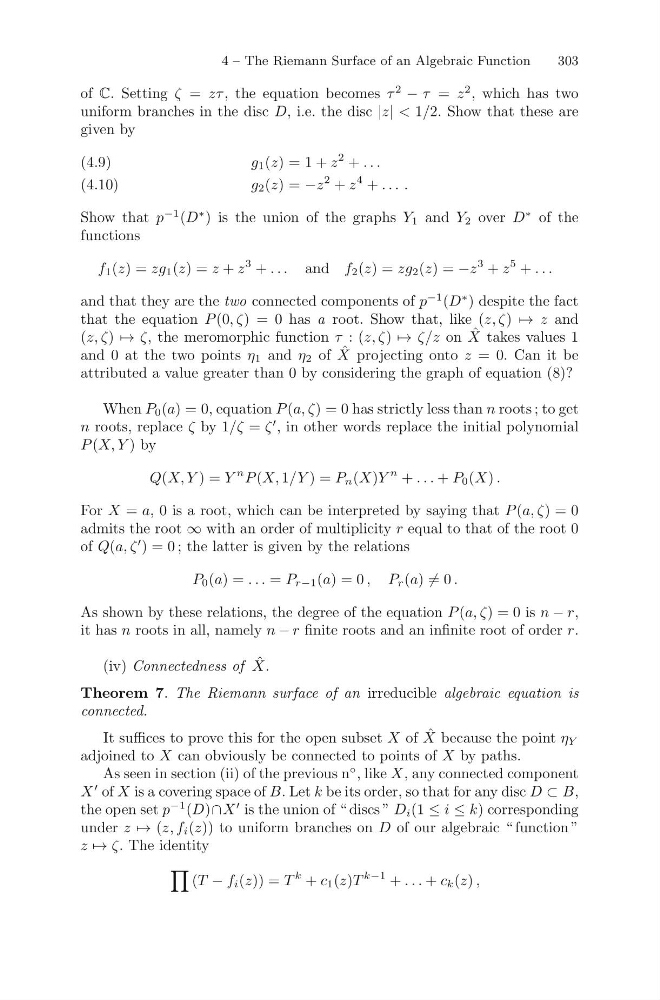
of C. Setting ζ = zτ , the equation becomes τ
2
− τ = z
2 , which has two
uniform branches in the disc D, i.e. the disc |z| < 1/2. Show that these are
given by
g 1 (z) = 1 + z
2 + . . .
(4.9)
g 2 (z) = −z
2 + z
4 + . . . .
(4.10)
Show that p
−1 (D
∗ ) is the union of the graphs Y 1 and Y 2 over D
∗ of the
functions
f 1 (z) = zg 1 (z) = z + z
3 + . . . and f 2 (z) = zg 2 (z) = −z
3 + z
5 + . . .
and that they are the two connected components of p
−1 (D
∗ ) despite the fact
that the equation P (0, ζ) = 0 has a root. Show that, like (z, ζ) → z and
(z, ζ) → ζ, the meromorphic function τ : (z, ζ) → ζ/z on ˆ
X takes values 1
and 0 at the two points η 1 and η 2 of ˆ
X projecting onto z = 0. Can it be
attributed a value greater than 0 by considering the graph of equation (8)?
When P 0 (a) = 0, equation P (a, ζ) = 0 has strictly less than n roots ; to get
n roots, replace ζ by 1/ζ = ζ
, in other words replace the initial polynomial
P (X, Y ) by
Q(X, Y ) = Y
n P (X, 1/Y ) = P n (X)Y
n + . . . + P 0 (X) .
For X = a, 0 is a root, which can be interpreted by saying that P (a, ζ) = 0
admits the root ∞ with an order of multiplicity r equal to that of the root 0
of Q(a, ζ
) = 0 ; the latter is given by the relations
P 0 (a) = . . . = P r−1 (a) = 0 , P r (a) = 0 .
As shown by these relations, the degree of the equation P (a, ζ) = 0 is n − r,
it has n roots in all, namely n − r finite roots and an infinite root of order r.
(iv) Connectedness of ˆ
X.
Theorem 7. The Riemann surface of an irreducible algebraic equation is
connected.
It suffices to prove this for the open subset X of ˆ
X because the point η Y
adjoined to X can obviously be connected to points of X by paths.
As seen in section (ii) of the previous n
◦ , like X, any connected component
X
of X is a covering space of B. Let k be its order, so that for any disc D ⊂ B,
the open set p
−1 (D)∩X
is the union of “ discs ” D i (1 ≤ i ≤ k) corresponding
under z → (z, f i (z)) to uniform branches on D of our algebraic “ function ”
z → ζ. The identity
(T − f i (z)) = T
k + c 1 (z)T
k−1 + . . . + c k (z) ,
303
of C. Setting ζ = zτ , the equation becomes τ
2
− τ = z
2 , which has two
uniform branches in the disc D, i.e. the disc |z| < 1/2. Show that these are
given by
g 1 (z) = 1 + z
2 + . . .
(4.9)
g 2 (z) = −z
2 + z
4 + . . . .
(4.10)
Show that p
−1 (D
∗ ) is the union of the graphs Y 1 and Y 2 over D
∗ of the
functions
f 1 (z) = zg 1 (z) = z + z
3 + . . . and f 2 (z) = zg 2 (z) = −z
3 + z
5 + . . .
and that they are the two connected components of p
−1 (D
∗ ) despite the fact
that the equation P (0, ζ) = 0 has a root. Show that, like (z, ζ) → z and
(z, ζ) → ζ, the meromorphic function τ : (z, ζ) → ζ/z on ˆ
X takes values 1
and 0 at the two points η 1 and η 2 of ˆ
X projecting onto z = 0. Can it be
attributed a value greater than 0 by considering the graph of equation (8)?
When P 0 (a) = 0, equation P (a, ζ) = 0 has strictly less than n roots ; to get
n roots, replace ζ by 1/ζ = ζ
, in other words replace the initial polynomial
P (X, Y ) by
Q(X, Y ) = Y
n P (X, 1/Y ) = P n (X)Y
n + . . . + P 0 (X) .
For X = a, 0 is a root, which can be interpreted by saying that P (a, ζ) = 0
admits the root ∞ with an order of multiplicity r equal to that of the root 0
of Q(a, ζ
) = 0 ; the latter is given by the relations
P 0 (a) = . . . = P r−1 (a) = 0 , P r (a) = 0 .
As shown by these relations, the degree of the equation P (a, ζ) = 0 is n − r,
it has n roots in all, namely n − r finite roots and an infinite root of order r.
(iv) Connectedness of ˆ
X.
Theorem 7. The Riemann surface of an irreducible algebraic equation is
connected.
It suffices to prove this for the open subset X of ˆ
X because the point η Y
adjoined to X can obviously be connected to points of X by paths.
As seen in section (ii) of the previous n
◦ , like X, any connected component
X
of X is a covering space of B. Let k be its order, so that for any disc D ⊂ B,
the open set p
−1 (D)∩X
is the union of “ discs ” D i (1 ≤ i ≤ k) corresponding
under z → (z, f i (z)) to uniform branches on D of our algebraic “ function ”
z → ζ. The identity
(T − f i (z)) = T
k + c 1 (z)T
k−1 + . . . + c k (z) ,