

294
X – The Riemann Surface of an Algebraic Function
D
D'
D''
z'
z''
z
a
γ'
γ
γ''
δ
δ'
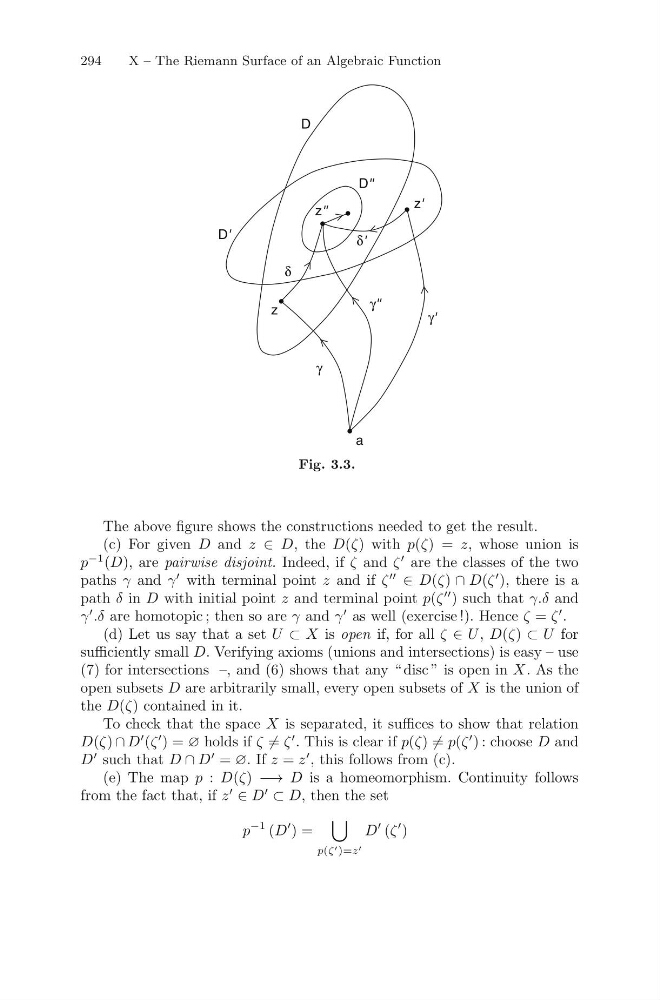
Fig. 3.3.
The above figure shows the constructions needed to get the result.
(c) For given D and z ∈ D, the D(ζ) with p(ζ) = z, whose union is
p
−1 (D), are pairwise disjoint. Indeed, if ζ and ζ
are the classes of the two
paths γ and γ
with terminal point z and if ζ
∈ D(ζ) ∩ D(ζ
), there is a
path δ in D with initial point z and terminal point p(ζ
) such that γ.δ and
γ
.δ are homotopic ; then so are γ and γ
as well (exercise !). Hence ζ = ζ
.
(d) Let us say that a set U ⊂ X is open if, for all ζ ∈ U , D(ζ) ⊂ U for
sufficiently small D. Verifying axioms (unions and intersections) is easy – use
(7) for intersections –, and (6) shows that any “ disc ” is open in X. As the
open subsets D are arbitrarily small, every open subsets of X is the union of
the D(ζ) contained in it.
To check that the space X is separated, it suffices to show that relation
D(ζ) ∩ D
(ζ
) = ∅ holds if ζ = ζ
. This is clear if p(ζ) = p(ζ
) : choose D and
D
such that D ∩ D
= ∅. If z = z
, this follows from (c).
(e) The map p : D(ζ) −→ D is a homeomorphism. Continuity follows
from the fact that, if z
∈ D
⊂ D, then the set
p
−1 (D
) =
p(ζ )=z
D
(ζ
)
X – The Riemann Surface of an Algebraic Function
D
D'
D''
z'
z''
z
a
γ'
γ
γ''
δ
δ'
Fig. 3.3.
The above figure shows the constructions needed to get the result.
(c) For given D and z ∈ D, the D(ζ) with p(ζ) = z, whose union is
p
−1 (D), are pairwise disjoint. Indeed, if ζ and ζ
are the classes of the two
paths γ and γ
with terminal point z and if ζ
∈ D(ζ) ∩ D(ζ
), there is a
path δ in D with initial point z and terminal point p(ζ
) such that γ.δ and
γ
.δ are homotopic ; then so are γ and γ
as well (exercise !). Hence ζ = ζ
.
(d) Let us say that a set U ⊂ X is open if, for all ζ ∈ U , D(ζ) ⊂ U for
sufficiently small D. Verifying axioms (unions and intersections) is easy – use
(7) for intersections –, and (6) shows that any “ disc ” is open in X. As the
open subsets D are arbitrarily small, every open subsets of X is the union of
the D(ζ) contained in it.
To check that the space X is separated, it suffices to show that relation
D(ζ) ∩ D
(ζ
) = ∅ holds if ζ = ζ
. This is clear if p(ζ) = p(ζ
) : choose D and
D
such that D ∩ D
= ∅. If z = z
, this follows from (c).
(e) The map p : D(ζ) −→ D is a homeomorphism. Continuity follows
from the fact that, if z
∈ D
⊂ D, then the set
p
−1 (D
) =
p(ζ )=z
D
(ζ
)